Visit arvindagarwal2.blogspot.com for posts from 2017 to 2019
Sunday, October 30, 2022
Green Expressways completed or under Implementation
NHs provide roads for local traffic, whilst expressways give fast, direct & low-cost connectivity to freight and fast-moving traffic. Slow-moving bodies like animals, carts & bicycles are unsafe on expressways and pose a hazard to others. It is seen that existing NHs and green expressways can happily co-exist on similar routes.
State Government Expressways
=================
1. Delhi–Meerut Expressway
2. Purvanchal Expressway
3. Bundelkhand Expressway
4. Gorakhpur Link Expressway
5. Ganga Expressway
6. Mumbai–Nagpur Super Communication Expressway
7. Coastal Road (Mumbai)
8. Mumbai Trans Harbour Link
9. Mumbai–Pune Expressway’s Missing Link
10. Airoli–Katai Naka Freeway
11. Chandili–Rourkela (Biju) Expressway
Central Government Expressways linklinklink
=================
GM mustard is expected to increase mustard yields, which will increase oilseeds availability, improve self-sufficiency in edible oils and increase farmers' incomes!! After many years of waiting, GEAC (Genetic Engineering Appraisal Committee, apex regulator) has finally allowed the commercial release of GM mustard (complete with the DMH-11 gene)!! Commercial seeds of GM mustard will take around 2 years to come to the market.
Transgenic mustard DMH-11
Dhara Mustard Hybrid 11 (or, DMH-11) was indigenously developed by Indian scientists and researchers, and headed by Deepak Pental (former VC of Delhi University). DMH-11 is very significant for large number of crops — as explained in my note, from a few years ago:
¶ Yield accretion had stagnated. Mustard is self-pollinating, which means that it invariably pollinates with its own female and male parts and this prevents hybridisation with other parental lines. Pental & co created the technology to make the male part sterile so better hybrids could be created. link
Government go-ahead
There are reasons to believe that Ministry of Environment under Centre will allow this innovation to pass.
➖ 1) GEAC employs a "rigorous regulatory system" that takes account of years of objective research and scientific data.
➖ 2) Environmental safety tests, undertaken for GEAC approval, should dispel the false propaganda that there is an "adverse impact of GM mustard on the environment".
➖ 3) Domestic scientific research gets a major impetus in the emerging biotechology sector. BT cotton was approved in India and was a huge success. GM technology is already used in imported foods and in foreign corn, which has seen a big uplift in yields (ie.10 t/ha in US vs 3 t/ha in India).
➖ 4) It probably has tacit Govt approval — eg. it enhances National Mission on Oilseeds and Oil Palm (NMOOP) Scheme to realise self-sufficiency in edible oils (see chapter 8; pages 68-75). It also works towards doubling farmers' incomes and reducing import bill of Rs 81,682 (for 13.45mt edible oil import) in 2020-21.
Per capita consumption of edible oils increased from 15.8 to 19.7 kg/yr per person, from 2012/13 to 2020/21. This created an acute dependency on imports—for palm oil, soya oil and sunflower oil.
Recently (see insert), domestic EO demand has plateaued & domestic EO supply (from all sources) has increased rapidly @5.3% pa — so much so, that imports are on a downward trend.
NMOOP along with GM mustard (above) is expected to double the area under Mustard [in rice fallows], hike Mustard yields to top global standards [by 30-50%, from 1.51 t/ha to 2-2.3 t/ha] and provide additional 2.5 to 5.2mt of CPO.
Oilseeds
♠ Production target for 2021/22 @38.4mt & yield @1.3 t/ha to 2021/2 (achieved 37.7mt)
♠ Target new areas under mustard @6.8m ha, to utilise rice fallows of East India, AP, TN, Maha and Kar
♠ Facilitation by quality seed production & distribution (35+ seed hubs), demonstrations/ FLD & staff training, soil ameliorants (gypsum), pesticides, sprinklers, seeders(?)
Oil Palm
Expectation to reach 5+ mt once all planted area blooms to fruit-bearing
♠ Expansion in AP, Chht, Guj, Kar, Odis, TN, Tel, ArP, Assam, Miz, Man & Nag, to become major oil palm growing states
♠ Planted area from 0.37m ha (2020/21) to 0.65m ha (2025/6) to 1.67m ha (2029/30). Fruit-bearing area @ 50% of total
♠ Palm fruit (FFBs) to reach 17mt and Palm oil (CPO) at 2.8mt by 2029-30. This will double once all planted area is bearing fruit
♠ Yields of FFB ~ 20 t/ha & yields of CPO ~ 3.36 t/ha ! (fruit-bearing area only)
♠ Farmers will be paid for planting material, maintenance, drip irrigation, etc, and have compensation for low prices.
Friday, October 21, 2022
In practical terms, how productive is Indian agriculture
Major crops (excluding horticulture) have lower yields compared to the world and the average of top-producing countries. These crops include maize, cotton, oilseeds, rice, wheat, pulses, etc. In practical terms, the comparison is much closer.
India is clearly far behind in Maize, Cotton and major Oilseeds (soybean, mustard & groundnut). In Rice and Wheat, India is competitive vs the world & top producers ex China. Since China does not export rice or wheat, its influence in the world markets is minimal. India is not far behind in pulses if 2020/21 India stats are used. India is ahead in sugarcane vs the world & all top producers.
~ ~ ~ ~ ~ ~
➖ MAIZE - Yield is growing at a fast clip @ 3.3-3.4% pa over 5 years (aver of last 3/4 yrs). Its rate is much faster than top producers US, China, Brazil, EU27 & Argentina @: 0.13%, 1.03%, 0.78%, 0.65%, 1.0%. Despite the fast yield growth, overall yield gap is too big to make up, unless there is a change in approach like GM crops. OTOH, Maize is an important crops and a significant yield growth creates surpluses for domestic industry (eg feed, ethanol).
➖ COTTON - Yields of 0.454-0.462 t/ha are very low compared to top producers like China, Brazil and USA (1.9, 1.7, 0.93 t/ha). Yields have fallen in recent years by -1.1 to -1.28% pa. Irrigation is an issue but not the most important one. Irrigation rates have hovered at 33-34%, except for a few spike years. For example, irrigation was 45% in 2019 and 33.2% in 2018. Maha with largest area under cotton has irrigation of just 2.7% and sub-par yields of 0.36 - 0.25 t/ha (see insert). A new approach is needed eg. new GM variety. Cotton is exported so if profit is there, states like Maha should go for micro-irrigation. India can switch some cotton areas to other crops, as selling raw cotton is only helping international competitors get low prices due to Central govt subsidies
➖ OILSEEDS - Soyabean (share 35%) - Yields fell from a high of 1.35 to 0.76 t/ha. The current yields of 1.0-1.2 t/ha, though higher, represent a decline over a long period. India ranks worst among 45 countries and is going nowhere.
Mustard (share 31%) & Groundnut (share 27%) - India ranks poorly in both, more so Mustard where it is last among 28 countries. Production for both fell by some margin till 2014 or 2015 but has since risen to record levels in the last 3 to 4 years.
Mustard production has grown from 7.92 to 11.75mt in 5 years. Mustard yield is 1.51 t/ha, going up 4.1-4.5% pa. Canada & China are at 2.32 & 2.07 t/ha but growing slowly (as of now) at 1.2% pa. As of now, the gap to China is closing and may close in 10 years!
Groundnut yields alternate with low-high years at 1.68 & 2.06 t/ha, and are going up 5.2% pa now & 3.2% pa earlier. So, India has a biannual yield of 1.87 t/ha and a mid-term growth of 4.2% pa. This compares very poorly to China at 3.8 t/ha (even if it is growing at just 0.79% pa), but it is better than next big producers from Africa. China has 37% global share in Gn. India is 2nd at 13%. As such, China is the big comparator. Insert shows top 3 Indian states (Guj, Raj, TN) have excellent yields, whose high year yields are high. If national growth rate is applied, these states may be comparable to China in 13 years. Eg. high yield year are 2.75, 2.2 & 3.0 t/ha. Low yield years are 1.9, 2.26, 2.3 t/ha (down 19%). Top 3 states have 69-73% share: Gujarat has 41-46%, Raj 16-19%, and TN 9-10%.
➖ WHEAT & RICE - Wheat yields are growing at @ 2.8-3.2% pa. Rice yields are growing at @ 2.0-2.3% pa. Yield growth rates have seen a jump, esp for Wheat. So, it is safe to say India can make up a 10% gap quite quickly if the past holds.➖ PULSES - Pulses production has taken off remarkably in last few years. Yields are also rising @ 2.7-3.0% pa. It is helped by government actions (eg regional seed banks of high-yielding varieties, higher MSP and assured MSP offtakes, etc). Gram 4-5% pa (share 50%), Tur dal 2.8%-3.3% pa (share 16%). Lentil (Masur) 4.2%-4.5% (share 5%). Yield growth in Gram, Tur dal and Lentil can close the pulses gap with global average & top producers.
➖ SUGARCANE - Yield is up 2.2% to 82.2 t/ha in 2020/21. Yields are likely to go up in the future. This is because sugarcane is a profitable crop and there is a strong govt offtake for bioethanol and sugar exports. Supply-side changes are contributing to large surpluses, like new sugarcane varieties, continued investment in micro-irrigation esp in Maharashtra (with rain-affected yields), good prices in North India, virtual elimination of sugar dues of farmers, govt incentives for bioethanol capacity. NB. Water is not the limiting factor in Maha if micro-irrigation is promoted, or inter-seasonal storage is created in the Konkan region.
Eg. In Sugar Season (Oct-Sep) 2021-22, Sugarcane production is at record 500m tons(!) PIB Link—making India the world's largest producer of sugar. India also consumes the most, even as it diverts record & much higher amounts each year to ethanol and exports. First estimate 2022-23 for Sugarcane production is 8% higher than fourth estimate of 2021-22. It would suggest production could exceed 550m tonnes in 2022-23.
PADDY RICE
-
WHEAT
MAIZE
PULSES
SUGARCANE
Indigenous Aluminium trains to bring greater speed and cost-efficiency link
---------------------------------------
"These lightweight aluminium wagons are a great innovation for Indian Railways. They combine the best of global technologies and local resources, so railways logistics is more efficient and adds greatly to Atmanirbhar Bharat."
"These wagons will help Railways towards its freight share target of 45% by 2030. Benefits to India's economy are huge, as 1% increase in Railways' freight share saves ₹2.32 lakh cr (or 0.9% of GDP)!!" link
On 16th October 2022, Indian Railways flagged off the first indigenous aluminium goods train. It is manufactured by Besco Ltd (for wagons fabrication) and Hindalco (which supplies HS plates and extrusions). Its design and development were done in collaboration with RDSO. Alu rakes are extensively used in Japan, Europe and US. IR plans to acquire over 1 lakh wagons @15% shift to alu wagons. Benefits of alu freight rakes are listed below.
On the passenger side, Railways will introduce 'next-generation' Vande Bharat, or Vande-3 design (see insert) with light-weight alu bodies. Whereas Vande-3 trains that are made of steel are able to cruise at 200kmph on existing tracks, the alu versions are 40-50% lighter and have a top speed of 225 kmph. Speed is increased because rakes can tilt into the curve. Alu coaches are widely used in USA, Europe, Japan, China and S Korea. They are revolutionary because of much lower operating costs, and longer lifespans by over 10 years.
Railways will acquire at least 200 next-gen VBs at cost of Rs 26,000cr in both normal AC chair and AC sleeper versions. Trains will come after a few years when prototyping and testing (of Vande-3 design) are concluded and after the order of 75 Vande-2 is completed. In the next tender of 400 Vande-3, first 200 are expected to be steel-bodied. But if alu version is available, perhaps all 400 Vande-3 trains will be made of aluminum. IR workshops will manufacture the trains. Hindalco is likely to supply aluminium, whose TOT comes from South Korea.
➖ Rakes are 180 tonnes lighter than existing steel rakes, so carrying capacity is increased. [19% higher payload to tare ratio @2.85]. These rakes have lower haulage fuel cost per kilometre, lower annual maintenance costs and higher speeds. Speed is increased because rakes can tilt into the curve.
➖ Rakes have a 10-year longer lifespan because they are not prone to weather corrosion and have abrasion resistance. So, there is minimal wear and tear to rolling stock and rails!."They are 100 per cent recyclable and even after 30 years, they will be as good as new!" Resale value of scrap is 80% of cost!
➖ Although rakes are 35% more costly, they don't use imported nickel or cadmium; and the "fully lock bolted construction with no welding on the superstructure" is superior. As such, it will spur growth in domestic aluminium mining, alu fabrication and precision manufacturing.
➖ Rakes have lower carbon manufacturing & operating footprint. 14,500 tonnes of carbon is saved by a single rake (~ 60 wagons) over its lifetime. A 20% shift to these wagons will reduce CO2 emissions/year by a whopping 60 million tons.
Irrigation: it gets even better with micro-irrigation
India's irrigation of area under foodgrains has crossed 54% and is moving higher with each passing year. Link
Area under irrigation has increased steadily from 18.1% in 1951, to 32.6% in 1987, and 54.3% in 2019. Total cropped area had risen considerably from 97.3m ha in 1951, to 127.2m ha in 1987. It has not changed much since.
Foodgrain production has increased by 50% from 2000-01, from 196.8m MT to 308.7m MT in 2020-21.
Yield rather than area increase is the reason for such an impressive growth in production. As irrigation is a major contributor for the change, expect productivity to keep growing year on year.
~ ~ ~ ~
Maharashtra has the worst irrigation coverage of all major producing states (@18.1%). Its foodgrain yields are also the worst. A similar trend is seen for Rajasthan & Karnataka at the lower end, and Punjab & Haryana at the upper end.
Whilst Maha governments have done very poorly on the irrigation front, large numbers of its farmers are taking up micro-irrigation to turn around their fortunes.¶ Micro-irrigation is promoted by Centre's scheme of more crop per drop (PMKSY).
¶ Maharashtra has 1.9263m ha covered under MI, which is 2nd highest after Rajasthan, or @14.3% of total on 31/3/2021. →
One study in Maharashtra finds that benefits under PMKSY micro-irrigation scheme are both large and manifold. Micro-irrigation conserves water and will benefit multiple number of farmers. As such, micro-irrigation should be taken up expeditiously across the country where it can help raise India's low productivity levels towards global standards.
A study was done in Maharashtra to gauge the impact of Per Drop More Crop (PDMC) component of PMSKYLink
➖ What would be the reduction in inputs like water, fertilizer, power, pesticides and labour?
➖ What happens to productivity, quality, farmers' incomes, employment generation, etc
➖ What are the advantages, disadvantages, co-factors, etc.
Maharashtra state has been a leading adopter of MI since 1980s. Till 2019/20, 25.3 lakh ha (or 42.5% of gross irrigated area) is under drip irrigation. PDMC scheme has contributed 6.42 lakh ha or 25.4% from 2015/6 to 2019/20. Drip irrigation is the preferred method, as new installations are overwhelmingly for drip irrigation (91-96%) rather than sprinkler system. The main source of irrigation water is well & tubewell (79%) and 12% is lift irrigation from rivers.[PDMC has brought large area of Maha (specific crops) under drip irrigation, in a very short period of 5 years.]
Cotton crop has highest share at 24%, sugarcane is 11.8% and the rest is mainly fruit crops like bananas, citrus, pomegranate and grapes. Increasingly, MI is being put in areas under horticultural crops like sundry vegetables, chilli, onions, etc. Even wheat, a rabi crop is part of the increase. [MI is not used in foodgrain production, only for high value items.]. Cotton is the dominant kharif crop. Preference for DI is at 91%. Sugarcane is a perennial crop with DI at 97%. Banana is also a perennial crop with DI at 93%.
➖ Labour mandays and labour costs in drip irrigation reduced by 37% and 40% respectively. Manpower is used to put in drip laterals at time of sowing and for removing drip laterals after harvest.
➖ Almost all farmers were using water-soluble fertilisers through fertigation, which reduces labour costs and improves yield. As cost of fertigation is higher, so overall fertilizer cost is ~ 8% higher under DI. Similarly, small increase (~11-12%) is seen for weedicides and seeds.
➖ Weed growth was negligible as surrounding areas are dry. Labour cost of weeding, weedicides and intercultural operations is minimal.
➖ For sugarcane, water consumption and irrigation costs were much lower. Water charges were down by 72%. Electicity cost for irrigation was down 20%. Irrigation hours were reduced by 57%, as hours per irrigation were just 42% of those of floor irrigation.
➖ For sugarcane, a 36% increase of yield per hectare was seen under DI. It was 1446 quintals under DI (or 144.6 tonnes per ha) vs 1067 quintals without DI. Price received was higher (higher sugar yield?). Profit per hectare increased by 200% (from Rs 81k to Rs 246k).
ETC
MAJOR POINTS
■ Cotton: "Despite being a major crop for Maha, and ranking 1st by area in India, Maha suffers from very low yields. The main reason for low yields is that the cotton crop is mainly rainfed and failure of monsoons leads to crop failure. Our sample indicated that DI increases yields by almost 80%, which will give a big boost to the agri economy, allied manufacturing and rural services."
■ Sugar: "Maha is a water-stressed state. Yet, it is a major producer of a water-guzzling crop like sugarcane. Only 3 lakh ha (25.7%) of area under sugarcane is covered by DI. This indicates a huge potential for adopting DI, increasing yield and saving water. All means including extension services are required to make that switchover happen." [Edit: Konkan (coastal) region of Maha receives a lot of surface water run-off from the Deccan plateau. There is enough water but major irrigation projects in DP or Kn are not adequate to capture this water, and store it after monsoon. More inter-seasonal storage and MI in Kn will help to significantly expand the area under sugarcane and other high value crops.Deccan plateau eg. Marathwada, a draught-prone region, needs check dams, ponds, irrigation tanks, lift irrigation and basin water transfer to retain water at high altitudes. MI & irrigation tanks in DP will increase yields of cotton and/or prevent crop failure in low monsoon years.]
■ Horticulture: "Maha is known as a horticultural state. Significant increase in productivity and production of horticultural crops is possible by micro-irrigation. Farmers can reap benefits of existing marketing infrastructure."
■ Practical issues: "Subsidy of costs needs to continue. Maintenance is costly and wear-and-tear to plastic tubes is quite likely. Mice and stray aminals can physically damage drips. Specific measures are required. Grid electricity comes to farms mainly at night, and erratic grid electricity supply creates risk of malfunction or fires. So solar power is desired and this needs subsidy. Awareness and education of the benefits of MI is necessary for non-adopters."
Monday, October 3, 2022
National Logistics Policy impacts: costs, efficiency, investments and new tech
---------------------------------------
— "It will improve the Ease of Doing Business and will be very beneficial for the economy."
— "National Logistics Policy complements PM Gati Shakti masterplan, but works on operations and systems delivery aspects, to remove many bottlenecks in the logistics business".link
— "NLP focuses on the development of support infrastructure, ways to reduce systemic inefficiencies and for heavy use of technology ...so as to cut India's logistics costs [from 13%]to global standards [of 7 - 8%]. The key is successful implementation, and realising improvements over 5 to 10 years."link
— "NPL will also bring further massive infra development, such as what is happening under programs like Sagarmala, Bharatmala and DFCs."
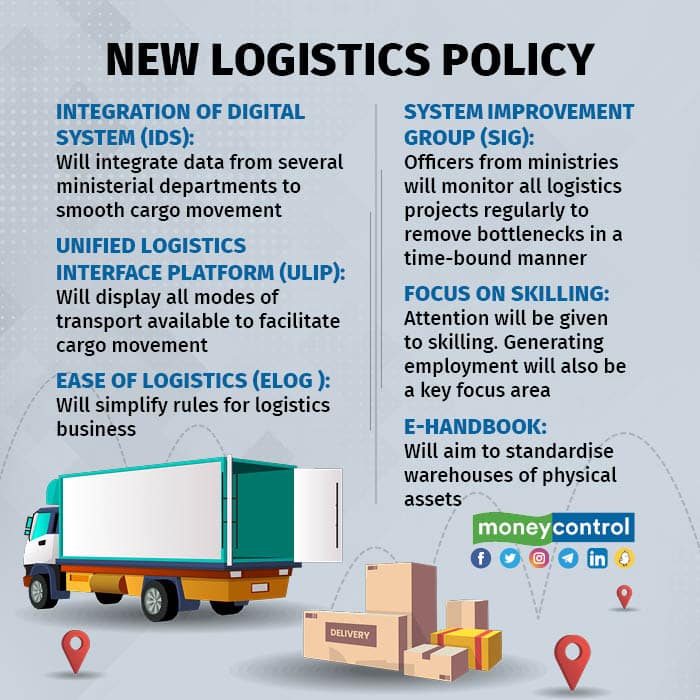
— "Technology initiatives like Unified Logistics Interface Platform (ULIP) and Ease of Logistics Services (E-Logs) are now in place (see insert). Better tracking and digitization will fast forward industry towards being more efficient and organized."
While Gati Shakti and National Infrastructure Pipeline add infrastructure, the National Logistics Policy will help to instruct and guide the delivery of quality logistics. NLP will extract additional value from logistics infra projects (ie. higher returns on assets deployed). It will further lower logistics costs and improve Logistics Performance Index.
Under the NLP, all stakeholders will develop commonality in infra, equipment, processes, procedures, compliances, conflict resolution and human resources, which together are capable of providing global standards of performance.
Each party stands to benefit enormously from lower costs, reliability and better outcomes. In addition, more investments will happen due to better returns, and new technologies will be adopted faster.
Costs - Users benefit from end-to-end connection to the cheapest or most convenient mode of transport, transported seamlessly & at greater speed, real-time tracking and other user-friendly information; reduced delays [eg. reduces wastage of perishable cargo, increases asset utilisation of trucks & railway assets]; fewer back-and-froth journeys [multimodal hubs; shortening of value chains over time, by better logistics planning by firms & of industrial zones]; and use of cheaper fuels like ethanol, methanol, electricity.
— Multimodalitythrough building Multimodal logistics parks (see below)
— Higher capacity & scale benefitsthrough big ticket infra spending [eg. doubling of railway tracks, DFCs, expressways, NH upgrades to 4/ 6-lane roads, dredging so ports can accept capsize ships, transshipment ports and large ports like proposed Vadhavan port, etc.]
— Faster & reliable deliveriesthrough big ticket infra spending for: — faster transit[eg. new green expressways — like Surat- Hyderabad expressway that gives a shorter direct route to South India & avoids Mumbai & Pune traffic, ring roads, tunnels & bridges, 200+kmph enabled rail tracks (fenced track, OHE upgrade), higher loco freight trains]; — reliable or safer transit[eg. regular maintenance; modern rail signalling, walled-off rail tracks; all-weather roads in mountainous areas, removal of blackspots, wayside amenities, safer road designs incl. emergency lanes, crash barriers, wide road dividers, signage, lighting, very durable road surfaces via materials & good water run-off, landslide protection]
— Personalised servicethrough support infra spending [eg. missing connectivity — coal rail links, railway; infra to enable time-tabled schedules — kisan rail; new freight terminals, specialist wagons], low cost or fast transit as required [eg. freight Vande Bharat trains, air transport, drones], reduced waste [eg cold storage]
— Hassle-free transit through equipment, technology devices and policies: by equipment or technology spending [eg. equipment standarisation, cargo scanners, weight scanners, FASTag, Automatic Number Plate Recognition, monitoring of traffic and hazards by 5G/ CCTV & AI/ track ultrasound/ sensors + IOT] and policies [vehicle designs & safety ratings, enforcement of traffic rules & checks on driving licences or retesting, emergency assist, security]
— Non-fossil fuels that are clean, cheaper and indigenous, whose prices are not volatile and can be kept at affordable levels. Infrastructure spending will be done as part of all-of-country energy transition away from imported fossil fuels [eg. ethanol or methanol distilleries, bioCNG plants + crop waste collection, EV batteries + charging infra + RE, green hydrogen + fuel cells + sewage waste/ excess RE]
Efficiency - Reduce statutory hindrances, heavy use of technology [digitally process transactions, supply timely information, automate tasks, faceless enforcement, increase load factor, etc]; faster throughput, handling, processing, transfer between modes of transport, making just-in-time deliveries and last-mile connectivity.
— Statutory hindrancesStates should adopt national logistics policy, train staff, keep good labour relations, change anti-business legislations/ practices, ensure fast & efficient customs clearances, use technology for enforcement [eg. cargo scanners, weight scanners, Automatic Number Plate Recognition]
— TechnologyLogistics portal for booking and back-end processing- ie. which is faceless and paperless, single-window & does one-time processing of all forms; RFID tracking for fast pass-through (automation); tracking information, information of empty cargo spaces and software to fill them
— Faster throughput, just-in-time delivery, connectivitySpecialist equipment & standardisation [eg warehouses], use of technology[eg scanners, artificial intelligence];multimodal logistics parks for optimal transfers, sorting, processing, aggregating & storage, mechanisation;removal of connectivity gaps & better last-mile connectivity
Investments - Multimodal Logistics parks, National Infrastructure Pipeline and Gati Shakti masterplan, port-rail connectivity initiative[ie. under "National Master Plan for Multi-modal Connectivity"], private freight terminals, cold chains, specialist wagons, mechanised handling, scanners etc, HR investment. In future, expressways with e-charging lanes?
New technology - Drones .. 5G, Internet of things, Artificial intelligence.
In 2017, Centre had planned to spend Rs 50,000cr to build 35 MMLP (multi-modal logistics parks or hubs), that would handle 50% of India's freight traffic. Crucially, these MMLPs, once complete, would be the biggest contributors to reducing logistics costs from 16% to 10%!
Progress has been slow — as only 3 sites out of 35 are completed or under construction. However, tendering & DPR are being progressed in 14 sites (see below) and sites for other MMLPs are being finalised. Under phase 2 of Bharatmala Pariyojana, 11 more sites will have MMLP, taking the sanctioned number to 46. Total no. of MMLPs in the country will be much greater.♫
♫ MMLPs are also being developed by private sector (eg Adani in UP) and other public agencies like Container Corporation of India and DFC corp (DFCCIL). Besides NH agency, Railways is mandated to develop MMLPs under Gati Shakti Multimodal Cargo Terminal (GCT). HSR stations will get multi-modal connectivity (MM Gateways) and light freight handling facilities may be created there.
What is a MMLP? =============
MMLP is a logistics hub in the 'Hub and Spoke' formulation. In other words, it is a major centre for handling freight [eg disembarkment, mechanical transfer, storage and repackaging or processing for outward travel] and it is also an intersection point of multi-modal freight traffic from the rail, road, inland waterways and/ or air transport.
MMLPs have comprehensive freight facilities like terminals to handle containers and bulk cargo, warehouses, cold storage, mechanised material handling and customs clearances [bonded storage yards, quarantine zones, testing facilities and special warehousing].
MMLPs have many advantages:
--------------------
1. Road, rail, waterway, etc are integrated with the MMLP, so the least-cost or most convenient logistics options can be utilised for trunk and last-mile connectivity.
2. Economy of scale in warehousing, cold storage & specialist equipment for handling goods. Because MMLP is a cluster development, complex logistics tasks are performed properly and cost-efficiently.
3. MMLP will declutter ports as cargo can be taken directly to MMLP where bonded storage & custom clearance is done
4. MMLPs are built outside cities where land is cheap and infra can come up quite quickly. Thus, storage happens outside cities and fast dedicated routes are developed to bring goods into cities. This improves just-in-time deliveries and reduces city traffic on other routes
5. MMLP is an ideal location for setting up new manufacturing, assembling and repackaging clusters. 2 lakh jobs are to be created under the initiative.
Details of MMLP scheme ==================
— 1. Gati Shakti to map 35 MMLP hubs (insert shows MMLPs and DFC line phases 1 & 2).
— 2. 35 MMLP provided in states (cities in insert):
5 in Gujarat ... 4 in Maha ... 3 in Punjab ... 2 in AP, Haryana, MP, Odisha, Raj & TN ...
1 each in Assam, Bihar, MP, Chhitts, Goa, HP, Karn, Kerala, Telangana, WB, Delhi & J&K.
— 3. 11 MMLP more in phase 2 as follows:
2 in UP (Gorakhpur, Kanpur) ... 2 in Maha (Dighi, Bidkin) ... 2 in Raj (Jodhpur, Bikaner)
1 each in TN, WB, Jhar, Uttarak, Tripura (Tuticorin, Siliguri, Ranchi, Haridwar, Udaipur)
— 4. National Highway Logistics Management Limited, a subsidiary of NHAI, is the nodal agency of the MMLP projects. It creates SPVs with public bodies, PSUs & private companies for each MMLP or for each state. So, equity partners in the SPV can be a Port Trust, State development body, NHAI, Indian railways, utility companies, major corporations, etc.
— 5. Land and legal authority are provided by SPVs but MMLP infrastructure is built by selected contractors under Design, Build, Finance, Operate and Transfer (where ownership is eventually transferred to SPVs). A commissionaire agreement applies. For example, the Model Concession Agreement provides for starting commercial operations within two years of the start of the project.
Check the progress as of July 2022:
— 6. Chennai & Nagpur aims to be ready by end-2024. Bids were invited for Bangaluru. DPRs started for 9 sites. Initial studies started for 21 others. Actual construction was started in Assam on 10/2020. The park, spread across 317 acres in Bongaigaon district of lower Assam, has a cargo capacity of 13 million metric tons (MMT) per year.