Towards higher farm productivity Link
Institutional factors such as land size and access to land, credit, effective markets, technology, and infrastructure such as irrigation influence smallholders’ ability to commercialize and diversify. Governments have worked on strengthening these factors to improve farm productivity. It is now also looking for climate change resilience and sustainability in terms of resource utilization (e.g., irrigation that uses more water for higher production is not sustainable for a water-stressed India).
 |
| Yield growth (helped by a shift to dry season & irrigation) has lowered the water footprint, as both irrigation water (blue) and plant uptake (green) have fallen. |
 |
| Yields for corn, rice and wheat are high and increasing. Millet and sorghum yields are low. Millet yields are increasing fast, while sorghum yields are stagnant. |
Rice production is surplus. Due to the water-stressed nature of North India, it makes sense to shift paddy (except basmati rice) to East India, where water is plentiful and productivity is expected to rise. The area vacated in the North can be cultivated for low-water-intense crops like oilseeds or profitable horticultural crops. Covered horticulture minimizes water loss.
Wheat is a Rabi crop and the preferred crop for farmers in North & Central India. This is due to high MSP and predictable production. Yield growth has been excellent (e.g., 3.14 t/ha to 3.42 t/ha between 2014-19). Lack of domestic demand slowed wheat production from 2015 onwards but rising export uptake has once again boosted sown area and production.
Maize is grown in South India where superior yields are achieved due to improved irrigation. Demand from poultry and industry contributes to higher production. Maize production in Bihar will be used for biofuels. Significant area under the nutrient-cereals (particularly sorghum) has shifted to other crops. Pulses area was expanded to achieve self-sufficiency. Likewise, the government has identified rice fallow lands to achieve partial oilseed self-sufficiency.
Coastal regions are ideal for export-oriented production of premium horticulture & processed foods (e.g., bananas, processed fruits, dry milk powder). Micro-irrigation coupled with high-yielding sugarcane varieties in UP and South India has the potential to significantly increase production with reduced water use.
New regional oilseed seed hubs are being set up that will boost yields by providing farmers with high yielding, drought- and pest-resistant varieties. It targets 14m ha of total rice fallow, particularly in the East and NE states, such as Jharkhand, Odisha, WB, Eastern UP, and Assam. Value chains will also emerge for processing and marketing. ICAR stated, “Private mustard seed companies are already active in West, North & Central India, so 20 seed hubs will be set up in the East, exclusively for mustard, by the next financial year.”
ICAR says farmers in major mustard growing regions in MP, Haryana, UP and WB have shifted to wheat, but oilseed area has risen in eastern parts to a similar extent. MSP hike also played a crucial role in boosting oilseed acreage in non-mustard growing areas. “Last year, the average mustard yield was 1.49 t/ha and is expected to remain the same in 2019-20. But in some areas of eastern UP, it’s reaching a record 1.9 t/ha!
Soil health initiative weaning farmers off fertiliser overuse

- The National Productivity Council study, with a sample of 1700 farmers, found a 10% cut in chemical fertilizer usage and a 5-6% increase in farm productivity (higher incomes & time savings for farmers).
- The NAIEM or Hyderabad study among growers of cotton, paddy and soybean, found those who followed recommendations of SHC had lowered costs by 4-10%, and increased incomes by 30-40%.
Issue with the blind use of fertilizers
India consumes 25.6 mt of fertilisers, with 17 mt of N, 6mt of P and 2.5mt of K. The ideal ratio of NPK (4:2:1) has been skewed towards nitrogen (6.7:2.4:1). Started during the Green Revolution in the 1960s, farmers over-sprayed subsidised chemical fertilisers on crops, imperilling public health, degrading soils and upending crop yields. Urea, in particular, was used in doses several times above recommended levels. It accentuated deficiencies in other elements (P, K & micro-nutrients) and caused soil imbalance.
Health impact
The “chemical health epidemic” describes high incidences of cancers and other diseases found in states with excessive per-hectare chemical use. For example, fertilizer chemicals have entered Punjab’s food chain, groundwater and soil.
SHC, its implementation and the way forward
At the farmers’ level, SHC is meant to reduce input costs, increase crop yields, increase hybrid seeds use, encourage different types of crops and increase farmers’ incomes. On a broader scale, its aim is to restore severely degraded soils and promote the balanced chemical use.
While soil deficiencies in a region are well-known, SHC gives specific recommendations for farmers. A former ICAR member says testing can’t be a “one-time affair” and routine testing is required for better results.
SHCs are renewed every two years and offer local farmers specific recommendations on fertilizer use, based on tests for main elements and micro-nutrients. Sampling, testing and reporting are done through a nationwide network of laboratories built up under the SHC scheme by the Central govt in 2015.
250 million cards have been sent to farmers so far! Nitrogen shortages were found in Punjab, Haryana, UP, Raj, Guj and Mah. Phosphorous-depleted soil was found in HP, Haryana, UP, Raj, Guj, Bihar and Jharkhand.
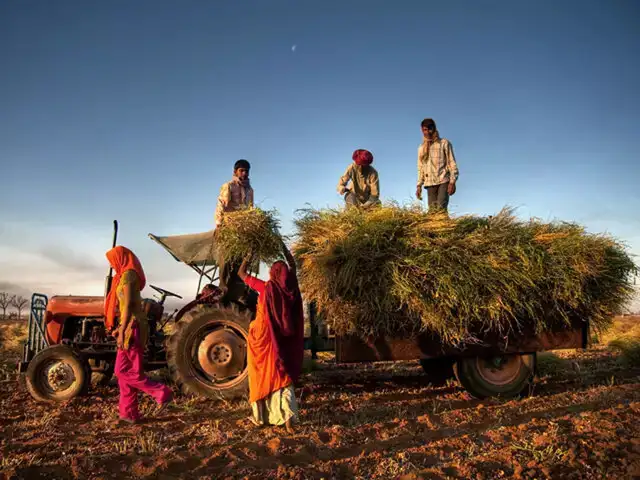
Role of farmer producer organization (slide 17+)
Marginal farmers are not well-organized or powerful. Their produce is often the last to be sold so it is likely to be underpriced and undersold. Farmer Producer Organizations were set up by the central government that combined marginal farmers into local units of around 20 and aggregated them into thousands. FPO helps farmers with generating value at the local level where the farmer and his family have a financial stake in it.
FPOs are designed to provide margibal farmers with economic, institutional and political clout. As an example, FPOs can get easier financing under PM KUSUM to buy solar PVs. FPO can make independent and optimal choices, e.g. planning of water bodies (under Jal Shakti Abhiyan) and piped water (under Jal Jeevan Mission).
One distinct benefit is that FPO needs to be market-oriented and encourage farmers to produce only what can be sold in terms of quantity & quality. Farmers’ cooperatives must plan for selecting crops, improving yields and establishing quality standards. Careful thought is given to storage, processing, branding, packaging, the use of chemicals, traceability, etc. FPO can deploy experts and technologies to assist them in estimating markets, understanding distribution & buyers preferences, pricing and export opportunities
WB worked on a model scheme for improving HP’s water management and land use.
Better hydrological information: Hydrological monitoring stations will be set up in uplands to monitor water quality and flow quantity.
Better water infrastructure: Catchment area treatment (CAT) plans were devised to create sustainable water sources. Construction of micro-watersheds in the upper catchment areas was done to increase the year-round supply of water for uplands and to control the discharge of water for lowlands. Irrigation facilities were created for cultivable land (which were downstream), and rationing of water through water charges was introduced.
Better land-based resource management: A shift was made from low-value cereal production to climate-resilient varieties and higher-value fruits, vegetables, and aromatic & medicinal plants. This improved the ability of farmers/ lowland citizens to pay for water infrastructure via water charges. State land plans helped in respects of infrastructure, training, land acquisition, distribution, and marketing.
