 PLANTATION CROPS in India
Horticultural Others
3. Cashew Nut 8. Rubber yield4. Oil Palm 9. Tobacco link yield
5. Cocoa 10. Sugarcane / Bamboo

(Large insert below shows countries ranked by aggregrate values for 10 plantation crops, excl bamboo. Two inserts on top right show the most globally significant country-crop pairs.)
 Plantation crops are cash crops often grown as a single crop over a large area, and owned and managed by large estates. Sugarcane, cotton & others are ignored in the narrative.India is among the top global producers of plantation crops, such as Arecanut, Coconut, Cashew nut, Tea, Rubber, Tobacco and Bamboo. Where India is not among the top producers (eg oil palm, cocoa, coffee), it is trying to increase production. Plantation crops are mainly concentrated, due to climate, in South India and the North-East. India is trying to diversify the sourcing of plantation crops to non-traditional areas (eg Oil Palm in Telangana, Rubber in NE) and tribal areas. Contributions to the country are not always recognized, but they are nevertheless enormous.
 Plantation crops are non-perishable and usually processed into many finished products. Economic value addition is key to overall profitability. Export demand is quite robust but internal consumption is also rising fast. Thus, there is a continuous effort to increase the area and/or productivity of these crops (esp coconut, coffee, rubber & oil palm). Since crops are long-standing and slow-maturing, the sector is always buffeted by market forces (such as global prices and demand-supply) and this can create difficulty in realising good profits for the owners. It is for these reasons that Centre and State goverments, from time to time, take an active role in this sector.
Plantation crops are cash crops often grown as a single crop over a large area, and owned and managed by large estates. Sugarcane, cotton & others are ignored in the narrative.
 Centre recently closed the Rubber development board, as only 4 crops (coffee, tobacco, tea & coconut products) are likely be net-exported. Production and yields of some plantation crops have not grown as they should have. So, Centre is encouraging the private sector, eg. 4 tyre companies plan to develop NE for natural rubber (5-year, Rs 1100cr for new 200,000 ha, skills training & high-yielding crop), just as chocolate companies promote domestic cocoa production. Perhaps, cashew nut processors can do the same! link

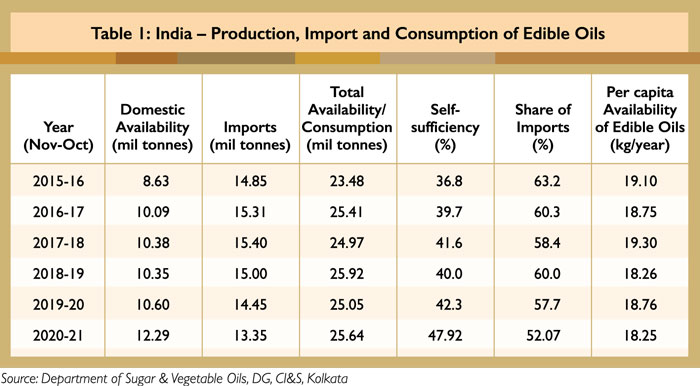
 ◘ Oil palm cultivation is essential for edible oil self-sufficiency. There is news that Telangana wants to devote 20 lakh acres to oil palm in the next 4 years!! Potential is 4m tonnes/yr of palm oil, or >25% of imports!! ♫ (see insert). [New irrigated tracts are available in Telangana due to the massive Kaleshwaram lift irrigation project & near 100% govt-sponsored drip irrigation. Profits expected to be $2500/ acre, or x5 more than rice]. Other states are getting encouraged, though Nagaland is having practical difficulties.

 ♫ "Oil palm is the highest oil yielding perennial crop. With good planting material, irrigation and proper management, it has a potential of 20-25 MT fresh fruit bunches (FFB) per hectare after 5 years, and is capable of yielding 4-5 MT of palm oil & 0.4-0.5 MT of palm kernel oil (PKO). Yields are 5 times those of oilseeds. Economic life span is 30 years, comprising juvenile period (1-3 yrs), stabilizing period (4-8 yrs) & stabilized period (9-30 yrs)."
 ◘ Bamboo is a sunrise sector in India (IMHO). Recent legislative change allows commercial exploitation of bamboo (see Concept note on bamboo & National Bamboo Mission). Centre wants to make NE a bamboo hub, though many states, eg MP offer state incentives as well. Almost guaranteed offtake, as investment is being made to use bamboo in manufacturing (as raw material for Agarbatti, furniture, flooring, etc) and for fuel (electricity and biofuel). Support to massively increase bamboo production, particuarly by productivity jumps through correct planting methods and commercialisation. Aim is to export bamboo goods and replace imports.
◘ Coconut — rehabilitate senile palms, improve planting methods and increase value addition. Excellent export demand.
◘ Rubber — new areas and high-yielding plants (up 25%) to meet elevated domestic demand.
◘ Coffee — careful increase in area and climate change resistance. Premium export market.
◘ Cashew nuts — domestic demand is up on lifestyle trends but exports are declining due to stagnant production. Competition from Vietnam is hurting nut processing industry.
