National Logistics Policy impacts: costs, efficiency, investments and new tech
— "National Logistics Policy complements PM Gati Shakti masterplan, but works on operations and systems delivery aspects, to remove many bottlenecks in the logistics business". link
— "NLP focuses on the development of support infrastructure, ways to reduce systemic inefficiencies and for heavy use of technology ...so as to cut India's logistics costs [from 13%] to global standards [of 7 - 8%]. The key is successful implementation, and realising improvements over 5 to 10 years." link
— "NPL will also bring further massive infra development, such as what is happening under programs like Sagarmala, Bharatmala and DFCs."
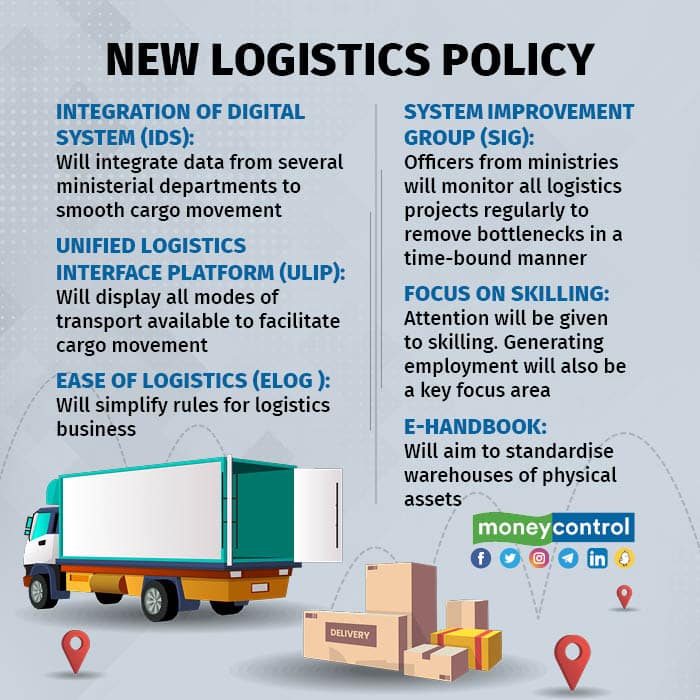 ~ ~ ~ ~
While Gati Shakti and National Infrastructure Pipeline add infrastructure, the National Logistics Policy will help to instruct and guide the delivery of quality logistics. NLP will extract additional value from logistics infra projects (ie. higher returns on assets deployed). It will further lower logistics costs and improve Logistics Performance Index.
- Costs - Users benefit from end-to-end connection to the cheapest or most convenient mode of transport, transported seamlessly & at greater speed, real-time tracking and other user-friendly information; reduced delays [eg. reduces wastage of perishable cargo, increases asset utilisation of trucks & railway assets]; fewer back-and-froth journeys [multimodal hubs; shortening of value chains over time, by better logistics planning by firms & of industrial zones]; and use of cheaper fuels like ethanol, methanol, electricity.
— Multimodality through building Multimodal logistics parks (see below)
— Higher capacity & scale benefits through big ticket infra spending [eg. doubling of railway tracks, DFCs, expressways, NH upgrades to 4/ 6-lane roads, dredging so ports can accept capsize ships, transshipment ports and large ports like proposed Vadhavan port, etc.]
— Faster & reliable deliveries through big ticket infra spending for: — faster transit [eg. new green expressways — like Surat- Hyderabad expressway that gives a shorter direct route to South India & avoids Mumbai & Pune traffic, ring roads, tunnels & bridges, 200+kmph enabled rail tracks (fenced track, OHE upgrade), higher loco freight trains]; — reliable or safer transit [eg. regular maintenance; modern rail signalling, walled-off rail tracks; all-weather roads in mountainous areas, removal of blackspots, wayside amenities, safer road designs incl. emergency lanes, crash barriers, wide road dividers, signage, lighting, very durable road surfaces via materials & good water run-off, landslide protection]
— Personalised service through support infra spending [eg. missing connectivity — coal rail links, railway; infra to enable time-tabled schedules — kisan rail; new freight terminals, specialist wagons], low cost or fast transit as required [eg. freight Vande Bharat trains, air transport, drones], reduced waste [eg cold storage]
— Hassle-free transit through equipment, technology devices and policies: by equipment or technology spending [eg. equipment standarisation, cargo scanners, weight scanners, FASTag, Automatic Number Plate Recognition, monitoring of traffic and hazards by 5G/ CCTV & AI/ track ultrasound/ sensors + IOT] and policies [vehicle designs & safety ratings, enforcement of traffic rules & checks on driving licences or retesting, emergency assist, security]
— Non-fossil fuels that are clean, cheaper and indigenous, whose prices are not volatile and can be kept at affordable levels. Infrastructure spending will be done as part of all-of-country energy transition away from imported fossil fuels [eg. ethanol or methanol distilleries, bioCNG plants + crop waste collection, EV batteries + charging infra + RE, green hydrogen + fuel cells + sewage waste/ excess RE]
- Efficiency - Reduce statutory hindrances, heavy use of technology [digitally process transactions, supply timely information, automate tasks, faceless enforcement, increase load factor, etc]; faster throughput, handling, processing, transfer between modes of transport, making just-in-time deliveries and last-mile connectivity.
— Statutory hindrances States should adopt national logistics policy, train staff, keep good labour relations, change anti-business legislations/ practices, ensure fast & efficient customs clearances, use technology for enforcement [eg. cargo scanners, weight scanners, Automatic Number Plate Recognition]
— Technology Logistics portal for booking and back-end processing- ie. which is faceless and paperless, single-window & does one-time processing of all forms; RFID tracking for fast pass-through (automation); tracking information, information of empty cargo spaces and software to fill them
— Faster throughput, just-in-time delivery, connectivity Specialist equipment & standardisation [eg warehouses], use of technology [eg scanners, artificial intelligence]; multimodal logistics parks for optimal transfers, sorting, processing, aggregating & storage, mechanisation; removal of connectivity gaps & better last-mile connectivity
- Investments - Multimodal Logistics parks, National Infrastructure Pipeline and Gati Shakti masterplan, port-rail connectivity initiative [ie. under "National Master Plan for Multi-modal Connectivity"], private freight terminals, cold chains, specialist wagons, mechanised handling, scanners etc, HR investment. In future, expressways with e-charging lanes?
- New technology - Drones .. 5G, Internet of things, Artificial intelligence.
Multi-Modal Hubs needed for lowering Logistics costs Link
---------------------------------------
Highways minister, Mr Gadkari now expects investment of Rs 200,000cr in MMLPs.
In 2017, Centre had planned to spend Rs 50,000cr to build 35 MMLP (multi-modal logistics parks or hubs), that would handle 50% of India's freight traffic. Crucially, these MMLPs, once complete, would be the biggest contributors to reducing logistics costs from 16% to 10%!
Progress has been slow — as only 3 sites out of 35 are completed or under construction. However, tendering & DPR are being progressed in 14 sites (see below) and sites for other MMLPs are being finalised. Under phase 2 of Bharatmala Pariyojana, 11 more sites will have MMLP, taking the sanctioned number to 46. Total no. of MMLPs in the country will be much greater. ♫
♫ MMLPs are also being developed by private sector (eg Adani in UP) and other public agencies like Container Corporation of India and DFC corp (DFCCIL). Besides NH agency, Railways is mandated to develop MMLPs under Gati Shakti Multimodal Cargo Terminal (GCT). HSR stations will get multi-modal connectivity (MM Gateways) and light freight handling facilities may be created there.
What is a MMLP?
=============
MMLP is a logistics hub in the 'Hub and Spoke' formulation. In other words, it is a major centre for handling freight [eg disembarkment, mechanical transfer, storage and repackaging or processing for outward travel] and it is also an intersection point of multi-modal freight traffic from the rail, road, inland waterways and/ or air transport.
MMLPs have comprehensive freight facilities like terminals to handle containers and bulk cargo, warehouses, cold storage, mechanised material handling and customs clearances [bonded storage yards, quarantine zones, testing facilities and special warehousing].
MMLPs have many advantages:
--------------------
1. Road, rail, waterway, etc are integrated with the MMLP, so the least-cost or most convenient logistics options can be utilised for trunk and last-mile connectivity.
2. Economy of scale in warehousing, cold storage & specialist equipment for handling goods. Because MMLP is a cluster development, complex logistics tasks are performed properly and cost-efficiently.
3. MMLP will declutter ports as cargo can be taken directly to MMLP where bonded storage & custom clearance is done
4. MMLPs are built outside cities where land is cheap and infra can come up quite quickly. Thus, storage happens outside cities and fast dedicated routes are developed to bring goods into cities. This improves just-in-time deliveries and reduces city traffic on other routes 5. MMLP is an ideal location for setting up new manufacturing, assembling and repackaging clusters. 2 lakh jobs are to be created under the initiative.

Details of MMLP scheme
==================
— 1. Gati Shakti to map 35 MMLP hubs (insert shows MMLPs and DFC line phases 1 & 2).
— 2. 35 MMLP provided in states (cities in insert):
5 in Gujarat ... 4 in Maha ... 3 in Punjab ... 2 in AP, Haryana, MP, Odisha, Raj & TN ... 1 each in Assam, Bihar, MP, Chhitts, Goa, HP, Karn, Kerala, Telangana, WB, Delhi & J&K.
— 3. 11 MMLP more in phase 2 as follows:
2 in UP (Gorakhpur, Kanpur) ... 2 in Maha (Dighi, Bidkin) ... 2 in Raj (Jodhpur, Bikaner) 1 each in TN, WB, Jhar, Uttarak, Tripura (Tuticorin, Siliguri, Ranchi, Haridwar, Udaipur)
— 4. National Highway Logistics Management Limited, a subsidiary of NHAI, is the nodal agency of the MMLP projects. It creates SPVs with public bodies, PSUs & private companies for each MMLP or for each state. So, equity partners in the SPV can be a Port Trust, State development body, NHAI, Indian railways, utility companies, major corporations, etc.
— 5. Land and legal authority are provided by SPVs but MMLP infrastructure is built by selected contractors under Design, Build, Finance, Operate and Transfer (where ownership is eventually transferred to SPVs). A commissionaire agreement applies. For example, the Model Concession Agreement provides for starting commercial operations within two years of the start of the project.
Check the progress as of July 2022:
— 6. Chennai & Nagpur aims to be ready by end-2024. Bids were invited for Bangaluru. DPRs started for 9 sites. Initial studies started for 21 others. Actual construction was started in Assam on 10/2020. The park, spread across 317 acres in Bongaigaon district of lower Assam, has a cargo capacity of 13 million metric tons (MMT) per year.
