Featured Post

Visit arvindagarwal2.blogspot.com for posts from 2017 to 2019

Wednesday, May 22, 2019

Exclusive| ‘This election will be India’s turning point’: PM Modi
===========================
Q. What are the big issues in this election?
The 2019 elections are special because it is the first time that those born in the 21st century are voting. These youngsters are not burdened by the past, they are in pursuit of a better future. These youngsters do not want to be bogged down by dynastic shenanigans, they want a nation where merit is recognised. They do not want old-school caste politics, they want a new age development agenda. Hence, in these elections, people will vote for those who they feel can build a better nation and lay the foundations of a strong and inclusive India. People will see our exemplary track record of 60 months, contrasting it with the inertia of those who got the opportunity to rule for almost 60 years.

Q. Are you sure because at least in Uttar Pradesh and Bihar, we hear that caste is still the most important factor?
People of all castes want development. Especially, the young generation, women – they want a solution for their problems. And all the schemes and programmes of my government not only provide them with a solution but also brings them hope of the 21st century.

Q. Why is the narrative of this election so polarizing — on both sides?
This is an election that will prove to be the turning point in India’s rise in the world. I am glad that this election has brought out the differences between the two sides clearly. Now, the people of India will be able to make a clear choice between the two ways of looking at the country.

Those who say family first or those who say India first. Those who send love letters when terror strikes or those who answer terrorists in their own language. Those who stand with “tukde-tukde” gang or those who stand with the armed forces. Those who stand to protect those who are guilty of sedition or those who live and die to protect and preserve India’s integrity. Those who did dalali (brokered) defence deals and weakened Indian defence or those who proved India’s mettle even in space. Those who made headlines for scams after scams in every sector or those who have ended the culture of scams. Those who tried their best to besmirch India’s 5,000-year-old civilization or those who stand for learning from India’s glorious past to build a bright future.

The choice is simple and clear. Therefore, if you call such an election, where the two sides have been clearly identified the positions they take on vital issues, as polarized, then I would say it is a good thing.

Q. There are so many complaints to the Election Commission, and the whole thing has become controversial.
The Congress and its durbaaris have decided not to allow the EC to do its job well. Therefore, everywhere, they have people, professionals, who e-mail complaints, making sure the EC can’t do anything else. The other thing is that in our country, courts never interfered in elections. These days, unfortunately, the court has also been pulled into it (with cases on the EC’s actions being filed before it). The third thing is that before the great loss in the elections, just like a student who hasn’t done well makes excuses, they (the opposition) are pointing fingers at EVMs (electronic voting machines), EC. Irrespective of whether there are elections or not, we have to respect institutions.
May 22nd, 2019

More: ‘Naam bhi, kaam bhi’: PM Modi breaks down BJP’s election strategy | Interview
CHINTAMANI-5DOTS LS Exit Poll post-poll adjusted

When we set out on the 2019 journey, the scenario was quite fuzzy. The opposition parties were resurgent after the 2018 Assembly Elections. Congress was brimming over with confidence, and talk of grand alliance was in the air. BJP, on the other hand, was licking its wounds after losing in 3 states, which had given it 62 out of 65 Lok Sabhā seats in 2014. They had lost Karnataka narrowly just a little earlier, with a bad scare even in Gujarat where BJP barely got away with the skin of its teeth. Suddenly, it looked probable that BJP would be losing 50 to 60 seats in these 5 States alone. Things could not be more dismal.

The UP Mahagathbandhan with SP, BSP, RLD, and Congress was looking scary. Congress and JDS were already running a government together in Karnataka and were set to go together in the Lok Sabhā as well.  To compound and confound matters, Shiv Sena was flexing its muscles, threatening to go its own way, and JDU was acting up too. Some smaller parties like Kushwaha’s RLSP had already broken away. Even Apna Dal of Anupriya Patel was trying to stare BJP down. If all these little explosives were to blow up, the prospect of BJP remaining at 160-180 levels were quite real.

So roundabout February, it looked certain that BJP would have no way forward to go beyond 180 seats – even 160. Many in the BJP started salivating on that prospect with visions of a Prime Minister other than Modi. The opposition started behaving as if the President had already invited them to form the government.

Yet, as the days wore on, it was clear that one swallow does not a summer make. First, the Grand Alliance plan fell apart. A Federal Front started doing the round instead. A dozen PM aspirants sprung up. KCR with a prospect of 15 seats, Mamata didi with a prospect of 35 seats, and Mayawati, who was contesting on 37 seats and had 0 seats in the present Lok Sabhā, all started jostling and positioning for Prime Minister’s chair. It got reflected in Mayawati putting her foot down and throwing Congress out of the UP coalition of Mahagathbandhan. The Karnataka seat distribution was no less messy. Maharashtra was the only place where the opposition could do an alliance without much hullabaloo. That became possible because of Sharad Pawar’s maturity, and an experienced Congress core team in Maharashtra. Bihar confusion went on for ages. NDA, on the other hand, not only sealed all its alliances – in Maharashtra, Bihar, UP, and the North-East, but stitched up even the Tamil Nadu alliance without much ado, even as UPA constituents kept wrangling.

The Rajasthan-MP-Chhattisgarh setback was utilised by BJP to do introspection, out of which emerged two important initiatives – the reservation for economically weaker sections, and the Budget provisions for farmers and middle class. This addressed two of its most important constituencies.

The other opportunity was provided by Pakistan. A leader is one who knows when to take an opportunity. Pulwama and its revenge gave the big bump to BJP on top of the economic and welfare measures taken by the BJP. It is actually a measure of the connect that BJP has with the masses, for which it has to thank not only its own organisation, but also its mentor RSS.

Trust in the leader, welfare and nationalism is a deadly cocktail at most times. Going into the election, the BJP was ready to dispense this heady brew.

As the election bugle was a sounded, the formidable BJP machinery rolled out a near perfect campaign. The way the Labharthis were targeted, the key marginal constituencies were mapped out. To compare with this, we had near comical efforts of leaders like Chandrababu Naidu, and Mayawati. In this background, the Phase 1 was very important, specially in UP and Bihar, as they gave 120 constituencies. In UP lay the key to denying BJP the bulk that would give it the majority or near-majority. Then Mayawati made the biggest mistake of her career.

In their first combined SP-BSP-RLD rally in Saharanpur, which has nearly 40% Muslim population, Mayawati appealed directly to Muslims, telling them that they should vote only the MGB. In the already surcharged post-Pulwama atmosphere, this was the proverbial fat in the fire. The fire leapt and burnt high, and consumed the MGB in the first round. The internal vote-transfer among the MGB constituents, which was suspect anyway, almost came unstuck, as the election became polarised. Not just it saved the BJP, but actually gave it 5-6 seats out of the 8 that went to poll in that round. The agenda for UP got set in the same way as had happened in 2017 Vidhan Sabhā elections.

Also, the biggest votary of Grand Alliance, Chandrababu Naidu got routed in AP in the first round. Vidarbha went solid with NDA, and Bihar arithmetic, never in doubt, got confirmed. To beat other odds, BJP performed beyond expectations in West Bengal, Odisha and North-East in the first round itself.

Once the momentum was set, a supremely well-oiled election machine was never going to let the opportunity slip. This was not the gentle party of Atal-Advani era. It was a ruthless war machine. The campaign strategy of BJP was meticulous. As Narendra Modi let loose his famous oratory, the party fielded him in vulnerable seats, whereas Amit Shah covered the areas around the place where a Modi rally was being held. Targeted rallies were held by other influential leaders of BJP. A virtual laser guided carpet bombing of voters and their sensibilities was relentlessly carried out by BJP. Congress, in comparison, was not only listless but badly handicapped by the lack of conviction that Rahul Gandhi carried. Moreover, while Modi, Shah and other BJP leaders campaigned separately, Rahul would invariably have to be accompanied by every other leader of consequence in the State he would go campaigning. While Modi and Shah would average 40-45 minutes of well drilled, customised message, Rahul Gandhi could never go beyond clichés and platitudes.

As the campaign progressed into the next rounds, some State satraps started panicking. Mamata and Naveen Patnaik suddenly sensed the ground slipping away from beneath their feet. Naveen Patnail responded by campaigning vigorously in spite of not keeping well, whereas Mamata Banerjee let her goons loose as the voting progressed into her strongholds of central and south Bengal. This tactic seems to have backfired as we have noticed that areas considered totally safe for TMC till two weeks are also showing signs of moving over to BJP. With the level of high-technology surveillance, and 24×7 media, it was idle on part of Mamata to think that she could rig the election against the BJP in the same way as she did in the Panchayat elections. 23rd May could be her day of reckoning as the news emanating from Bengal is showing an unprecedented surge for the saffron. It is quite large in Odisha also, but Bengal could be larger. However, we have remained very cautious in predicting Bengal seats due to the high possibility of local level rigging. If we were sure about fair polls, we would have safely given 25 seats to BJP in West Bengal instead of the 16 we have given, which would have been humongous.

As the campaign progressed, and the word of mouth started spreading, the already considerable Modi support got further consolidated. By the time, the campaign reached Gujarat, Rajasthan and MP, it had become Modi vs others elections, the candidate becoming irrelevant. In such a situation, there could be only one winner. Haryana and Delhi only carried the trend forward. So much so, the safe Congress bastion of Punjab has also got impacted and brought down the seats for Congress.

The denouement is crystal clear. As we have done a post-poll at the end of every round, we have also been publishing our results. However, we have been doing the post-poll at the level of 91% confidence level. This gave 297 seats for BJP, and 366 for NDA.

As we wanted to bring the result to 95% confidence level, we eliminated the seats for the leading party when we felt the result was less than 25,000. This brought the UP seats down to 55, and a few other seats in other States. Thus the final result for BJP at 95% confidence level are as delineated in our final chart, i.e., 285 for BJP, and 347 for NDA. The range is kept at +/- 3%, so that we project BJP at 285 +/- 16 (269-301), and NDA at 347 +/- 17, i.e., 330-364. Similarly, Congress would be at 53 +/- 2 (51-55), and UPA at 89 +/- 3 (86-92).
CHINTAMANI-5DOTS EXIT POLL cum POST-POLL 2019 LOK SABHA ELECTIONS
May 22nd, 2019
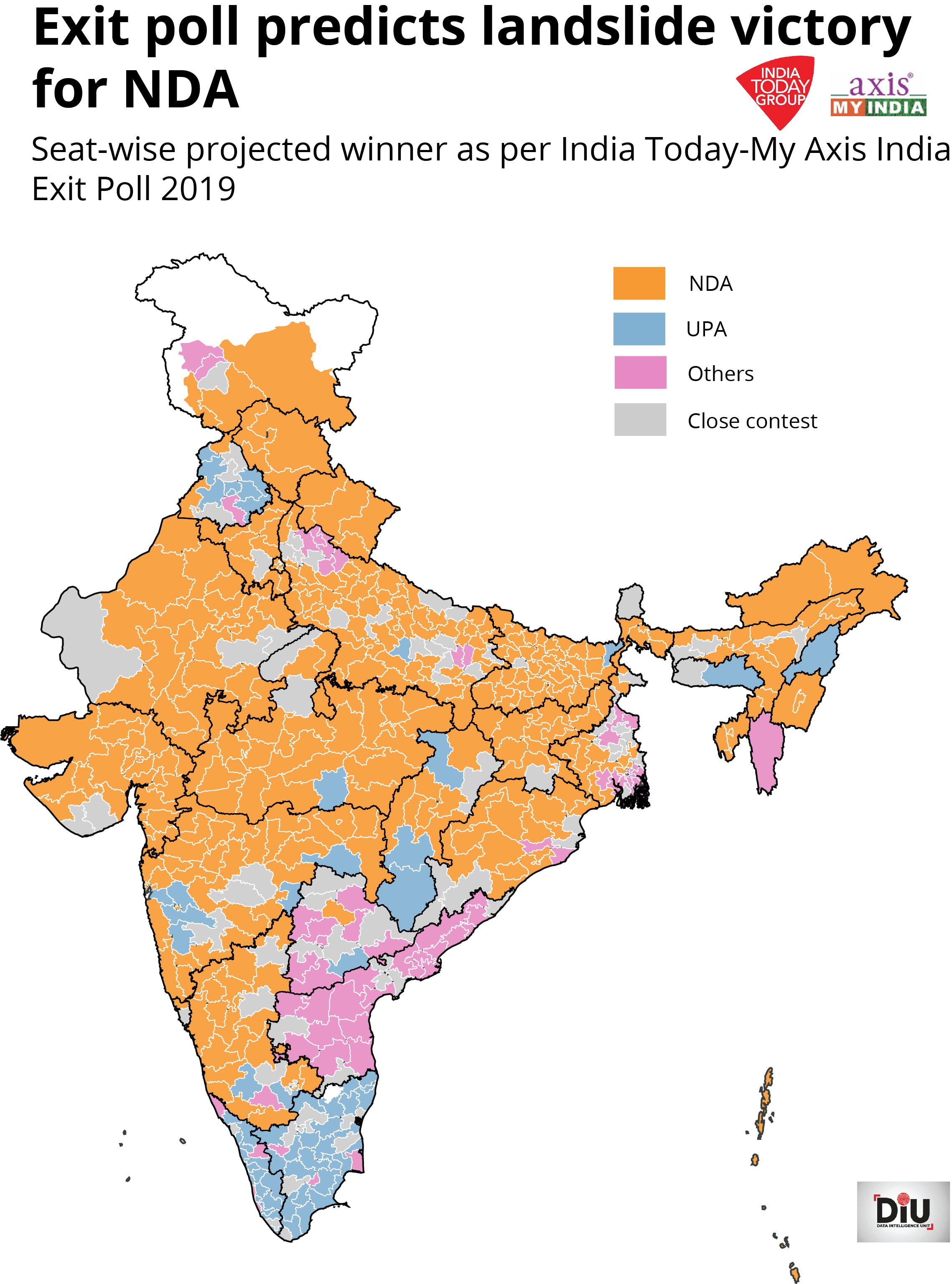
India Today fake exit poll has a hidden truth?
-------------------------------------------
NDA         177   -177  changed to 177 + 177   = 354  IT/ MyAxis exit poll 339 - 365

UPA          141   +76   changed to 141  -  76    =  65                     exit poll  77 - 108

OTHERS  224   +101 changed to 224  - 101  = 123                     exit poll  69 -  95
                                                          Total      =  542

India's biggest exit poll video: Comment
-------------------------------------
"Rajdeep asks why is BJP getting the big mandate. India is a vast, diverse country so there are many reasons. But, Rajdeep and the panelist start talking about fear (eg. of changing the constitution, etc) then Rahul puts it simply: it is anti-appeasement (of minorities) and BJP has set it out clearly in the manifesto. One can say it is about giving respect to Indians (nationalism, article 370) and positively promoting India's inherent culture (Ram temple). Congress is hostile to it (which makes it a pseudo-liberal, a darling of the world, and gets it a good vote bank as a result). It seems to wash away sins of the Gandhis. We hear Rajdeep barking: "they would not stop until they put a Gandhi in jail". My point is Gandhis & Vadra are on bail, and Rahul Gandhi was taking it easy on BJP's re-election, hoping Modi/BJP are soft on the family."
May 20th, 2019
CNNnews commentary:  https://twitter.com/CNNnews18/status/1130073032972595201
May 20th, 2019

BJP's half-term manifesto for LS polls

=======================
On Apr 08, 2019, BJP leaders launched the 'sankalp patra' for achieving 75 election pledges by 2022 (ie. 75 years after independence). Most striking are the pledges to abrogate Articles 35A & 370, build the Ram Mandir, and double farmers' income. 

Highlights:
1.   Establish 1.5 lakh health and wellness centres under Ayushman Bharat
2.   Ensure access to safe and potable drinking water for all households
3.   Ensure 100% waste collection, 100% disposal of liquid waste and reuse of waste water
4.   Strive to ensure all-weather connectivity for every village. 
5.   Ensure a pucca house to every family
6.   Aim to cover all the secondary schools under Operation Digital Board
7.   Enable digital delivery of government services such as tele-medicine
8.   Work towards digitising land records
9.   Ensure comprehensive social security coverage for all unorganised labourers including insurance, pensions, etc
10. Provide short-term new agriculture loans up to Rs 1 lakh at 0% interest rate for 1-5 yrs
11. Complete Phase-1 of Bharatmala (34,800 km) and double length of national highways
12. Start developing smart railway stations across India
13. Achieve 175 GW of renewable energy capacity
14. Ensure the supply of piped cooking gas in major Tier 1 and 2 cities. 
15. Strive to achieve 10% blending of ethanol in petrol
16. Work towards completely eliminating crop residue burning to reduce air pollution
17. Strive to make all government buildings accessible to disabled people

          AGRICULTURE
          =========
          Achieve the target of doubling farmers’ income by 2022. Work towards ensuring that maximum farmers get income support under the PM Kisan Samman Nidhi Yojana. Launch a pension scheme for small and marginal farmers to ensure social security after 60 years of age. 

          Provide short-term new agriculture loans up to Rs 1 lakh at 0% interest rate for 1-5 years on the condition of prompt repayment of the principal amount.

          Ensure adequate market avenues for the realisation of MSP through e-NAM, GrAMs and PM AASHA Yojana. Enable the creation of 10,000 new Farmer Producer Organizations. 

          Work towards completing all irrigation projects under the PM Krishi Sinchayi Yojana and increase the cropped area under irrigation.

          Work towards assisting the maximum number of fishermen by ensuring the availability of storage and other infrastructure under a new ‘Matsya Sampada Yojana’.

          Work towards digitising land records.

          INFRASTRUCTURE
          ============
          Ensure a pucca house to every familyEnsure a toilet in every household. Ensure 100% electrification of all households. Ensure the LPG gas cylinder connection to all poor rural households. Ensure every citizen has access to a bank account. Ensure the availability of banking services within 5 kms of every individual. Connect every Gram Panchayat with high speed optical fibre network. Strive to ensure all-weather connectivity for every village. 

          Ensure access to safe and potable drinking water for all households. 
          Form a new Ministry of Water unifying the water management functions. This will help approach the issue of water management holistically and ensure better co-ordination of efforts.

          Ensure the supply of piped cooking gas in major Tier 1 and 2 cities. .

          Ensure ODF status for all villages and cities. Ensure 100% waste collection under Swachh Bharat Mission and achieve ODF+ and ODF++ in cities and villages. 

          Ensure 100% disposal of liquid waste and reuse of waste water. Achieve the goal of Clean Ganga by 2022.

          Complete Phase-1 of Bharatmala Project expeditiously. Double the length of national highways. Aim to increase the number of operational airports to 150 for better air connectivity. Increase port capacity to 2,500 MTPA. Achieve 175 GW of renewable energy capacity. 

          Strive to achieve 10% blending of ethanol in petrol.

          RAILWAYS
          =======
          Ensure conversion of all viable rail tracks to broad gauge by 2022. Make all efforts to ensure electrification of all railway tracks by 2022. Work towards equipping all main railway stations with Wi-Fi facility. Start developing smart railway stations across India. 

          Complete the ongoing dedicated freight corridor projects by 2022.

          HEALTH, CHILD and WOMEN
          ==============
          Establish 1.5 lakh health and wellness centres under Ayushman Bharat. Target provisioning of tele-medicine and diagnostic laboratory facilities at all health and wellness centres to ensure quality primary medical care to the poor at their doorstep.

          Start setting up 75 new medical colleges/postgraduate medical colleges. Increase the doctor-population ratio to 1:1400#.

          Ensure a drastic reduction in cases of tuberculosis. Ensure full immunisation coverage of children. Under the POSHAN Abhiyaan, aim to reduce the malnutrition levels at an accelerated pace.

          Work towards increasing female workforce participation rate. 
          Work towards increasing the number of childcare facilities threefold.

          Ensure justice for Muslim women by enacting the law against Triple Talaq.

          YOUTH AND EDUCATION
          ============
          Aim to cover all the secondary schools under Operation Digital Board.

          Enable investment of Rs 100,000 crore in higher education through Revitalising of Infrastructure and Systems in Education (RISE).

          Work towards increasing the number of seats in premier management institutes, in premier engineering institutes and in premier law institutes. Establish at least one ATAL Tinkering Lab in every block.   


          Under a new 'Entrepreneurial Northeast' scheme, provide financial support to MSMEs and for employment generation in northeastern states.

          ECONOMY
          =======
          Further improve India’s rank in ‘Ease of Doing Business’ ranking. Work towards improving GDP share from manufacturing sector. Work towards doubling the total exports.

          Strive to ensure reduced tax rates, higher tax collection and greater compliance. Work towards ensuring a stable taxation regime. 


          In order to incentivise compliance of law and ease of doing business, amend the Companies Act to impose civil liability for technical and procedural defaults of a minor nature, thus unclogging the majority of cases from courts. 

          Ensure comprehensive social security coverage for all unorganised labourers including insurance, pensions, etc. Expand the PM Shram Yogi Maandhan scheme to cover all small shopkeepers. 

          Work towards creating a single-window compliance and dispute resolution mechanism for MSMEsEstablish National Traders’ Welfare Board and create a National Policy for Retail Trade for the growth of retail business.

          GOOD GOVERNANCE
          ============

          Enable digital delivery of government services. Achieve complete digitisation and modernisation of courts. Promote and increase digital transactions. Ensure end-to-end digitisation of government processes.

          Work towards substantially reducing the current levels of air pollution. Work towards completely eliminating crop residue burning to reduce air pollution.

          Put an Indian in space in an Indian spacecraft as part of ‘Gaganyaan’ mission.

          INCLUSIVE DEVELOPMENT and CULTURAL HERITAGE
          ============
          Strive to make all government buildings accessible.

          Ensure the completion of six Tribal Freedom Fighters Museums. 
          Work towards completing the development of ‘Panchteerth’ circuit.

          Complete the development of all projects under Swadesh Darshan, PRASAD and HRIDAY schemes. Work towards digitisation of collections in all national museums.
          May 17th, 2019
          India to achieve 1.03:1000 or WHO recommended doctor–population ratio by 2024
          BJP manifesto for Lok Sabha polls released: Top promises | Economic Times


          Piped drinking water is the next priority
          "After constructing toilets and giving dignity to women, I will focus my next term on ensuring clean drinking water" 

          163 million out of India's population of 1.3 billion are silently suffering and around 200,000 die every year, for inadequate access to safe drinking water. But in the election campaign where sundry promises were made, providing water to every home has not been talked about. It seems the elite are either not aware, or more likely, are unwilling to confront this issue wholeheartedly. 

          In the very last election rally at Khargone, Madhya Pradesh on 17th May, PM Modi said, "Fifty years ago, Lohia told Nehru that the two most important issues facing women were sanitation and water, so I will be fulfilling Lohia's wishes". By promising piped water supply to all homes by 2024, the BJP would have delivered something that no politician has ever promised, let alone delivered!! 

          BJP knows that women fetch water for homes in hundreds of villages, which is used for cooking and cleaning for a family of four or eight persons. And the women have to walk several miles a day to carry two pots of water on their headsevery day, regardless of aches and pains or poor health. Girls drop out of school because the chore is thrust on them when they are barely old enough to carry the two pots of water. 

          If Modi achieves this in addition to Swachh Bharat, Ujwala Yojana and Beti Bachao Beti Padhao, then he would have secured the confidence of women voters, and it gives BJP a sure-shot chance of winning the next general election!!

          With almost all of rural India depending on monsoon rain for agriculture and domestic purpose, there is a desperate need for water management on a war footing. From April to July every year the situation in at least eight states in the country is grim. For example, Centre has issued drought advisory to Maharashtra, Gujarat, Karnataka, Andhra Pradesh, Telangana, and Tamil Nadu, owing to low water storage in dams. 

          BJP's manifesto promises the setting up of a unified Ministry of Water to end the water woes. Currently, management of water resources is fragmented between six or seven ministries, where as a centralised system would plug loopholes that will even benefit river clean up missions across the country. The centralised team can focus on cleaning up the river and managing it so that more water is given for agriculture, and fresh, sanitised water is piped into every home in the next two or three years.
          May 18th, 2019
          https://economictimes.indiatimes.com/news/elections/lok-sabha/india/water-management-to-be-modis-priority-if-nda-is-re-elected/articleshow/69389336.cms

                         PM Modi addresses Public Meeting at Khargone, Madhya Pradesh

          2019 polls: Noida versus Lodhi road

          Socially-aware middle-class from ordinary backgrounds, keen to shed the old notions of secularism and socialism, are strong backers of Narendra Modi's vision for India

          The battle for 2019 is in full swing but there is an even bigger war being fought for over a decade now which will have a more decisive say on the future of India. Since Independence, the destiny of India has been dominated by a small group of urban upper-caste Nehruvian elites ruling in alliance with local feudal elites who were responsible for ensuring election victories. The social structure of power was simple: The urban elites would dominate the academia, bureaucracy, institutions and policymaking, and local feudal elites would be left alone except to undertake some token pro-people actions like tenancy reforms which would be passed off as land reforms. The poor and destitute could hardly exercise their votes freely. They voted as they were told to by the feudals of the dominant castes or were denied the vote. Booth capturing and preventing people from reaching the polling venues were common events.

          The major reason why the Nehruvians ruled unchallenged for years and a specific Idea of India reigned supreme was this politics of unfreedom at the grassroots notwithstanding all talk of social justice and democracy in the seminar halls and party manifestos. This was challenged vigorously from the 1980s by the Dalit and OBCs’ (other backward classes) assertion which changed the dynamics of the electoral battle and reduced the space available to the traditional elites in the direct exercise of the power. But even they couldn’t challenge the hegemony of the Nehruvian consensus as the terms of reference remained the same old Idea of India which is a secular-socialist, Gandhian dystopia. Even the Bharatiya Janata Party (BJP) remained stuck within this framework.

          But something else was churning on the ground. The economic reforms created a new class of people who were not part of the old elite. They were not landed elites in the countryside or part of the bureaucratic structures or derived their power and wealth from proximity to the corridors of power in Lutyens’ Delhi. They were simple middle and neo-middle class folk from small towns armed with modern education for whom the avenues of socioeconomic mobility were suddenly opened up by the growing private sector. Over the past two decades, millions of them moved from mofussil towns and regional capitals to the burgeoning metropolises of Delhi, Mumbai and Bengaluru. They could hope for a better lifestyle and opportunities without being part of the old system.

          These new urban denizens were not part of the globetrotting old urban elites. They did not have foreign degrees or relatives settled in the West. They were rooted in their customs and traditions and their drawing room talks centred not on US politics but local concerns back in their home districts. They were to be found in the rapidly growing new urban landscapes of Noida and Gurugram. Their dream, and the dream they inspired back home, was to buy a flat in the satellite towns of metropolises — not to move to London or the US. And they did not agree with the Nehruvian Idea of India imposed from the top through newsrooms and academic propaganda. They looked at the old elites with disdain and held them responsible for the bad policies which kept India a poor and backward country. For them, the nation and nationalism were not abstract concepts nor their religion or culture was an academic object to be deconstructed using psychoanalysis and twisted beyond recognition. They had had enough of being talked down to by the high priests of the Nehruvian consensus on the virtues of secularism and socialism.

          Rebellion was in the air but the old elites, nested comfortably in Lodhi Road, had no idea about its existence. And then came social media. Facebook, Whatsapp and Twitter completely changed how public discourse was conducted. No longer could journalists, news anchors or even academics, pass on their versions as indisputable facts. They were challenged by your average officegoer or by college students. One by one, all the myth-making of the Nehruvian consensus was shredded by the millions who now had a voice and an audience. It is they who rooted for the new BJP under Narendra Modi in 2014 and swept aside the old mainstream media. It is they who have been marked as the new evil by the old elites as bhakts who must be demonised and purged. It is this war of the narratives that underpins the 2019 elections. It is about who will dominate the avenues of power in the future and whose Idea of India will reign supreme. It is a war between the old urban power centre and the new upcoming challengers. It is a war between Noida and the Lodhi Road.

          Abhinav Prakash Singh is an assistant professor at SRCC, Delhi University
          May 3rd, 2019
          2019 polls: Noida versus Lodhi road


          A political philosophy that works!


          Let's look at what works

          Political parties and governments have experimented over centuries and failed to lift people out of poverty. The capitalist model has worked wonders across the globe and it is also the best model for India. On the other hand, dependency on other countries or unstable macro-economics does not work, nor do farm loan waivers, Nyay of Congress (eg), and taking big risks with the social engineering of the type espoused by liberals and the left. 

          -- A prosperous country has a vibrant middle class
          -- A prosperous country has a working class that is eager and willing to work
          -- A prosperous country has the monied class that deserves the monies and has to work hard to maintain that success

          1. It is not possible for the monied class to fund the middle class. If the country tries to do that, it will lose this monied class. If at all govt does this, then privileged or connected people will thrive and others will fall down to middle class.

          2. So the aim of governments is to make the middle class capable, hard-working, able to make more than they need to spend and contribute in some way to govt revenues.

          3. The government can make the working class more resourceful, by giving them more towards their essential needs and by increasing the efficiency in their daily lives -- so they need less money to look after themselves. Yet they should be incentivized to earn for their keep until old age.

          Let's look at what BJP is doing for the poor

          1. If basic utilities are a great help in the daily lives of people, then why haven't the poor paid for the connections themselves? It is like asking if computers can make your life easier, then why haven't you made use of them. It is better to ask when a connection is made, will the poor benefit by using them -- Eg. electricity - is it worth having? cylinder gas and toilets - are they worth having? clean, piped water - is it worth having? 

          2. If the benefits exceeds the costs for maintaining and using the facility, then by providing it the govt would have improved the lives of the working class, reduced poverty and reduced the burden of looking after the poor.

          3. One can ask the same about education and health. To push the poor into the middle class, education is a pre-requisite. There is no avoiding the need for treating illness and all people do their best till they die. But in this process, do they lose valuable days, months and years of useful working life. It is worth the govt investing in health because this gives higher benefits compared to costs.

          4. Infrastructure is another good route to reducing deprivation or poverty. A person needs shelter against bad weather and bad climate. For bad weather, he needs good housing which is adapted for annual weather cycles. For climate, it is about having community infrastructure for drought proofing, flood proofing, cyclone proofing, landslide proofing, snow proofing, etc. 

          5. Similarly, there is a need for both law & order and security. Law & order is like weather and security is like climate. This can be expanded to banking, insurance and savings, transportation, communications, digital services, etc

          6. It is also important for govt to build in incentives for work. Work incentive schemes are useful for creating employment opportunities. A lot of govt work should be about bringing jobs, or rather bringing income-earning opportunities within the reach of poor people in particular regions, districts, towns, and villages.

          7. There is a need for work-related social security, which includes a subsidized pension. 

          8. Govt shouldn't be doling out income benefits but it can help the poor to buy some necessary day to day items, which can't be afforded on working-class incomes and during retirement.

          The need for a strong middle class

          The crux of govt efforts is to achieve a vibrant middle class. An expanded middle-class is the overall aim of the govt. It can't hope to do that all by itself, as it must be done by the people who are competent, hard-working and wanting to be self-sufficient. Any govt should encourage the middle-class to prosper, to save for their present and future needs and also have good consumption. Domestic consumption helps other people reach or maintain middle-class status. In the global scenario, the middle-class must be able to export so they can consume foreign goods and services, yet keep the trade balance and achieve the same outcome. If higher valued exports are increased, India's relative per capita standing will improve.

          The upper-class that is not corrupt, privileged or benefited by connections

          Govt legislation should encourage entrepreneurship so that more middle class can be wealthy. At the same time, higher direct taxation will help to reduce those who have accumulated wealth simply due to privilege. Govt should go after those who have acquired their wealth illegally or have wrongly declared their incomes or wealth. As long as newer entrepreneurs enter the wealthy bracket there will be a steady dilution of the corrosive presence of the "corrupt, privileged or connected people" that form the feudal, monied classes. 

          The importance of good infrastructure

          Infrastructure costs money to build and maintain. But infrastructure often survives the person and so is accumulated over the years by monies earned by previous generations. This type of infrastructure will help to uplift the area and people living in them. Secondly, community infrastructure, one that is shared by rich and poor should be encouraged through sponsorships and community efforts. Good infrastructure might mean higher wealth, not necessarily higher incomes but are desirable never the less (eg a capable military, sports facilities, good environment). If the govt is investing in good infrastructure, it may not necessarily increase the people's incomes too much but will increase the feel-good factor or wealth. A steady build-up of this is also good.

          On the way to a developed India

          Fair progressive taxation will take care of most things -- provided the govt takes care of working class, middle class, and monied class as I have suggested. A good govt should work tirelessly to improve labour productivity and labour participation in order to increase per capita incomes. It should combat economic losses from various, avoidable social activities. As income growth gains momentum, it should start to ramp up wealth creation across the country, in terms of quality infrastructure, disaster prevention & mitigation, security, dharma, beautification of the environment, sustainable growth & development, recreation & better quality of life. 
          May 6th, 2019
          VDPAssociates @VDPAssociates: 01 May 2019
          Lok Sabha results will stun political pundits across India on May 23rd. Some states will give results no one imagined
          12 May 2019
          Quite a few records could be broken on May 23rd. Only 2 incumbent Prime Minister's Pandit Jawahar Lal Nehru and Indira Gandhi won re-elections with single party majorities in peace time conditions(war tensions and sympathy wave post assassination).Will there be a third addition on May 23rd?
          Records broken + Hint: BJP is poised for a clear majority (13th May 2019)
          -------------------------------------------------
          BJP+ has been close to zero in LS seats so can't break records by being zero or low in any state. NDA or BJP can break records by being high -- but it is probably difficult to predict a new high mark, with high confidence, after the highs in 2014.
          States where BJP is likely to go higher: 1. West Bengal 2. Odisha 3. Kerala 4. Tamil Nadu 5. North- East 6. Karnataka 7. Haryana. Unlikely to match 2014 : Andhra Pradesh, Telangana, Uttar Pradesh. Punjab, Jharkhand, Jammu & Kashmir. Certain to be below 2014: Bihar, Maharasthra, Madhya Pradesh, Chhattisgarh
          Others: YRS Congress will get majorities in LS & Assembly for the first time. Left will fall to its lowest level in West Bengal and may reach its lowest seat numbers. TRS might win all but one seat in Telangana. If BSP is in favour it may win the most seats in history outside UP. SP, TMC, NCP, Congress, DMK, AIDMK will not top their high-mark. Congress can reach a new low -- but seats in Punjab, Kerala, Chhattisgarh and TN are likely to boost its numbers.
          The pundits were saying this
          ------------------------------------
          1. Uttar Pradesh is split btw BJP and Mahagatbhandan (~40:38)
          2. Gujarat, Rajasthan & Madhya Pradesh are given to BJP with losses of 15-20% from 2014
          3. Maharashtra is given to BJP-SS+ alliance
          4. West Bengal is given to TMC
          5. Andhra Pradesh is given to YSR Congress and Telangana to TRS
          6. Bihar is given to BJP-JDU+ alliance
          7. Tamil Nadu is given to DMK-Cong+ alliance
          8. South Karnataka is given to Cong-JDS, North Karnataka to BJP
          9. Chhattisgarh is given to Cong and Jharkhand is split btw BJP and Cong+ alliance
          10. Odisha is split btw BJP and BJD
          11. Kerala is given to Cong-UDF alliance
          12. Assam, Arunachal, Tripura are given to BJP+
          13 Delhi and Haryana are given to BJP
          14. Punjab is given to Cong
          15. Himachal and Uttarakhand are given to BJP
          16. Other NE states are as per the assembly
          17. Kashmir is given to NC-Cong+, Jammu to BJP
          Likely stunners to unimagined results
          =============
          BJP stunner in Kerala with 2 seats (to 3+ seats)
          NDA stunner in Tamil Nadu with 16 seats (to 20+ seats)
          BJP stunner in West Bengal with 13 seats (to 18+ seats)
          BJP stunner by winning Karnataka by 19 seats (to 21+ seats)
          BJP stunner by winning Odisha by 13 seats (to 16+ seats)
          BJP stunner by winning UP by 60 (to 65+ seats)
          BJP stunner by winning Haryana by 9 (to all10 seats)
          NDA stunner by winning Punjab (7+ seats) (to 8+ seats)
          NDA stunner by winning North East (19+ seats) (to 21+ seats)

          Unlikely stunners
          =============
          Major Losses for TRS or YRS Congress down to below 50% seats
          Major win for LDF (10+ seats) in Kerala
          NDA loss of over 10+ seats in Bihar plus Maharashtra
          Mahagatbhandan stunner in Uttar Pradesh (45+ seats)
          Congress stuns by winning 85+ seats or 20+% seats in any BJP heartland state except Chh
          List of Upsets
          --------------------
          Pro-incumbency for BJP/ NDA
          # NDA stunners in Tamil Nadu, Punjab
          # BJP shockers in Kerala, Chattisgarh, South Karnataka
          # BJP outstanding in Uttar Pradesh, WB, Odisha
          # BJP clean sweeps Haryana, Delhi, HP, Uttarakhand, Jammu & Ladakh
          # BJP sweeps, winning 90% of seats in Gujarat, Raj, MP plus Jharkhand
          # NDA sweeps like 2014 in Maharashtra and Bihar
          # NDA wins 10+ in Assam, 19+ in North East

          Pro-incumbency for State Govts
          # TDP stunner in Andhra Pradesh
          # LDF shocker in Kerala
          # TMC wins a 2014 level mandate
          # BJD sweep in Odisha
          # AAP shocker in Delhi (wins 2+ seats)
          Congress/ UPA+ resurgence
          # Cong wins 25+ seats in Gujarat, MP plus Rajasthan
          # Mahagatbhandan sweep in Uttar Pradesh
          # Cong shocker in North Karnataka, Haryana, North East or Jammu
          May 13th, 2019 
          It's a shocker for all but Congress supporters but is this survey bogus? Nos in red boxes are too low for BJP+