Visit arvindagarwal2.blogspot.com for posts from 2017 to 2019
Friday, May 24, 2019
Many misjudgements during LS campaign: My comment
-------------------------------------
Rahul Gandhi was noisy for more than a year with Rafale this, Rafale that, and "I will put Modi in jail". (I thought RG had gone psycho when he said this). Rahul's lieutenants spoke nonsense (eg Sam Pitroda said "middle class were selfish and must pay more tax") and they sneered collectively at PM Modi's family calling them neech or "chowkidar chor hai". But where it mattered, on Gandhi family's corruption, Nyay and Modi govt's development, it was chup chap or as Mr Akbar puts it, "silence always has a story to tell". People took their revenge on Congressi's feudal families, as Mr Akbar has mentioned.
TV pundits (eg NDTV) were saying Modi was making shor (noise) but the undercurrent among voters was against him. People unashamedly supported Modi in the huge rallies and right up to Rahul Gandhi's face -- but the silent ones also backed Modi particularly in Uttar Pradesh. One Yadav leader said Akhilesh Yadav will be "searching for a home after these elections like Charan Singh's son". Post elections, Samajwadi party scored just 5 seats, same as 2014. Many Yadavs had deserted them. Mr Akbar says many Muslims (in high Muslim dominated areas) also voted BJP!!
These media pundits didn't miss the tsunami (they just lied), because even I could sense it, from Rajasthan rallies, Modi-Modi chants from voters travelling to north Karnataka in packed out trains, MP's high voter turnout, loss of enthusiasm in later stages of Congress's UP campaign, Mamata Banerjee's brutality and voter suppression, and the quiet confidence in BJP from Amit Shah down to Piyush Goyal. In his rallies, Narendra Modi said he came to rallies not asking for votes but for thanking the voters (meaning he was getting overwhelming voter support).
Seats lost in UP & Punjab (73 - 64) + (6-4) equals
= Seats gained in Bihar + rest of North India + MP,RJ,GU,JH (39-32) + (30 - 27) + 1
Seats lost in Maharashtra, Chhattisgarh, Goa, 4-UT (42-41) + (10-9) +1 + 2 = less 5, matches seats gained in North Karnataka (20-16) = +4
Max potential is for extra 45 out of 345 total seats
New territories with good prospects
1. West Bengal (42 seats) from 2 --> 18 .... potential for extra 24
2. Odisha (21) from 1 --> 8 13
3. Telangana (17) from 1 --> 4 13
4. North East (25) from 12 --> 18 7
5. South Karnataka (8 seats) from 1 --> 5 3
36 seats captured in 2019, adding to 17 in 2014
Max potential is for extra 60 out of 113total seats
Territories hard to capture
1. Kerala (20) zero
2. Andhra Pradesh (25) zero, loss of 1 seat
3. Tamil Nadu & Puducherry (40) 1 held, loss of 2 in old alliance and 39 in new alliance
(TN alternates completely between TN regional parties-- will BJP be a -ve factor in the alliance for 2024?)
40 seats lost in 2019
Total seats 85 have given just 1 seat
May 24th, 2019
Election results live coverage from Aaj Tak & DD:
Taking on FMCG giants on home turf
Patanjali bagged the edible oil maker Ruchi Soya with Rs 4,325cr bid. Ruchi Soya was heavily indebted with loans of Rs 9,345cr to lenders like SBI, Central Bank, PNB & Standard Chartered and was put on insolvency auction. Patanjali won a protracted contest where it first delayed the deal and then outbid Adani Wilmar when the latter cited that Ruchi Soya was losing value due to the delay! Patanjali hits a snag ============== Patanjali is an innovative & fast emerging FMCG company (with a turnover of Rs10,000cr). It had clocked 111% growth in turnover 2016-17, which dropped to marginal growth in 2017-18 after demonetization and GST. Its ambition was to rapidly scale up to Rs 20,000 to 25,000cr turnover. The slowdown is bad for Patanjali as it needs to become a dominant player before others start to challenge it on its core Ayurvedic offerings. Lack of strong distribution channels is holding back the sales growth in the core business whilst it had entered new sectors where it is still vulnerable. What is special about Ruchi Soya? ======================= Ruchi Soya is in the business of refining, processing and packing edible oils and has 14% of Indian market share (2nd to Adani Wilmar which has 19%). It had already signed various deals with Patanjali. Now, Ruchi Soya can make exclusive sales and distribution arrangements for the entire range of Patanjali edible oils, in large packs. Ruchi Soya can help to process Patanjali's other foods and agri-products. It can dramatically increase the market presence of Patanjali products, increase their brand value and push sales while Patanjali retains a strong brand recognition.
India’s Mumbai to Ahmedabad bullet train project (509 km) will use Japan’s E5 Shinkansen technology -- also known for a zero-fatality record. This technology can propel trains at 320 kmph but does it with excellent safety throughout. NHSRCL will study feasibility of 10 more bullet train corridors of around 6,000 km, which will cost an incredible Rs 10 lakh crore!! Six routes have been identified: New Delhi-Mumbai, New Delhi-Kolkata, New Delhi-Amritsar, Chennai-Bengaluru, New Delhi-Varanasi, Patna-Kolkata.
India has one of the world’s longest road network spanning a total of 5.6 million km. However, while China has developed an expressway network of 140,000 km (or 3% of total road network) in the last few decades, India has around 1,5000 km of expressways. Govt wants to build "world-class expressways" at much faster pace -- it has plans for a 10-fold increase (15,600 km) in expressways by 2022. For example, the 135-km-long Eastern Peripheral Expressway (around Delhi, completed in May 2018) was built in a record time of 17 months.
1. Delhi-Mumbai Expressway This signal-free access controlled corridor, which will run through five states to connect India's political and economic capitals, will be the country's longest once complete. Announced by the government in April last year, work on the expressway will begin in March 2019 and the target is to have it completed by March 2022. The 1,250-km long expressway will cut down the travel distance between Delhi and Mumbai by 250 km, and time for cars from 25 hours (through NH-8) to 12 hours and for trucks from 44 to 22 hours. It will also help reduce traffic on NH-8, which, according to some accounts, is used by around three lakh vehicles every day. The National Highways Authority Of India (NHAI) is acquiring about 12,000 hectares for the project for the expressway, which will have a 80 km stretch in Haryana, 380 km in Rajasthan, 120 km in Gujarat, 300 km in Madhya Pradesh and 370 km in Maharashtra. Reports suggest that the process of land acquisition has been completed in Haryana while it is at different stages in other states. Construction for the Vadodara-Mumbai stretch is already underway, NDTV has reported. After deciding on a new alignment for the expressway, the government will be able to save over Rs 16,000 crore in land acquisition. "While an acre is coming in at Rs 7 crore according to the original alignment, the new alignment has brought it down to Rs 80 lakh a hectare. The land alone will cost around Rs 6,000 crore," the Times of India has reported. The work on the expressway has been divided into 34 stretches. Tenders have been floated for multiple stretches and bids for six stretches in Haryana and Rajasthan for a total of 173 km have been received. NHAI is likely to complete tendering-related work for 22 other stretches by mid-February this year.
2. Purvanchal Expressway This is a 343 km long under-construction six-lane, access-controlled highway that will connect eastern Uttar Pradesh, one of the least developed parts of the country, to the state capital of Lucknow. The expressway will will provide uninterrupted connectivity to nine districts of Barabanki, Sultanpur, Faizabad, Ambedkar Nagar, Azamgarh, Mau and Ghazipur, and will be linked to Prime Minister Narendra Modi's constituency Varanasi through a special link road. Construction of the expressway will cost Rs 23,000 crore. The Uttar Pradesh Expressways Industrial Development Authority (UPEIDA) has divided the project into eight packages. Gayatri Projects, GR Infra and PNC Infratech have been awarded two packages each while Apco and Oriental have been awarded one package each. When the Yogi Adityanath-led Bharatiya Janata Party government took office, it canceled earlier bids alleging that they were overpriced as bidders "worked as cartels".
“The last time the bids were almost 10.97 per cent overpriced because construction companies joined hands and worked as cartel. They identified their own packages and bade accordingly. The UPEIDA was able to break the cartel and new bids are almost 10 per cent less which will save a round Rs 600 crore,” a senior UPEIDA official has said.
3. Delhi-Meerut Expressway The Delhi-Meerut corridor is India's first 14 lane expressway. The first phase of the expressway, 9 km long, has been built at a cost of Rs 841 crore. It was inaugurated by Prime Minister Narendra Modi in May last year. The total length of the expressway is 96 km and it is being developed by the National Highways Authority of India (NHAI) and Welspun Enterprises under the 'Hybrid Annuity Model'. The project, which will reduce travel time between Delhi and Meerut to just 45 minutes from the current 4-5 hour, is expected to cost somewhere around Rs 7,500. The remaining 82 km long part of the expressway is likely to be operational by March 2019 while the deadline set by the government is August 2019. Vehicles from Punjab, Haryana, Rajasthan, Himachal Pradesh and Uttrakhand, not destined for Delhi, will be able to reach Uttar Pradesh using this expressway.
4. Mumbai-Nagpur Super Communication Expressway Also known as the Maharashtra Samruddhi Mahamarg, this is a 701 km long, eight lane expressway connecting Mumbai on the western edge of Maharashtra and Nagpur on the eastern end of the state. One of the longest high-speed road corridors in the country, the Mumbai-Nagpur expressway will run through 10 districts, 26 tehsils, and 390 villages in the state and is expected to cut travel time between the two cities to little over eight hours from around 16 hours currently. The project is being financed through a Rs 2.5 lakh crore loan by a consortium of 20 banks led by the State Bank of India. Land acquisition for the project, which is being implemented by the Maharashtra State Road Development Corporation, has been completed. Compensation has been issued to 90 per cent of the affected farmers. Ground cleaning and levelling work has began on several stretches of the road. The state government plans to commission the expressway by December 2020.
5. Bundelkhand Expressway (or Atal path) This is a proposed 289-km, four lane access-controlled highway that will connect six districts in Uttar Pradesh’s Bundelkhand region - Auraiya, Jalaun, Orai, Rath, Banda, Chitrakoot - to the 300 km long Lucknow-Agra expressway. These districts are part of the larger region along the border of Uttar Pradesh and Madhya Pradesh which is considered one of the most backward areas in the country. Land acquisition for the project has began. The Yogi Adityanath government has already released Rs 640 crore for the purpose. The project will benefit from the Nirmala Sitharaman-led Defence Ministry’s plan to bring the country’s second defence corridor to the Bundelkhand region. The government has identified about 5,125 hectares of land for the development of the defence corridor. 6. Salem-Chennai Expressway Source of much controversy in Tamil Nadu recently, the Salem-Chennai expressway is a proposed 277 km long, six-lane Green Corridor which will cut down the travel time between Chennai and Salem by three hours and distance by 68 km. The expressway is proposed to start near the Chennai Outer Ring Road junction and will pass through the districts of Kancheepuram, Tiruvannamalai, Krishnagiri, Dharmapuri and Salem. It is a part of the Centre’s plan to improve freight movements under the ‘Bharatmala Pariyojana’ programme. By December 2018, nearly 90 per cent of land acquisition had been completed. The project has been met with opposition from farmers and left-leaning activists in Tamil Nadu, which had initially affected the land acquisition process. The Madras High Court had in September 2018 dismissed a petition against land acquisition. 7. Chandili-Rourkela Expressway (or Biju Expressway) This is an under construction corridor stretching over 656 kms from Rourkela in the northern part of Odisha to Chandili in the southern part of the state. The Rs 3,600 crore highway is being built in multiple phases, some of which have been completed and inaugurated. The 163 km long four-lane stretch of the expressway between Rourkela to Sambalpur, which has been completed, was inaugurated by Chief Minister Naveen Patnaik in March 2018. The 41 km stretch between Berhampur and Taptapani has also been completed and opened to traffic. The deadline to complete the remaining phases of the expressway, according to reports, is Match 2019. Odisha’s KBK districts - Koraput, Nabarangpur, Kalahandi and Nuapada, considered the most backward region in the country by the now abolished Planning Commission, will benefit hugely from this expressway. It will connect this region to the Western Odisha districts of Bargarh, Sambalpur, Jharsuguda and Sundargarh and to industrial hubs of Chhattisgarh, including Jagdalpur and Raipur. 8. Bengaluru-Chennai Expressway This is a proposed eight-lane corridor that will stretch 262 km between Hoskote in Bengaluru to Sriperumbudur in Chennai, cutting down the travel time between the two metropolises to around four hours from six to seven hours currently. It will pass through the districts of Hoskote, Malur (Karnataka), V Kota, Palamaner (Andhra Pradesh), Gudiyatam, Arakkonam and Sri Perambadur (Tamil Nadu). There are two existing routes which connect Chennai and Bengaluru, one is via Hoskote and Andhra Pradesh and the second is via the Electronic City and Hosur. The proposed alignment of the Bengaluru-Chennai Expressway will lie between these two stretches.
The project, which is expect to cost around 17, 900 crore, requires the acquisition of 2,650 hectares of land. Acquisition of land is in the final stages. By December 2018, the Centre had already spent Rs 1,370 crore towards pre-construction activities. This will ease the flow of traffic between Bengaluru and Chennai on existing roads. At least 9,500 passenger car units travel between the two cities every day. The expressway will also cut down the distance between the two cities by around 80 km. The current distance between Bengaluru and Chennai through Krishnagiri in Tamil Nadu is around 345 km. 9. Brahmaputra Express Highway The Brahmaputra express highway, the first of its kind high-speed road corridor in Northeast India, will stretch along the 890-km bank of the river it is named after, from Sadiya in eastern Assam to Dhubri in the western part of the state. The project is expected to incur an investment of around Rs 40,000 crore. The construction of the expressway would also help arrest river-bank erosion. Survey work for the project had been launched in January 2017. Assam Chief Minister Sarbananda Sonowalhas has said that his government has sought support from the World Bank and the Asian Development Bank for the project. May 24th, 2019 India's Expressways to look out for
Wednesday, May 22, 2019
Exclusive| ‘This election will be India’s turning point’: PM Modi =========================== Q. What are the big issues in this election? The 2019 elections are special because it is the first time that those born in the 21st century are voting. These youngsters are not burdened by the past, they are in pursuit of a better future. These youngsters do not want to be bogged down by dynastic shenanigans, they want a nation where merit is recognised. They do not want old-school caste politics, they want a new age development agenda. Hence, in these elections, people will vote for those who they feel can build a better nation and lay the foundations of a strong and inclusive India. People will see our exemplary track record of 60 months, contrasting it with the inertia of those who got the opportunity to rule for almost 60 years. Q. Are you sure because at least in Uttar Pradesh and Bihar, we hear that caste is still the most important factor? People of all castes want development. Especially, the young generation, women – they want a solution for their problems. And all the schemes and programmes of my government not only provide them with a solution but also brings them hope of the 21st century. Q. Why is the narrative of this election so polarizing — on both sides? This is an election that will prove to be the turning point in India’s rise in the world. I am glad that this election has brought out the differences between the two sides clearly. Now, the people of India will be able to make a clear choice between the two ways of looking at the country. Those who say family first or those who say India first. Those who send love letters when terror strikes or those who answer terrorists in their own language. Those who stand with “tukde-tukde” gang or those who stand with the armed forces. Those who stand to protect those who are guilty of sedition or those who live and die to protect and preserve India’s integrity. Those who did dalali (brokered) defence deals and weakened Indian defence or those who proved India’s mettle even in space. Those who made headlines for scams after scams in every sector or those who have ended the culture of scams. Those who tried their best to besmirch India’s 5,000-year-old civilization or those who stand for learning from India’s glorious past to build a bright future. The choice is simple and clear. Therefore, if you call such an election, where the two sides have been clearly identified the positions they take on vital issues, as polarized, then I would say it is a good thing. Q. There are so many complaints to the Election Commission, and the whole thing has become controversial. The Congress and its durbaaris have decided not to allow the EC to do its job well. Therefore, everywhere, they have people, professionals, who e-mail complaints, making sure the EC can’t do anything else. The other thing is that in our country, courts never interfered in elections. These days, unfortunately, the court has also been pulled into it (with cases on the EC’s actions being filed before it). The third thing is that before the great loss in the elections, just like a student who hasn’t done well makes excuses, they (the opposition) are pointing fingers at EVMs (electronic voting machines), EC. Irrespective of whether there are elections or not, we have to respect institutions. May 22nd, 2019 More: ‘Naam bhi, kaam bhi’: PM Modi breaks down BJP’s election strategy | Interview
CHINTAMANI-5DOTS LS Exit Poll post-poll adjusted When we set out on the 2019 journey, the scenario was quite fuzzy. The opposition parties were resurgent after the 2018 Assembly Elections. Congress was brimming over with confidence, and talk of grand alliance was in the air. BJP, on the other hand, was licking its wounds after losing in 3 states, which had given it 62 out of 65 Lok Sabhā seats in 2014. They had lost Karnataka narrowly just a little earlier, with a bad scare even in Gujarat where BJP barely got away with the skin of its teeth. Suddenly, it looked probable that BJP would be losing 50 to 60 seats in these 5 States alone. Things could not be more dismal.
The UP Mahagathbandhan with SP, BSP, RLD, and Congress was looking scary. Congress and JDS were already running a government together in Karnataka and were set to go together in the Lok Sabhā as well. To compound and confound matters, Shiv Sena was flexing its muscles, threatening to go its own way, and JDU was acting up too. Some smaller parties like Kushwaha’s RLSP had already broken away. Even Apna Dal of Anupriya Patel was trying to stare BJP down. If all these little explosives were to blow up, the prospect of BJP remaining at 160-180 levels were quite real.
So roundabout February, it looked certain that BJP would have no way forward to go beyond 180 seats – even 160. Many in the BJP started salivating on that prospect with visions of a Prime Minister other than Modi. The opposition started behaving as if the President had already invited them to form the government.
Yet, as the days wore on, it was clear that one swallow does not a summer make. First, the Grand Alliance plan fell apart. A Federal Front started doing the round instead. A dozen PM aspirants sprung up. KCR with a prospect of 15 seats, Mamata didi with a prospect of 35 seats, and Mayawati, who was contesting on 37 seats and had 0 seats in the present Lok Sabhā, all started jostling and positioning for Prime Minister’s chair. It got reflected in Mayawati putting her foot down and throwing Congress out of the UP coalition of Mahagathbandhan. The Karnataka seat distribution was no less messy. Maharashtra was the only place where the opposition could do an alliance without much hullabaloo. That became possible because of Sharad Pawar’s maturity, and an experienced Congress core team in Maharashtra. Bihar confusion went on for ages. NDA, on the other hand, not only sealed all its alliances – in Maharashtra, Bihar, UP, and the North-East, but stitched up even the Tamil Nadu alliance without much ado, even as UPA constituents kept wrangling.
The Rajasthan-MP-Chhattisgarh setback was utilised by BJP to do introspection, out of which emerged two important initiatives – the reservation for economically weaker sections, and the Budget provisions for farmers and middle class. This addressed two of its most important constituencies.
The other opportunity was provided by Pakistan. A leader is one who knows when to take an opportunity. Pulwama and its revenge gave the big bump to BJP on top of the economic and welfare measures taken by the BJP. It is actually a measure of the connect that BJP has with the masses, for which it has to thank not only its own organisation, but also its mentor RSS.
Trust in the leader, welfare and nationalism is a deadly cocktail at most times. Going into the election, the BJP was ready to dispense this heady brew.
As the election bugle was a sounded, the formidable BJP machinery rolled out a near perfect campaign. The way the Labharthis were targeted, the key marginal constituencies were mapped out. To compare with this, we had near comical efforts of leaders like Chandrababu Naidu, and Mayawati. In this background, the Phase 1 was very important, specially in UP and Bihar, as they gave 120 constituencies. In UP lay the key to denying BJP the bulk that would give it the majority or near-majority. Then Mayawati made the biggest mistake of her career.
In their first combined SP-BSP-RLD rally in Saharanpur, which has nearly 40% Muslim population, Mayawati appealed directly to Muslims, telling them that they should vote only the MGB. In the already surcharged post-Pulwama atmosphere, this was the proverbial fat in the fire. The fire leapt and burnt high, and consumed the MGB in the first round. The internal vote-transfer among the MGB constituents, which was suspect anyway, almost came unstuck, as the election became polarised. Not just it saved the BJP, but actually gave it 5-6 seats out of the 8 that went to poll in that round. The agenda for UP got set in the same way as had happened in 2017 Vidhan Sabhā elections.
Also, the biggest votary of Grand Alliance, Chandrababu Naidu got routed in AP in the first round. Vidarbha went solid with NDA, and Bihar arithmetic, never in doubt, got confirmed. To beat other odds, BJP performed beyond expectations in West Bengal, Odisha and North-East in the first round itself.
Once the momentum was set, a supremely well-oiled election machine was never going to let the opportunity slip. This was not the gentle party of Atal-Advani era. It was a ruthless war machine. The campaign strategy of BJP was meticulous. As Narendra Modi let loose his famous oratory, the party fielded him in vulnerable seats, whereas Amit Shah covered the areas around the place where a Modi rally was being held. Targeted rallies were held by other influential leaders of BJP. A virtual laser guided carpet bombing of voters and their sensibilities was relentlessly carried out by BJP. Congress, in comparison, was not only listless but badly handicapped by the lack of conviction that Rahul Gandhi carried. Moreover, while Modi, Shah and other BJP leaders campaigned separately, Rahul would invariably have to be accompanied by every other leader of consequence in the State he would go campaigning. While Modi and Shah would average 40-45 minutes of well drilled, customised message, Rahul Gandhi could never go beyond clichés and platitudes.
As the campaign progressed into the next rounds, some State satraps started panicking. Mamata and Naveen Patnaik suddenly sensed the ground slipping away from beneath their feet. Naveen Patnail responded by campaigning vigorously in spite of not keeping well, whereas Mamata Banerjee let her goons loose as the voting progressed into her strongholds of central and south Bengal. This tactic seems to have backfired as we have noticed that areas considered totally safe for TMC till two weeks are also showing signs of moving over to BJP. With the level of high-technology surveillance, and 24×7 media, it was idle on part of Mamata to think that she could rig the election against the BJP in the same way as she did in the Panchayat elections. 23rd May could be her day of reckoning as the news emanating from Bengal is showing an unprecedented surge for the saffron. It is quite large in Odisha also, but Bengal could be larger. However, we have remained very cautious in predicting Bengal seats due to the high possibility of local level rigging. If we were sure about fair polls, we would have safely given 25 seats to BJP in West Bengal instead of the 16 we have given, which would have been humongous.
As the campaign progressed, and the word of mouth started spreading, the already considerable Modi support got further consolidated. By the time, the campaign reached Gujarat, Rajasthan and MP, it had become Modi vs others elections, the candidate becoming irrelevant. In such a situation, there could be only one winner. Haryana and Delhi only carried the trend forward. So much so, the safe Congress bastion of Punjab has also got impacted and brought down the seats for Congress.
The denouement is crystal clear. As we have done a post-poll at the end of every round, we have also been publishing our results. However, we have been doing the post-poll at the level of 91% confidence level. This gave 297 seats for BJP, and 366 for NDA.
As we wanted to bring the result to 95% confidence level, we eliminated the seats for the leading party when we felt the result was less than 25,000. This brought the UP seats down to 55, and a few other seats in other States. Thus the final result for BJP at 95% confidence level are as delineated in our final chart, i.e., 285 for BJP, and 347 for NDA. The range is kept at +/- 3%, so that we project BJP at 285 +/- 16 (269-301), and NDA at 347 +/- 17, i.e., 330-364. Similarly, Congress would be at 53 +/- 2 (51-55), and UPA at 89 +/- 3 (86-92). CHINTAMANI-5DOTS EXIT POLL cum POST-POLL 2019 LOK SABHA ELECTIONS May 22nd, 2019
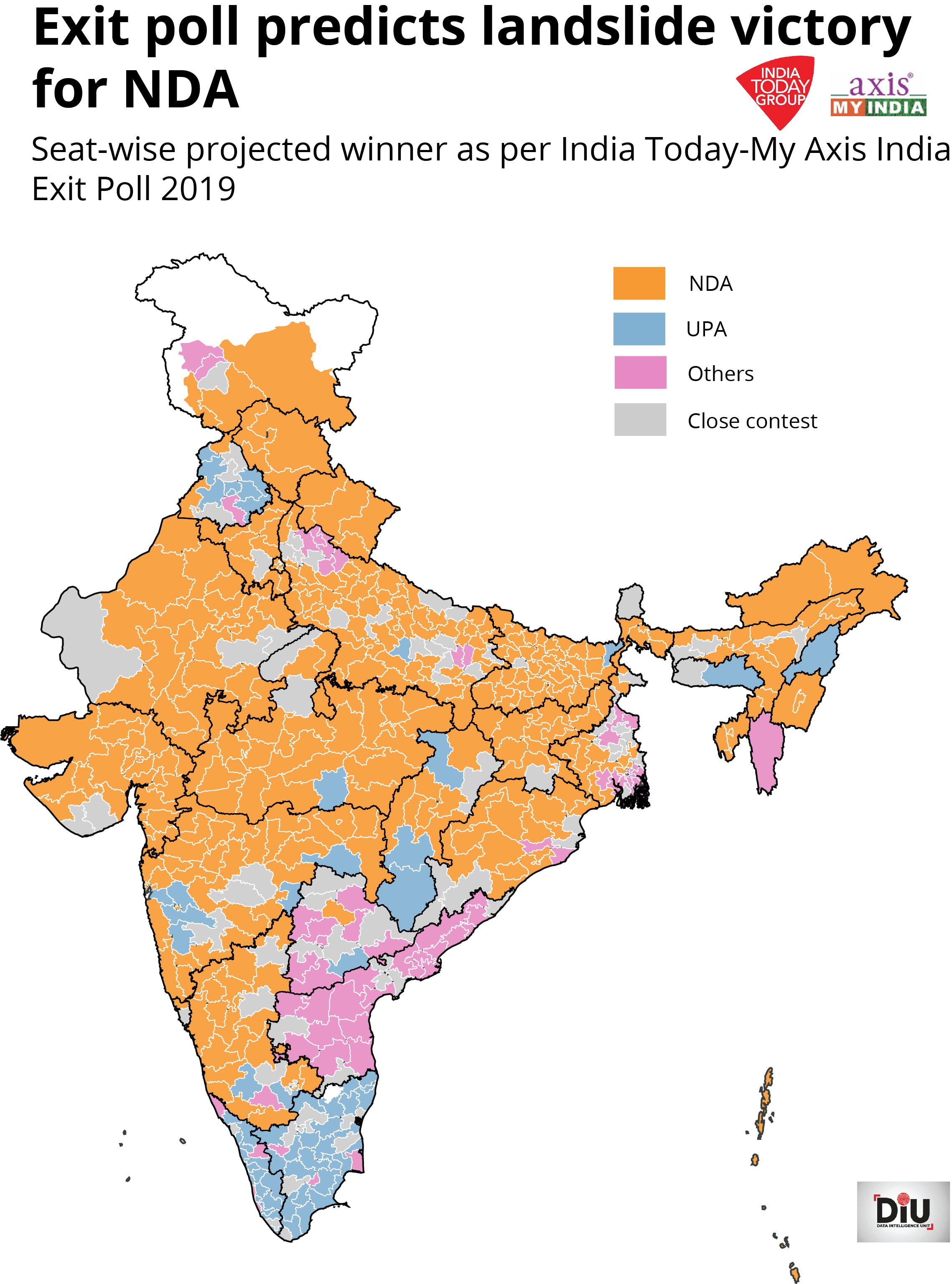
India Today fake exit poll has a hidden truth?
-------------------------------------------
NDA 177 -177 changed to 177 + 177 = 354IT/ MyAxisexit poll 339 - 365
OTHERS 224 +101 changed to 224 - 101 = 123exit poll 69 - 95
Total = 542
India's biggest exit poll video: Comment
-------------------------------------
"Rajdeep asks why is BJP getting the big mandate. India is a vast, diverse country so there are many reasons. But, Rajdeep and the panelist start talking about fear (eg. of changing the constitution, etc) then Rahul puts it simply: it is anti-appeasement (of minorities) and BJP has set it out clearly in the manifesto. One can say it is about giving respect to Indians (nationalism, article 370) and positively promoting India's inherent culture (Ram temple). Congress is hostile to it (which makes it a pseudo-liberal, a darling of the world, and gets it a good vote bank as a result). It seems to wash away sins of the Gandhis. We hear Rajdeep barking: "they would not stop until they put a Gandhi in jail". My point is Gandhis & Vadra are on bail, and Rahul Gandhi was taking it easy on BJP's re-election, hoping Modi/BJP are soft on the family." May 20th, 2019
======================= On Apr 08, 2019, BJP leaders launched the 'sankalp patra' for achieving 75 election pledges by 2022 (ie. 75 years after independence). Most striking are the pledges to abrogate Articles 35A & 370, build the Ram Mandir,and double farmers' income. Highlights: 1. Establish 1.5 lakh health and wellness centres under Ayushman Bharat 2. Ensure access to safe and potable drinking water for all households 3. Ensure 100% waste collection, 100% disposal of liquid waste and reuse of waste water 4. Strive to ensure all-weather connectivity for every village. 5. Ensure a pucca house to every family 6. Aim to cover all the secondary schools under Operation Digital Board 7. Enable digital delivery of government services such as tele-medicine 8. Work towards digitising land records 9. Ensure comprehensive social security coverage for all unorganised labourers including insurance, pensions, etc 10. Provide short-term new agriculture loans up to Rs 1 lakh at 0% interest rate for 1-5 yrs 11. Complete Phase-1 of Bharatmala (34,800 km) and double length of national highways 12. Start developing smart railway stations across India
13. Achieve 175 GW of renewable energy capacity 14. Ensure the supply of piped cooking gas in major Tier 1 and 2 cities. 15. Strive to achieve 10% blending of ethanol in petrol 16. Work towards completely eliminating crop residue burning to reduce air pollution 17. Strive to make all government buildings accessible to disabled people
AGRICULTURE ========= Achieve the target of doubling farmers’ income by 2022. Work towards ensuring that maximum farmers get income support under the PM Kisan Samman Nidhi Yojana. Launch a pension scheme for small and marginal farmers to ensure social security after 60 years of age. Provide short-term new agriculture loans up to Rs 1 lakh at 0% interest rate for 1-5 years on the condition of prompt repayment of the principal amount. Ensure adequate market avenues for the realisation of MSP through e-NAM, GrAMs and PM AASHA Yojana. Enable the creation of 10,000 new Farmer Producer Organizations. Work towards completing all irrigation projects under the PM Krishi Sinchayi Yojana and increase the cropped area under irrigation. Work towards assisting the maximum number of fishermen by ensuring the availability of storage and other infrastructure under a new ‘Matsya Sampada Yojana’.
Work towards digitising land records.
INFRASTRUCTURE ============ Ensure a pucca house to every family. Ensure a toilet in every household. Ensure 100% electrification of all households. Ensure the LPG gas cylinder connection to all poor rural households. Ensure every citizen has access to a bank account. Ensure the availability of banking services within 5 kms of every individual. Connect every Gram Panchayat with high speed optical fibre network. Strive to ensure all-weather connectivity for every village. Ensure access to safe and potable drinking water for all households. Form a new Ministry of Water unifying the water management functions. This will help approach the issue of water management holistically and ensure better co-ordination of efforts. Ensure the supply of piped cooking gas in major Tier 1 and 2 cities. . Ensure ODF status for all villages and cities. Ensure 100% waste collection under Swachh Bharat Mission and achieve ODF+ and ODF++ in cities and villages. Ensure 100% disposal of liquid waste and reuse of waste water. Achieve the goal of Clean Ganga by 2022. Complete Phase-1 of Bharatmala Project expeditiously. Double the length of national highways.Aim to increase the number of operational airports to 150 for better air connectivity. Increase port capacity to 2,500 MTPA. Achieve 175 GW of renewable energy capacity. Strive to achieve 10% blending of ethanol in petrol. RAILWAYS ======= Ensure conversion of all viable rail tracks to broad gauge by 2022. Make all efforts to ensure electrification of all railway tracks by 2022. Work towards equipping all main railway stations with Wi-Fi facility. Start developing smart railway stations across India. Complete the ongoing dedicated freight corridor projects by 2022. HEALTH, CHILD and WOMEN ============== Establish 1.5 lakh health and wellness centres under Ayushman Bharat.Target provisioning of tele-medicine and diagnostic laboratory facilities at all health and wellness centres to ensure quality primary medical care to the poor at their doorstep.
Start setting up 75 new medical colleges/postgraduate medical colleges. Increase the doctor-population ratio to 1:1400#.
Ensure a drastic reduction in cases of tuberculosis. Ensure full immunisation coverage of children. Under the POSHAN Abhiyaan, aim to reduce the malnutrition levels at an accelerated pace. Work towards increasing female workforce participation rate. Work towards increasing the number of childcare facilities threefold. Ensure justice for Muslim women by enacting the law against Triple Talaq. YOUTH AND EDUCATION ============ Aim to cover all the secondary schools under Operation Digital Board. Enable investment of Rs 100,000 crore in higher education through Revitalising of Infrastructure and Systems in Education (RISE). Work towards increasing the number of seats in premier management institutes, in premier engineering institutes and in premier law institutes. Establish at least one ATAL Tinkering Lab in every block. Under a new 'Entrepreneurial Northeast' scheme, provide financial support to MSMEs and for employment generation in northeastern states. ECONOMY ======= Further improve India’s rank in ‘Ease of Doing Business’ ranking. Work towards improving GDP share from manufacturing sector. Work towards doubling the total exports.
Strive to ensure reduced tax rates, higher tax collection and greater compliance. Work towards ensuring a stable taxation regime. In order to incentivise compliance of law and ease of doing business, amend the Companies Act to impose civil liability for technical and procedural defaults of a minor nature, thus unclogging the majority of cases from courts. Ensure comprehensive social security coverage for all unorganised labourers including insurance, pensions, etc. Expand the PM Shram Yogi Maandhan scheme to cover all small shopkeepers.
Work towards creating a single-window compliance and dispute resolution mechanism for MSMEs. Establish National Traders’ Welfare Board and create a National Policy for Retail Trade for the growth of retail business.
GOOD GOVERNANCE ============ Enable digital delivery of government services. Achieve complete digitisation and modernisation of courts. Promote and increase digital transactions. Ensure end-to-end digitisation of government processes.
Work towards substantially reducing the current levels of air pollution. Work towards completely eliminating crop residue burning to reduce air pollution. Put an Indian in space in an Indian spacecraft as part of ‘Gaganyaan’ mission.
INCLUSIVE DEVELOPMENT and CULTURAL HERITAGE ============ Strive to make all government buildings accessible. Ensure the completion of six Tribal Freedom Fighters Museums. Work towards completing the development of ‘Panchteerth’ circuit. Complete the development of all projects under Swadesh Darshan, PRASAD and HRIDAY schemes. Work towards digitisation of collections in all national museums. May 17th, 2019 # India to achieve 1.03:1000 or WHO recommended doctor–population ratio by 2024
BJP manifesto for Lok Sabha polls released: Top promises | Economic Times
Piped drinking water is the next priority "After constructing toilets and giving dignity to women, I will focus my next term on ensuring clean drinking water" 163 million out of India's population of 1.3 billion are silently suffering and around 200,000 die every year, for inadequate access to safe drinking water. But in the election campaign where sundry promises were made, providing water to every home has not been talked about. It seems the elite are either not aware, or more likely, are unwilling to confront this issue wholeheartedly. In the very last election rally at Khargone, Madhya Pradesh on 17th May, PM Modi said, "Fifty years ago, Lohia told Nehru that the two most important issues facing women were sanitation and water, so I will be fulfilling Lohia's wishes". By promising piped water supply to all homes by 2024,the BJP would have delivered something that no politician has ever promised, let alone delivered!! BJP knows that women fetch water for homes in hundreds of villages, which is used for cooking and cleaning for a family of four or eight persons. And the women have to walk several miles a day to carry two pots of water on their heads, every day, regardless of aches and pains or poor health. Girls drop out of school because the chore is thrust on them when they are barely old enough to carry the two pots of water. If Modi achieves this in addition to Swachh Bharat, Ujwala Yojana and Beti Bachao Beti Padhao, then he would have secured the confidence of women voters, and it gives BJP a sure-shot chance of winning the next general election!!
With almost all of rural India depending on monsoon rain for agriculture and domestic purpose, there is a desperate need for water management on a war footing. From April to July every year the situation in at least eight states in the country is grim. For example, Centre has issued drought advisory to Maharashtra, Gujarat, Karnataka, Andhra Pradesh, Telangana, and Tamil Nadu, owing to low water storage in dams. BJP's manifesto promises the setting up of a unified Ministry of Water to end the water woes. Currently, management of water resources is fragmented between six or seven ministries, where as a centralised system would plug loopholes that will even benefit river clean up missions across the country. The centralised team can focus on cleaning up the river and managing it so that more water is given for agriculture, and fresh, sanitised water is piped into every home in the next two or three years. May 18th, 2019 https://economictimes.indiatimes.com/news/elections/lok-sabha/india/water-management-to-be-modis-priority-if-nda-is-re-elected/articleshow/69389336.cms PM Modi addresses Public Meeting at Khargone, Madhya Pradesh