Demand for Indian Seafood sees a 17% yearly growth in Exports Link
Indian shrimp exports registered a 17% growth in 5 years to December 2017. It was expected to moderate to 7-10% as demand in Europe and Japan would be weak. Since then, US demand has slackened due to high inventory and stringent SIMP controls (started in Jan 2019). Chinese demand has more than made up, for the time being, as imports from India have grown by more than 40% in 2019.
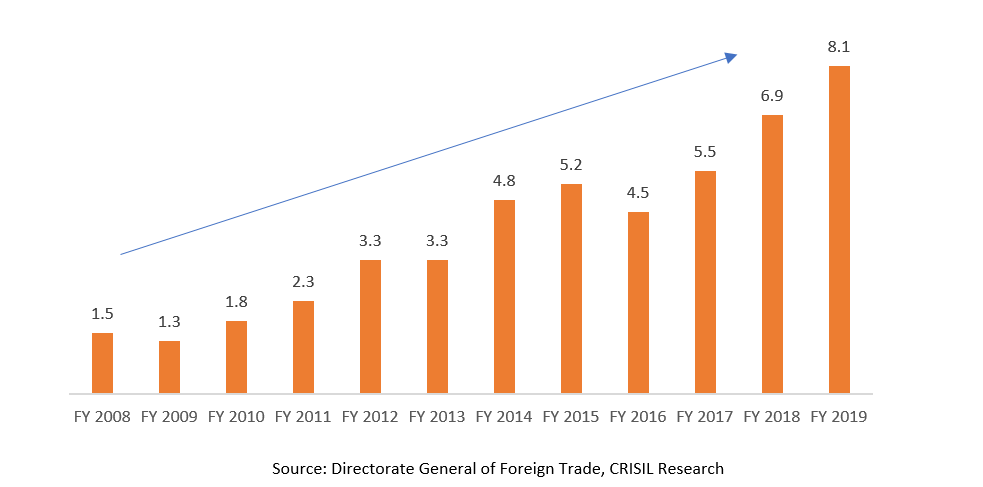 |
| Seafood exports, incl shrimps set to cross $8 billion in fiscal 2019 |
"The strong uptick in demand for Indian shrimps in the recent past was attributed to weak production in other major Asian shrimp producing nations such as Thailand and Vietnam. Going forward, Indian exporters face stiff competition from Ecuador, Indonesia, and Vietnam”. Ecuador's various investments (eg. automation of feeding) have realized a phenomenal jump in shrimp production. It has become a major player and rival to the Asian nations. Link
Prices have been volatile due to mismatches in demand and production in top shrimp trading nations. But, the Indian domestic market has absorbed more farmed shrimp in 2018, as and when international sales have slowed down. Link

Farmed Shrimps in Dec 2019
India's farmed shrimp production, which was expected to fall, showed a 7% growth in the first 8 months of 2019. "India's production is closing in on 1 mt, even as issues such as chronic disease are adversely impacting shrimp farming communities. I don't see any surprises coming up here for the next 2-3 years". Link
Most of India's production is exported. Around 40% of Indian shrimp goes to the US market and around 28 percent as headless and easy-peel shrimps. From looking at month-by-month US imports, India continues to dominate in the US market. China has grown to be the second biggest market for India. Japan is the major market for Black Tiger shrimp with a share of 49.4% in revenues.
Prospective shrimps and fisheries exports
The chairman of MPEDA said India's goal is to now grow annual aquacultural exports to $15billion in 5 years from an already impressive $7billion in 2019 and to take India's share of world seafood exports from 4.1% to 6.7% by 2030. India will aim to raise productivity from 5 to10mt/ha, expand areas, diversify species and look at infra, value addition, brand promotions, and trade promotions. Link
He said the aquacultural area has grown 800% over the last decade, but total area utilized is just 15 percent. India will diversify shrimp production beyond Pacific whites or Litopenaeus vannamei, and start exporting black tiger prawns in large quantities in the next 2 to 3 years. Further investments in advanced farms, hatcheries, and cold storage and more third-party certification for producers will increase exportable surpluses. There is huge scope to grow value-added products in the next few years, up from 5% currently. And looking beyond shrimps, "there is enormous scope for new finfish species, including tilapia in freshwater and cobia and sea bass in seas along the country’s vast coastline".
Black Tiger shrimps, MAC & microbiology labs Link Link
MPEDA is wanting to keep up the pace of shrimp production and yet avoid over-exploitation & over-dependence on L. vannamei, as this species has wreaked havoc through disease in rest of Asia. Also, rising prices and strong international demand for black tiger shrimps have lead to clamour to restart its farming. In the interim, MPEDA was able to research and develop the new "high-health" black tiger shrimp seeds at Rajiv G. Centre and has started distributing them since 2018. They are produced at MPEDA's new hatchery called MAC (or "multi-species aquaculture complex"), a 9-acres facility opened 2018 and based in Valladam, Kerala. MCA caters mainly for black tiger shrimp seeds but also has 6 nurseries for raising fingerlings such as GIFT tilapia, Asian seabass, cobia, pompano and mud crab. New microbiology labs, such as at Kochi inaugurated in Feb 2020, will help exporters to match up on quality demands.
The global shrimp production has increased at a CAGR of 3.2% during the period 2011-2017. The top 5 producers are from Asia namely, China, India, Indonesia, Vietnam, and Thailand, accounting for more than 80% of the total global shrimp production. These regions gained from access to large coastal belts, ambient climate, and suitable temperatures to cultivate shrimp. The domestic demand has taken away most of the surpluses in China and SE Asian countries like Indonesia. But, the low consumption of shrimps in India has meant that 80% or more of its production is exported to large markets around the world.
Due to this, India has established a massive prominence within the sector. India is now the largest exporter of shrimp with a 23% share of the total global export volumes. Global demand comes from major developed countries. USA, Europe, and Japan together account for 63% of total global shrimp imports as they have a large and growing demand base and insufficient production sources domestically. Thus, more than 70% of Indian exports are sent to the US (1st), Europe (2nd), and Japan (4th).
The rise of Indian Aquaculture Link Link
Whilst Rest of Asia was suffering from a massive plunge in shrimp production, as seen in China (60% fall in 2016), Thailand (65% below peak) & Vietnam (40% below peak), India was left unscathed. Asia was battling structural deficiencies like disease, labour issues, environmental norms, inadequate freshwater resources, and illegal fishing whereas Indian aquaculture prospered, mainly due to the low-density fishing approach and high quality throughout the value chain. For example, Indian farmers used resilient specific pathogen-free (SPF) brood-stock, that was imported from the US.
Not only had Indian firms doubled shrimp production (in 5 years to March 2017) and grabbed the leading global export share, but they had also strengthened their balance sheets. In 2017, CISIL predicted shrimp exports from India would double to nearly $7 billion by 2022. It said India had the ability to overcome the Asian comeback and its own rising domestic consumption, mainly due to the buoyant international demand, attention to quality and product development, and an increase of area under aquaculture (in AP, WB, Odisha, Gujarat - Gujarat is marred by higher salinity).
India has a natural advantage in the aquaculture sector. Freshwater resources comprising ponds and tanks amount to 2.43 m ha. The other resources readily available for the seafood industry players are natural lakes, reservoirs, irrigation canals and paddy fields and it boasts of 1.19 mn hectare area under brackish water.
India is the second-largest fish producing country in the world with an annual production of about 12.6 mt (2018), and it is aimed to increase it to 15.00 mt by 2020. In 2017, India was the largest exporter of the shrimp followed by Ecuador and South America.
Indian Industry Dynamics and increased Productivity
Indian shrimp's share in global exports has risen from 6% in 2009 to 23% in 2018. The production has been growing at 27% per annum, starting from just 97,000 tonnes and reaching 690,000 tonnes. The total industry value in 2018 is estimated at $4.3 billion. Positively, the total area under cultivation has increased by a small fraction, from 102,000 ha to 152,000 ha, indicating there was a strong leap in productivity in this period from 1 tonne/ ha to 4.5 tonnes/ ha.
These productivity improvements have helped the country to establish itself as the second-largest aquaculture producer in the world:
1. Modern aquaculture farms – Massive capacity building of modern facilities by large organized sector along the coastline, particularly in Andhra Pradesh which has large access to brackish water, has significantly improved productivity. It has improved disease control protocols compared to traditional aquaculture farms.
2. Growth in production of L. Vannamei species – L. Vannamei shrimp is not only popular but it is significantly easier to breed than other breeds like Tiger Shrimp, as they can be reared in higher densities and have a higher level of tolerance to different levels of water salinity. Production share of L. Vannamei shrimp in India, which was less than 5% of total shrimp production in 2010, has jumped to around 90% in 2018.
3. Use of High-Quality Feeds – High-quality shrimp feeds, made by large domestic organized players, have helped the shrimp industry maintain high-quality and improving productivity.
4. Government Support – The Marine Products Export Development Authority (MPEDA) has been providing the industry with a supportive policy framework, initiatives, and environment to help improve the industry’s productivity and quality. Going forward, the body has set a target to grow the value of the industry to USD 10 billion.
Indian Industry Outlook
The rise of the Indian shrimp industry has propelled it to take a central role in the global industry supply. However, the fast-growing exports from India have resulted in a decline in price realization of shrimp in global markets by ~10-15% depending on the grade and size. Another major cause of the declining price is the slump in demand growth in major developed markets as a result of lower consumer offtake in these countries during the last few years.
 The large organized players in India are expected to further expand capacity going forward in line with the target set by the MPEDA to grow the industry to USD 10 Billion. This can play a party pooper and has the potential to spoil the balance in the global market, leading to price declines in the global market.
However, we expect demand to turn around in the medium term, in light of the growing trend of health consciousness. Shrimp demand is expected to see an uptick in developed markets due to its high appeal in the seafood basket and nutritional value. Furthermore, amongst the large exporters, an increase in domestic demand in China is expected to shrink the surplus production available for export and the major South-East Asian exporters are expected to grow exports, only marginally, in line with the overall industry growth. The slowing of exports from other major supplying markets should arrest the current downward trajectory in prices and can stabilize the same.
In light of the same, we believe that Indian exporters will be able to fill a larger share of the expected demand growth in the medium term. The large Indian shrimp manufacturers are also complying with stringent quality standards globally which can help them export a greater volume of exports to other developed and emerging regions globally. This indicates that the future can bear a major role in the fast-growing Indian aquaculture industry in fulfilling global shrimp supplies.
Global outlook for aquaculture Link

India's farmed shrimp production, which was expected to fall, showed a 7% growth in the first 8 months of 2019. "India's production is closing in on 1 mt, even as issues such as chronic disease are adversely impacting shrimp farming communities. I don't see any surprises coming up here for the next 2-3 years". Link
Most of India's production is exported. Around 40% of Indian shrimp goes to the US market and around 28 percent as headless and easy-peel shrimps. From looking at month-by-month US imports, India continues to dominate in the US market. China has grown to be the second biggest market for India. Japan is the major market for Black Tiger shrimp with a share of 49.4% in revenues.
Prospective shrimps and fisheries exports
The chairman of MPEDA said India's goal is to now grow annual aquacultural exports to $15billion in 5 years from an already impressive $7billion in 2019 and to take India's share of world seafood exports from 4.1% to 6.7% by 2030. India will aim to raise productivity from 5 to10mt/ha, expand areas, diversify species and look at infra, value addition, brand promotions, and trade promotions. Link
He said the aquacultural area has grown 800% over the last decade, but total area utilized is just 15 percent. India will diversify shrimp production beyond Pacific whites or Litopenaeus vannamei, and start exporting black tiger prawns in large quantities in the next 2 to 3 years. Further investments in advanced farms, hatcheries, and cold storage and more third-party certification for producers will increase exportable surpluses. There is huge scope to grow value-added products in the next few years, up from 5% currently. And looking beyond shrimps, "there is enormous scope for new finfish species, including tilapia in freshwater and cobia and sea bass in seas along the country’s vast coastline".
Black Tiger shrimps, MAC & microbiology labs Link Link
MPEDA is wanting to keep up the pace of shrimp production and yet avoid over-exploitation & over-dependence on L. vannamei, as this species has wreaked havoc through disease in rest of Asia. Also, rising prices and strong international demand for black tiger shrimps have lead to clamour to restart its farming. In the interim, MPEDA was able to research and develop the new "high-health" black tiger shrimp seeds at Rajiv G. Centre and has started distributing them since 2018. They are produced at MPEDA's new hatchery called MAC (or "multi-species aquaculture complex"), a 9-acres facility opened 2018 and based in Valladam, Kerala. MCA caters mainly for black tiger shrimp seeds but also has 6 nurseries for raising fingerlings such as GIFT tilapia, Asian seabass, cobia, pompano and mud crab. New microbiology labs, such as at Kochi inaugurated in Feb 2020, will help exporters to match up on quality demands.
Global shrimps overview, Indian industry, and Outlooks Link
Asian dominance in global shrimp production
Aquaculture has grown at 6% in 15 years between 2001-16. As a result of the fast growth, its share of total fisheries has jumped from 25% to 45%. Captive fisheries, on the other hand, is debilitated by over-fishing. Shrimp production (derived from aquaculture) now forms a sizeable 7% of production volumes of the global fisheries and is classified as a high-value species with large trading volumes.The global shrimp production has increased at a CAGR of 3.2% during the period 2011-2017. The top 5 producers are from Asia namely, China, India, Indonesia, Vietnam, and Thailand, accounting for more than 80% of the total global shrimp production. These regions gained from access to large coastal belts, ambient climate, and suitable temperatures to cultivate shrimp. The domestic demand has taken away most of the surpluses in China and SE Asian countries like Indonesia. But, the low consumption of shrimps in India has meant that 80% or more of its production is exported to large markets around the world.
Due to this, India has established a massive prominence within the sector. India is now the largest exporter of shrimp with a 23% share of the total global export volumes. Global demand comes from major developed countries. USA, Europe, and Japan together account for 63% of total global shrimp imports as they have a large and growing demand base and insufficient production sources domestically. Thus, more than 70% of Indian exports are sent to the US (1st), Europe (2nd), and Japan (4th).
The rise of Indian Aquaculture Link Link
Whilst Rest of Asia was suffering from a massive plunge in shrimp production, as seen in China (60% fall in 2016), Thailand (65% below peak) & Vietnam (40% below peak), India was left unscathed. Asia was battling structural deficiencies like disease, labour issues, environmental norms, inadequate freshwater resources, and illegal fishing whereas Indian aquaculture prospered, mainly due to the low-density fishing approach and high quality throughout the value chain. For example, Indian farmers used resilient specific pathogen-free (SPF) brood-stock, that was imported from the US.
Not only had Indian firms doubled shrimp production (in 5 years to March 2017) and grabbed the leading global export share, but they had also strengthened their balance sheets. In 2017, CISIL predicted shrimp exports from India would double to nearly $7 billion by 2022. It said India had the ability to overcome the Asian comeback and its own rising domestic consumption, mainly due to the buoyant international demand, attention to quality and product development, and an increase of area under aquaculture (in AP, WB, Odisha, Gujarat - Gujarat is marred by higher salinity).
India has a natural advantage in the aquaculture sector. Freshwater resources comprising ponds and tanks amount to 2.43 m ha. The other resources readily available for the seafood industry players are natural lakes, reservoirs, irrigation canals and paddy fields and it boasts of 1.19 mn hectare area under brackish water.
India is the second-largest fish producing country in the world with an annual production of about 12.6 mt (2018), and it is aimed to increase it to 15.00 mt by 2020. In 2017, India was the largest exporter of the shrimp followed by Ecuador and South America.
Indian Industry Dynamics and increased Productivity
Indian shrimp's share in global exports has risen from 6% in 2009 to 23% in 2018. The production has been growing at 27% per annum, starting from just 97,000 tonnes and reaching 690,000 tonnes. The total industry value in 2018 is estimated at $4.3 billion. Positively, the total area under cultivation has increased by a small fraction, from 102,000 ha to 152,000 ha, indicating there was a strong leap in productivity in this period from 1 tonne/ ha to 4.5 tonnes/ ha.
These productivity improvements have helped the country to establish itself as the second-largest aquaculture producer in the world:
1. Modern aquaculture farms – Massive capacity building of modern facilities by large organized sector along the coastline, particularly in Andhra Pradesh which has large access to brackish water, has significantly improved productivity. It has improved disease control protocols compared to traditional aquaculture farms.
2. Growth in production of L. Vannamei species – L. Vannamei shrimp is not only popular but it is significantly easier to breed than other breeds like Tiger Shrimp, as they can be reared in higher densities and have a higher level of tolerance to different levels of water salinity. Production share of L. Vannamei shrimp in India, which was less than 5% of total shrimp production in 2010, has jumped to around 90% in 2018.
3. Use of High-Quality Feeds – High-quality shrimp feeds, made by large domestic organized players, have helped the shrimp industry maintain high-quality and improving productivity.
4. Government Support – The Marine Products Export Development Authority (MPEDA) has been providing the industry with a supportive policy framework, initiatives, and environment to help improve the industry’s productivity and quality. Going forward, the body has set a target to grow the value of the industry to USD 10 billion.
Indian Industry Outlook
The rise of the Indian shrimp industry has propelled it to take a central role in the global industry supply. However, the fast-growing exports from India have resulted in a decline in price realization of shrimp in global markets by ~10-15% depending on the grade and size. Another major cause of the declining price is the slump in demand growth in major developed markets as a result of lower consumer offtake in these countries during the last few years.
However, we expect demand to turn around in the medium term, in light of the growing trend of health consciousness. Shrimp demand is expected to see an uptick in developed markets due to its high appeal in the seafood basket and nutritional value. Furthermore, amongst the large exporters, an increase in domestic demand in China is expected to shrink the surplus production available for export and the major South-East Asian exporters are expected to grow exports, only marginally, in line with the overall industry growth. The slowing of exports from other major supplying markets should arrest the current downward trajectory in prices and can stabilize the same.
In light of the same, we believe that Indian exporters will be able to fill a larger share of the expected demand growth in the medium term. The large Indian shrimp manufacturers are also complying with stringent quality standards globally which can help them export a greater volume of exports to other developed and emerging regions globally. This indicates that the future can bear a major role in the fast-growing Indian aquaculture industry in fulfilling global shrimp supplies.
Global outlook for aquaculture Link
Key highlights were that global shrimp production will be 11% higher in 2021 compared to 2018, slowing from growth of 4.5% pa. Diseases, trade wars and unclear production data from China make future market conditions difficult to predict. Ecuador had achieved a 38% production increase in 2019, which is "unbelievable that the second-biggest supplier can do it in a low-price market.” A commentator noted that the sector was very competitive, where "supply and demand – supplies and suppliers – can switch quickly".
India is a relatively low user of antibiotics and will remain that way in 2030

No comments:
Post a Comment