Make-over of Discoms
Data from UDAY website
1. Operational performance: 100% scores were achieved in 5/ 9 criteria, namely feeder metering (urban & rural), rural feeder audit, household connections and LED bulbs. Others:
Feeder segregation 84%
DT metering (urban) 88%
DT metering (rural) 62%
Smart metering 5% (non-starter for most states)
Overall AT&C losses 21.35% & ACS - ARR gap Rs 0.38/unit loss
| 18.1% | -0.12 |
Good shape
| |
| Karnataka | 14.8% | -0.12 |
Good shape
| |
| Himachal | 7.4% | -0.07 |
Good shape
| |
| Gujarat | 10.2% | -0.04 |
Good shape
| |
| Uttarakhand | 31.7% | 0.01 |
Good shape
|
| Goa | 11.9% | 0.05 | Good shape |
Can make profits if AT&C losses are tackled with 100% smart metering, etc (good to poor)
| Chhattisgarh | 43.8% | 0.21 |
High Potential
|
| Jharkhand | 37.1% | 0.22 |
High Potential
|
| Uttar Pradesh | 33.1% | 0.13 |
Good Potential
|
| Tripura | 23.5% | 0.16 |
Aver Potential
|
| Meghalaya | 32.6% | 0.46 |
Good Potential
|
| Bihar | 35.9% | 0.61 | Good Potential |
| Madhya Pradesh | 30.1% | 0.47 |
Good Potential
|
Need for discom efficiencies, lower supply costs and/or higher prices (worst to bad)
| Jammu & Kashmir | 48.4% | 2.23 |
V High loss/ High potential
|
| Tamil Nadu | 13.6% | 1.13 |
V High loss/ Low potential
|
| Andhra Pradesh | 10.3% | 0.75 |
V High loss/ Low potential
|
| Manipur | 20.5% | 1.08 |
V High loss / Aver potential
|
| Telangana | 10.2% | 0.32 |
Moderate loss/ Low potential
|
| Kerala | 10.2% | 0.28 |
Moderate loss/ Low potential
|
| Rajasthan | 25.8% | 0.64 |
High loss/ Average potential
|
| Punjab | 28.5% | 0.66 |
High loss/ Average potential
|
| Assam | 22.1% | 0.48 |
High loss/ Average potential
|
| Haryana | 20.9% | 0.34 |
Moderate loss/ Aver potential
|

Analysis
Multiple polynomial regression (2nd-degree) tool shows a 73.5% correlation between AT&C losses (& 70.8% for unit losses) and 4 variables ie {smart metering (70.0% weighted to >500units), feeder segregation, DTmetering rural & urban}. This rises steeply if the following states are removed: Andhra Pradesh, Kerala, Jharkhand, Bihar, Uttarakhand, Meghalaya... to 99.8% (AT&C losses, wt 45-50%) and 99.96% (unit losses, wt 40-45%). In this case, the smart meter weighting can vary btw 40-50%. Online tool| vs AT&C losses | Smart Metering >500 | Smart Metering 200-500 | Feeder Segregation | DT metering urban | DT metering rural | ||
| Full state list | -24.15% | -11.49% | 9.01% | -24.79% | -39.52% | ||
| Restricted state list | -24.32% | -9.49% | 2.17% | -47.56% | -46.57% | ||
vs ACS - ARR | |||||||
| Full state list | -5.69% | -15.60% | -13.77% | -19.25% | -33.59% | ||
| Restricted state list | -8.21% | -18.28% | -25.60% | -19.90% | -39.38% |
 |
| Five parameters increase in step from 0% (none completed) to 100% (all completed). AT&C is first imputed by MLR, then added to Unit cost MLR analysis. "Yellow Star" marks the current situation (53% completed) - fully in sync. |
States can achieve govt's stated targets (ie nil unit losses & 12% or less AT&C losses) by completing 90% of the work. But there is much more to be done.
MLR analysis shows that AT&C losses affect unit losses independently of the 5 parameters. These additional factors are likely to be billing efficiency (ie. ability to collect 100% of electricity dues) & technical line losses. In other words, AT&C loss reduction is not only about accurately recording electricity usage, reducing the scope to cheat and early disconnections of defaulters.
Reasons for unit losses are many and more varied (eg level of subsidy not refunded, tariff revisions, cost of supply, apportionment of investment & levels of investment, financial efficiency of discoms). Whilst underpricing of electricity for political gain is also there, discoms can manage to eliminate unit losses if the fundamentals of operational & billing efficiency are tackled.
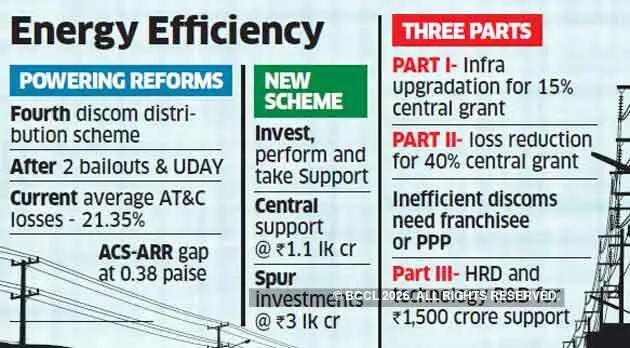
Government proposes a grant of Rs 1.1 lakh crore for state discoms
Discoms are facing heavy losses and are unable to invest in infrastructure upgrades. Earlier discom restructuring schemes have failed to control losses. The centre is proposing a new scheme that is expected to bring Rs 3 lakh crore into the sector.
It wants state discoms to start with a massive Rs 230,000cr investment in smart meters. Centre is contributing 15% or up to Rs34,500cr and state govts will add Rs 25,000cr.
Discoms must also take decisive action on billing and operational inefficiencies. Discoms with large losses first have to make institutional changes in the way they are run. The target for discoms is to not make overall losses and peg AT&C losses to 12% or less.
After billing efficiency, financial measures and smart meters have sufficiently stabilised the operating cashflows, Govt proposes a 60% grant or Rs 85,000cr for loss reduction measures like feeder segregation & aerial bunch cabling. Grant can be used to pay overdue bills, but discoms will want to keep investing as there is an incentive for over-achieving the targets for loss reduction.
On the other hand, discoms that fail to meet targets will face a consequence. In effect, states will lose absolute control over discoms. They have to go for a new arrangement, which is either a PPP model or private franchise model.
Lastly, Centre wants discoms to have a long-term vision of new technology infusion and human resource development. Rs 1,500cr is set aside for this.
It wants state discoms to start with a massive Rs 230,000cr investment in smart meters. Centre is contributing 15% or up to Rs34,500cr and state govts will add Rs 25,000cr.
Discoms must also take decisive action on billing and operational inefficiencies. Discoms with large losses first have to make institutional changes in the way they are run. The target for discoms is to not make overall losses and peg AT&C losses to 12% or less.
After billing efficiency, financial measures and smart meters have sufficiently stabilised the operating cashflows, Govt proposes a 60% grant or Rs 85,000cr for loss reduction measures like feeder segregation & aerial bunch cabling. Grant can be used to pay overdue bills, but discoms will want to keep investing as there is an incentive for over-achieving the targets for loss reduction.
On the other hand, discoms that fail to meet targets will face a consequence. In effect, states will lose absolute control over discoms. They have to go for a new arrangement, which is either a PPP model or private franchise model.
Lastly, Centre wants discoms to have a long-term vision of new technology infusion and human resource development. Rs 1,500cr is set aside for this.
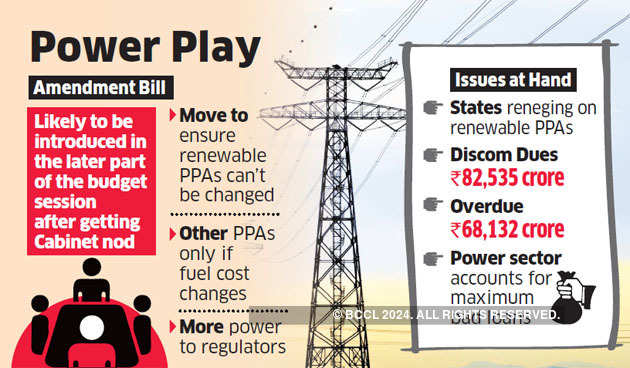
1. Change in Electricity Act to prevent states from reneging on power contracts
Renewable energy contracts are only entered into once a tender is called and bids are accepted by states. A unilateral violation of the contract, that robs investors of their hard-earned returns, is not acceptable. It is a case of abuse of power -- and the state govt knows it. Unfortunately, it also leads to "bad apples destroying the party for the rest".
2. An Act of parliament to tackle gross non-payment by state discoms
No industry can countenance unpaid dues of Rs 82,000cr which is what state discoms have notched up against power generating companies. The culprits (ie. state govts) are behaving like nutcases that have lost commonsense, or like little children that need a parent to discipline them. "The accumulated dues have to be settled to ensure the viability of power producers and the sector” -- very true, and which makes states' actions very short-sighted.
3. Discoms need more regulation for bad behaviour and help with unforeseen problems
The outcome of not being able to control oneself, or wilfully behaving badly, is more regulation. And a right for the aggrieved party to appeal regulatory decisions to the Appellate Tribunal. A separate resolution court may be set up to resolve unforeseen issues between discoms and power generating companies in a time-bound manner.
| Smart Metering >500U | Smart Metering 200-500U | Feeder Segregation |
DT
metering urban
|
DT metering rural
| AT&C loss |
ACS-ARR loss Rs/unit
| ||
| Karnataka | 0% | 1% | 100% | 100% | 80% | 14.85% | -0.12 | |
| Maharashtra | 0% | 0% | 100% | 31% | 19% | 18.09% | -0.12 | |
| Himachal P. | 81% | 100% | 0% | 100% | 72% | 7.40% | -0.07 | |
| Gujarat | 0% | 3% | 100% | 100% | 100% | 10.25% | -0.04 | |
| Uttarakhand | 0% | 0% | 37% | 100% | 0% | 31.71% | 0.01 | |
| Goa | 0% | 0% | 0% | 94% | 94% | 11.87% | 0.05 | |
| Uttar Pradesh | 0% | 91% | 80% | 100% | 8% | 33.14% | 0.13 | |
| Tripura | 42% | 46% | 0% | 65% | 46% | 23.52% | 0.16 | |
| Chhattisgarh | 0% | 0% | 38% | 71% | 50% | 43.77% | 0.21 | |
| Jharkhand | 0% | 0% | 43% | 100% | 100% | 37.14% | 0.22 | |
| Kerala | 0% | 0% | 0% | 76% | 80% | 10.22% | 0.28 | |
| Telangana | 15% | 1% | 9% | 100% | 100% | 10.20% | 0.32 | |
| Haryana | 15% | 0% | 100% | 66% | 7% | 20.87% | 0.34 | |
| Meghalaya | 2% | 3% | 100% | 100% | 41% | 32.59% | 0.46 | |
| Madhya P. | 23% | 12% | 100% | 43% | 100% | 30.13% | 0.47 | |
| Assam | 38% | 10% | 22% | 100% | 38% | 22.07% | 0.48 | |
| Bihar | 0% | 0% | 100% | 100% | 34% | 35.90% | 0.61 | |
| Rajasthan | 58% | 0% | 32% | 25% | 0% | 25.84% | 0.64 | |
| Punjab | 0% | 0% | 99% | 63% | 1% | 28.52% | 0.66 | |
| Andhra P. | 0% | 0% | 100% | 94% | 53% | 10.29% | 0.75 | |
| Manipur | 38% | 57% | 100% | 96% | 92% | 20.53% | 1.08 | |
| Tamil Nadu | 0% | 0% | 0% | 100% | 3% | 13.64% | 1.13 | |
| Jammu &K. | 0% | 0% | 0% | 52% | 0% | 48.38% | 2.23 |


No comments:
Post a Comment