DRDO Young Scientists Labs
Powerful emerging technologies are making headway in many fields including defence. And whilst startups are a great way of bringing innovations to the market, Govt recognises the importance of doing public research to evaluate them, to fully exploit them, and to achieve self-reliance. As such, new laboratories will be set up within the DRDO, each dedicated to one such "niche advanced technologies". DRDO has selected Artificial intelligence, Quantum technologies, Cognitive technologies, Asymmetric technologies, and Smart Materials.
Five DRDO Young Scientist Labs (DYSL) were formally launched on 2nd Jan 2020, at Bengaluru, Mumbai, Chennai, Kolkata and Hyderabad. Uniquely, labs would be led by young scientists below the age of 35 years. The idea is to nurture specialisms and retain talent for decades to come. PM Modi also said more DYSL will come up in the future. The scientists from DRDO will work on designing and developing commercial, futuristic defence products from these key technologies. In the budget (Feb 2020), Govt made a special outlay of Rs 8,000cr for work on Quantum computing.
"Today's rapidly evolving technology needs to be properly assessed and its future potential ascertained with urgency. Future game-changing technologies need to be nurtured within, with funding and scientific-calibre expertise. We can no longer wait to evaluate technology once it is mature and then invest. Speed of assessment, rapid prototyping, faster evaluation and focused development are necessary."
Mumbai - "all-important area of Quantum Technology" will be based out of IIT Mumbai.
Bengaluru - "rapidly evolving Artificial Intelligence".
Chennai - "future is dependent on Cognitive Technologies" and IIT Chennai will house it.
Hyderabad - "hot and critical area of Smart Materials and their applications".
Kolkata - "new and futuristic area of Asymmetric Technology will change the way war is fought" will be based out of Jadavpur University, Kolkata.
DRDO Chairman, Dr Reddy: All 5 Young Scientists Labs were set up and functioning since April 2019. "In the next year, they will be able to come up with substantial state-of-the-art technologies of value to defence applications. Work on Artificial Intelligence has been taken up in 2 labs. Our roadmap for AI will soon be in place. I believe every weapon and equipment will be driven by AI in the coming years. There is a dearth of young talent in DRDO and we are seriously looking at ways to bring in young talent in large numbers. I feel the synergy between DRDO, academia and industry is the key."
"We have consciously quickened the pace of work: our missiles have had multiple successes last year (Astra, QRSAM, Nag and Pinaka). Many, notably HELINA, MPATGM and NGARM are entering different stages of testing this year. We have laid down an aggressive schedule for MWF (Medium Weight Fighter) and AMCA (Advanced Medium Combat Aircraft). We are sure of developing these systems in record time!! DRDO has taken major steps in operationalising Space and Cyber, which are the 4th & 5th dimension of warfare."
"We have consciously quickened the pace of work: our missiles have had multiple successes last year (Astra, QRSAM, Nag and Pinaka). Many, notably HELINA, MPATGM and NGARM are entering different stages of testing this year. We have laid down an aggressive schedule for MWF (Medium Weight Fighter) and AMCA (Advanced Medium Combat Aircraft). We are sure of developing these systems in record time!! DRDO has taken major steps in operationalising Space and Cyber, which are the 4th & 5th dimension of warfare."
Lessons from Def Expo 2020
1. DRDO is not able to do enough across all technologies.
2. DPSUs and OFB have lagged behind in innovation, quality and production throughput.
3. Govt has a multi-pronged approach for turning India from a leading importer to a net exporter!!
4. After opening up Indian exports, buyers have shown good interest in many Indian products which are comparable but cheaper. Defence exports have climbed.
5. Defence corridor states are getting heightened interest from investors.
6. Industry is finding new comfort levels in investing in India for various reasons, such as improved EODB, tax policy, FDI policy, IPP policy, licensing & offset policy, a higher chance of private sector sales to MOD.
7. Major Indian firms are manufacturing for global defence companies for mutual benefit. Offsets and technology transfer from global suppliers are helping Make-in-India.
8. Concerted efforts are being made by armed forces to help and even trial MSME products for possible orders. In turn, Indian MSME products have shown a lot of innovation, that has sparked interest in armed forces and delight in all concerned.
9. Shift towards new-age technologies such as artificial intelligence is happening. Link
10. The private sector can contribute to defence exports with its own R&D and production. For example, artillery guns under development by the Kalyani Group have elicited Saudi interest, even without Indian defence orders.
11. Critical products have most of the value and if foreign, will lead to continued import dependency. Authorities should be supportive of Indian R&D efforts, done by the public or private sector. They should bear in mind that defence R&D is capital intensive with high uncertainty of success, and the private sector is not too keen on it without incentives.
12. Firm orders from MOD for Indian products will support Indian defence ecosystem and help in exports. It would help if Indian-designed and made products are inducted early, even if a little short of global standards & errors rectified along the way. Or, MOD should subsidize further R&D for making improvements to them.
--------------------------------------------
1. DRDO is not able to do enough across all technologies.
2. DPSUs and OFB have lagged behind in innovation, quality and production throughput.
3. Govt has a multi-pronged approach for turning India from a leading importer to a net exporter!!
4. After opening up Indian exports, buyers have shown good interest in many Indian products which are comparable but cheaper. Defence exports have climbed.
5. Defence corridor states are getting heightened interest from investors.
6. Industry is finding new comfort levels in investing in India for various reasons, such as improved EODB, tax policy, FDI policy, IPP policy, licensing & offset policy, a higher chance of private sector sales to MOD.
7. Major Indian firms are manufacturing for global defence companies for mutual benefit. Offsets and technology transfer from global suppliers are helping Make-in-India.
5. Defence corridor states are getting heightened interest from investors.
6. Industry is finding new comfort levels in investing in India for various reasons, such as improved EODB, tax policy, FDI policy, IPP policy, licensing & offset policy, a higher chance of private sector sales to MOD.
7. Major Indian firms are manufacturing for global defence companies for mutual benefit. Offsets and technology transfer from global suppliers are helping Make-in-India.
8. Concerted efforts are being made by armed forces to help and even trial MSME products for possible orders. In turn, Indian MSME products have shown a lot of innovation, that has sparked interest in armed forces and delight in all concerned.
9. Shift towards new-age technologies such as artificial intelligence is happening. Link
10. The private sector can contribute to defence exports with its own R&D and production. For example, artillery guns under development by the Kalyani Group have elicited Saudi interest, even without Indian defence orders.
11. Critical products have most of the value and if foreign, will lead to continued import dependency. Authorities should be supportive of Indian R&D efforts, done by the public or private sector. They should bear in mind that defence R&D is capital intensive with high uncertainty of success, and the private sector is not too keen on it without incentives.
10. The private sector can contribute to defence exports with its own R&D and production. For example, artillery guns under development by the Kalyani Group have elicited Saudi interest, even without Indian defence orders.
11. Critical products have most of the value and if foreign, will lead to continued import dependency. Authorities should be supportive of Indian R&D efforts, done by the public or private sector. They should bear in mind that defence R&D is capital intensive with high uncertainty of success, and the private sector is not too keen on it without incentives.
12. Firm orders from MOD for Indian products will support Indian defence ecosystem and help in exports. It would help if Indian-designed and made products are inducted early, even if a little short of global standards & errors rectified along the way. Or, MOD should subsidize further R&D for making improvements to them.
--------------------------------------------
--------------------------------------------
Major General (Retd) Harsha Kakar
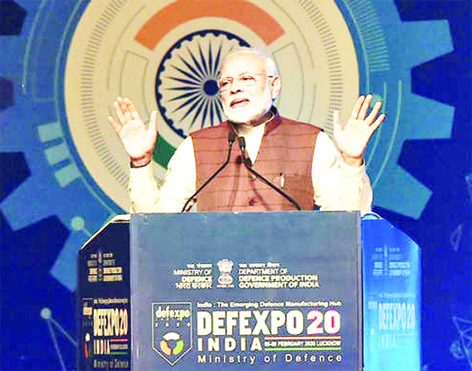
The Def Expo held last week at Lucknow provided a glimpse of the strides made by the Indian private sector in defence research and development. It was less than two decades ago that this sector was opened for private industries and entrepreneurs. Till then, defence was considered a holy cow with research, development and production controlled by the Defence Research and Development Organization (DRDO), Defence Public Sector Undertakings and the Ordnance Factory Board (OFB). Presently, with the government concentrating on Make in India, it is the private sector which was most keenly observed in the Def Expo.
The theme for current Def Expo was ‘India: the emerging defence manufacturing hub’ and was focused on ‘digital transformation of defence’. India is currently the world’s second-largest importer of defence equipment, after Saudi Arabia, hence major companies are keen to invest in the Indian defence market.
By projecting India as the emerging defence manufacturing hub, the government hopes to transfer the latest technology from across the globe to Indian manufacturers, expand ‘make in India’ and turn India into a net defence equipment exporter, rather than an importer. Digital Transformation of Defence implies the importance of technology in future warfare. The event also showcased Indian military power in live demonstrations and flypast of airpower.
Indian MSME products on display included modern fencing for securing Indian borders linked with sensors and camera to artillery guns developed inhouse to sniper rifles and drones. Army establishments like the College of Military Engineering displayed their own designed and presently under production bulletproof jackets with the capability to withstand a sniper bullet to the Electrical and Mechanical Engineering School at Baroda, which proudly projected its own fault-finding system incorporated into the newly inducted Vajra artillery gun.
The DRDO and OFB had their own products on display including the Brahmos missiles, Anti Satellite systems, remote-controlled vehicles, newly inducted Dhanush guns, Akash air defence systems and upgraded combat vehicles. Many products under development were also displayed. Foreign vendors cutting across countries had brought forth their latest designed and developed equipment, hoping to enhance their foray into Indian and other developing country defence markets.
Defence Research and Development (R & D) is capital intensive with limited guarantees of success. Not many private players are willing to get involved with it on a large scale. However, the success of smaller vendors in their limited fields was laudable.
Def Expo was an eyeopener for those seeking to observe strides made by smaller Indian companies and organizations. Senior defence officials, including the Chief of Defence Staff and the Army Chief, spent immense time at Indian industry pavilions with the intention of encouraging small entrepreneurs and even accepting to provide them with an opportunity to trial evaluate their products, which could then be considered for induction.
It was also an opportunity for foreign vendors to observe Indian research and development, seek to enhance inter-company cooperation and sign tie-ups. Multiple tie-ups were signed. States which had created defence corridors saw keen interest by industries seeking to invest in the corridors. Seminars highlighting cooperation between countries and on products under development witnessed keen attendance.
The presence of international delegates added to the flavour of the Def Expo. Companies, Indian and foreign, had an opportunity to display their products globally and thereby expand their markets beyond Indian shores. Foreign delegates displayed a keen interest in available systems and sought trials in their own countries.
There are multiple lessons which could be drawn from the Def Expo. The foremost is observing that in some fields, the Indian product was matching known international brands in quality while being far lower in price. They may have some shortcomings, but being home developed and produced, they could be considered for procurement and defects rectified even during the induction phase. It also indicated the technological breakthrough Indian entrepreneurs have achieved in some fields. The encouragement and opportunity provided to these vendors would push them further for enhancing the quality of their products.
On the contrary, in a few cases, there has been an over-reliance on imported components. While they have claimed that there is a high percentage of indigenization, these have not been in critical components. This implies that costs can never come down and dependence on foreign manufacturers would continue. In such instances, the armed forces need to intervene, re-evaluate their off-set policy and seek to procure critical technologies which the Indian industry desires, rather than just investment into the Indian market.
Large Indian private defence production units displayed their products which were being manufactured for foreign defence manufacturing concerns. This would need to be encouraged as India seeks to enhance defence manufacturing exports. There would also be near similar equipment from different vendors which the armed forces would not need. An example is artillery guns under development by the Kalyani Group, Bharat 52 and Garuda V2, on which the Saudi delegation envisaged keen interest, not the Indian armed forces. Encouraging and supporting their export and trials should be undertaken by the government.
The Indian armed forces need to realise that some Indian products may not be technologically superior to those available in the international market, but unless these are considered favourably, the fledging Indian defence industry may not be encouraged to invest in defence. Once inducted the manufacturer will be willing to improve his product by investing in R & D. Further, the prototypes displayed, if suitable for Indian armed forces’ needs, could be centrally financed for further R & D to enhance quality. This would boost the Indian defence manufacturing capability.
Finally, the armed forces need to lay down their future technological requirements. They should issue a road map of developing the same by means of a strategic white paper. This would guide major private and government manufacturers to concentrate on Indian military demands. Logically, this should flow from an analysis of the armed forces' role, emanating from the national security strategy.
The Prime Minister in his opening address remarked that his aim is that Indian defence exports should touch the USD 5 billion in the next five years. This would only be possible if the armed forces and private entrepreneurs, large and small, work together. Financial support and firm orders would be of major benefit. It is only then that reliance on foreign products would reduce and India would become a net exporter, rather than remain an importer of defence equipment.
--------------------------------------------
--------------------------------------------

No comments:
Post a Comment