Railways priorities over the next 3 years
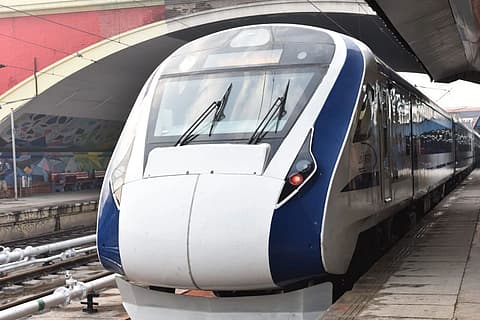
IR has already taken great strides in reshaping the railways business. The process of digitisation, modernisation, electrification, renewable power, corporatisation, private sector participation and asset utilisation will continue, as will its focus on network expansion, competitive freight rates and quality upgrades for passengers and freight.
Over the last 7 years, Govt has proactively invested huge resources in the expectation of creating a robust, world-class railways enterprise that also truly benefits all types of passengers and freight. For example, huge annual budgetary allocations have gone towards never-before-seen improvements in infrastructure, passenger amenities and production unit competencies.
Inter alia IR work is about building freight capacity, connecting remote areas/ strategic border states and industrial centres; doubling, uni-gauging and electrification of tracks, eliminating level crossings, completing the backlog of track and bridge maintenance, moving trains at higher speeds and keeping great punctuality, adding amazing & ergonomic coaches and modern high-HP locos, eliminating accidents to reach zero passenger deaths, installing AI surveillance and public Wifi, and giving 21st-century comforts and services to passengers.
In the next 3 years, IR will complete major projects like a semi-HSR corridor from Mumbai to Kolkata (via Delhi), and it will be embedding new ideas like operating premium passenger services through the private sector and using newly-acquired 5 MHz spectrum in 700 MHz frequency to its fullest extent in digitisation, signalling and safety.
This article talks about three areas of special interest for the IR.
These are station redevelopment, Vande Bharat trainsets (on lots of key passenger routes across India) and accident prevention measures like TCAS. It will be a chance for the Govt to redeem itself for Vande Bharat delay and prove it's credentials on Atmanirbhar Bharat by not importing the ETC Level-2 signalling from Europe.
If done properly, these initiatives will give a very favourable view of the Govt and IR transformation in particular. In other words, whether people like the Govt or not, they will be chuffed at the visuals and will be wanting to give the railways a ride. Let's see!
◙ Fast track manufacture of Vande Bharat coaches to add 600 in 2022-23 and 1000 in 2023-24.
◙ Complete overhaul 10s of busy railways stations, along with commercial RE development.
◙ Expand at a fast pace (from a pilot project), and cover the entire rail network with an indigenous ultra-modern signalling system (TCAS or train collision avoidance system).
Project Raftar
Project Rafter is a holistic endeavour aimed to raise passenger train speeds by 25kmph (& double freight train speeds) by 2022. It has been delayed due to COVID. PDF goes into details.
1) Removing bottlenecks
— Infra to remove permanent speed limits, eg. remove level crossings, track renewals, bridge maintenance, etc
— Complete unigauging & electrification to reduce changeover delays
2) Operational changes
— Operational changes to divert traffic (eg. economic measures); timetabling / time blocks for slow freight trains
— Increase throughput, eg longer freight trains, higher HP locos. Electric trainsets or MEMUs for passenger & mail trains will speed up acceleration, braking, climbing and descending.
— New technologies like automated track laying & repairing machines, early detection of cracks, use of Artificial intelligence, surveillance cameras, automatic data-loggers and 4G networking.

3) Further capacity improvements
— Proliferation of faster trains/ trainsets & higher-capacity freight trains
— Power supply sytems
— Automatic signaling
— Uniform track designed for min. 130kmph, incl. fencing
— Improved intersections, stabling yards; fly-past at busy junctions; maintenance blocks (ie. redundancy) on busy routes
— Build alternative routes & multiple rails on same track
This article talks about the semi-HSR upgrade for Delhi-Mumbai and Delhi-Howrah routes, a stretch of 3,008km. It is designed to run trains at 160 kmph and costs Rs 5,550cr (for all civil and technical works). Operational date is March 2024.
Realignment of curves, other track upgrades and ROB/ RUB at all level-crossings are essential requirements. Concrete wall barriers will be used - for stopping trespass - as barbed fence is liable to be stolen! Technical work involves signalling upgradation and strengthening of power supply. For the latter, OHE upgradation (over-head equipment) will deliver higher power flow to operate semi-HSR trains. 44 Taction sub-station (TSS) will also be installed.

No comments:
Post a Comment