Featured Post

Visit arvindagarwal2.blogspot.com for posts from 2017 to 2019

Tuesday, July 26, 2022

Tunnelling now and in the future  link

Mushrooming of new tunnelling projects, as seen over the last decade or so, was made possible by new tunnelling techniques. The speed and efficiency of the new methods, along with the massive capital expenditure and political get-go, have made a drastic change, both in the quantum of new projects, and how projects are planned and executed. 

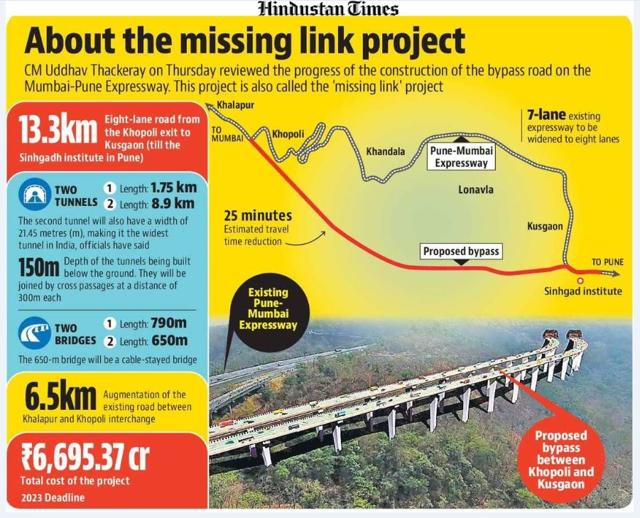
Times are changing and how! When the Mumbai-Pune expressway was built in the early 2000s, it was made to go around a mountain rather than a tunnel bored through it. Now, the "missing link" expressway is under construction to correct this deficiency (see image). 

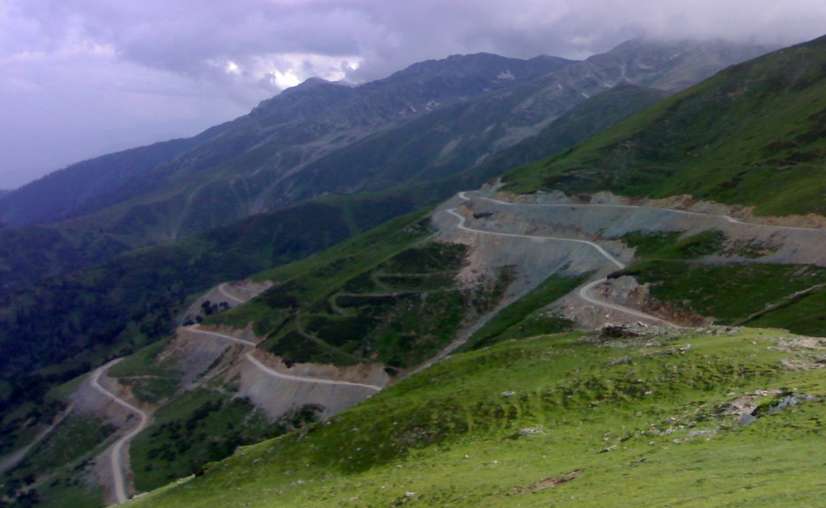
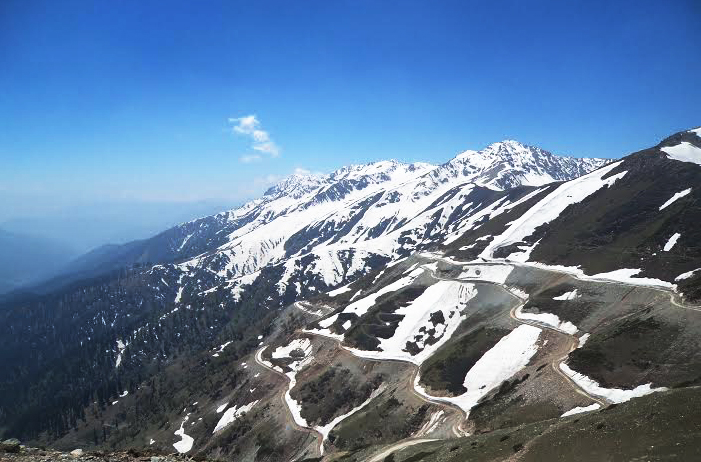
In other instances, also, tunnelling was avoided or not specified. Cut & Cover method is used for city underground infrastructure—now TBM tunnelling is the preferred method [CC has a cost advantage but causes disruption to the public]. Earlier, mountains were crossed at passes, by way of steeply ascending, winding and unsafe roads. Because of snowfall, roads were not motorable in the winter. Now a short-cut tunnel at a lower altitude is specified in all cases [eg. Sela tunnel at Sela pass, Atal tunnel at Rotung pass]. See news below:

NHIDCL invited bids for 10.3km mega-tunnel below Sinthan Pass in J&K, btw Singhpora & Vailoo. Project costs ₹3253 cr. Time 60 mo.

Notice how many expressway projects are sanctioned and how quickly they are getting completed. Contrast timelines of the Atal tunnel (9km, 2008-20), Chenani-Nashri tunnel (9km, 2011-17) and Zoji La tunnel (14.2km, 2020-25 est). Realise the audacity of two long tunnels in the Mumbai-Ahmedabad bullet train project [20km city tunnel from Thane to BKC, Mumbai; and a 21km under-sea tunnel btw Thane and Virar]

Tunnelling techniques

Conventional blasting method was used earlier but this is slow and cumbersome. Two new methods, namely TBM (tunnel boring machine) and NATM (new austrian tunelling method) are deployed in the recent times. They work well in cities [eg. metrorail] and mountainous areas [eg. border roads in Himalayas] respectively.

TBM in 57km long Metro-III tunnel from Colaba to Seepz

TBMs are preferred in cities, as they work efficiently in a limited space. TBM can do most tunnelling tasks by itself [eg. boring, shaping, stablising tunnel walls], whilst it bores and moves forward. TBM method does not need blasting by explosives; and so it would be safer to deploy in a city environment. New Austrian Tunnelling Method (NATM) is more effective and cost-efficient in challenging geologies. Eg. TBMs are unable to deal with shifting rock formations or heterogeneous rock strata of Himalayas. NATM requires specialist machines for many construction tasks, such as asboomers or jumbos; machines for shotcreting, grouting, strengthening the ground, etc.

Construction of the Chenani-Nashri tunnel used NATM technique

The Chenani-Nashri tunnel was of a complex nature as it involved cutting into Himalayan rocks, where forecasting of the rock mass is difficult due to rapidly changing geology. NATM is very useful in these complex and diversified geological conditions. Versatility is the primary benefit of NATM as it can be used for hard rock, soft rock, and blended ground conditions.

Under NATM, the tunnel was sequentially blasted, excavated and supported. Advanced tunnelling and drilling equipment were used. NATM sequences and carefully streamlines construction with regard to security, safety, and economy. 

 ~ ~ ~ ~

Improving on the present

1. Specify modern methodology in the contract: Geological engineers should lead tunnelling projects as they will support modern methods wherever such equipment is available (over conventional drilling and blasting). 

2. Made in India equipment: Major problems arise when equipment, eg TBM goes wrong. So, there is a pressing need for indigenisation. It will reduce equipment cost, increase parts availability and make more contractors use modern equipment. Key equipment such as heavy-duty loaders, Liebherr excavators (for loose strata), telehandlers, grouting pumps, Schaeff loaders, drum cutters, hydraulic crawler drill machines, side-dumping loaders.... a lot of advanced equipment for NATM.

"Ideally, we should localise the production of TBM, as this is so important for the industry. It can be done through Govt-industry collaboration and incentives for many years. Even if all the TBMs in India are imported, a lot of the ancillary components could be indigenised". See news below:

Chennai Updates 
@UpdatesChennai   30 July 2022

India’s first Tunnel Boring Machine (TBM) made by Herrenknecht at its factory in Chennai (60% localisation). TBM will be used by L&T on the stretch from Kellys to Taramani Road Jn.

3. “Slurry TBMs have a lot of potential in India in mixed geological strata [ie. TBM in challenging geology!]. 

4. Fill gaps by adding new technology products: Mobile equipment like borers, shotcrete equipment, machines that give more precision (speed up work) and equipment with safer blasting techniques (reduce risks).363

— Automated boomers can drill more accurately without any outbreak .. —  Manager measure while drilling (MWD) software for controlled blasts .. — Automated drilling increases productivity, and safety and reduces costs.. — Probing geology study (& utility mapping around excavation site) reduces costly mistakes in decision-making .. 

5. Training for operators and maintenance: Industry and government should come together to offer training through ITI-styled institutes. It works at many levels, incl imparts skills to give better performance, training to use new tech equipment, reducing equipment breakdown (as operators know how to use equipment properly), worker safety, etc. Qualified professions are also required.

Friday, July 15, 2022

Private Defence major

L&T Defence: Digitalisation finally pays off link


Precision comes into play at Larsen and Toubro’s (L&T) plantswhich manufacture defence equipment from warships, submarines, unmanned armoured systems to missileswith Industry 4.0 tools like automation, Internet of Things and artificial intelligence

Adoption of Industry 4.0

L&T Defence's orders are growing impressively. Industry 4.0, perhaps, has given L&T Defence an edge over its rivals. According to the defence market advisory firm Mordor Intelligence, the complete manufacturing ecosystems must be geared to support Industry 4.0. It means planning and investment in technologies, over and above simple cloud automation, and moving to digital platforms for basic operations.

"L&T India is one of the leaders in Industry 4.0 adoption, having adopted Industry 4.0 across its 13 engineering and manufacturing plants in India. This adoption includes internet-enabled facilities [Internet of Things], IIOT-enabled remote welding stations [robotics], in-facility logistics management [digitalisation], data-driven decision making [artificial intelligence]; forging, fabrications and equipment manufacturing [automation, 3D printing].”

Smart manufacturing

During ship metal fabrication and plate cutting, the final cutting machine is connected to a server and takes inputs from the CNC (computer numerical control). The machine follows exacting specifications with precision, by following programmed instructions and without a human operator to oversee operations. At the same time, a laser scanner keeps an eye on the dimensions and integrity, so the smallest distortion or variation from the original dimensions is corrected before the job is finished.

The precise weight of smallest nut, washer etc (and its effect on the centre of gravity of the vessel) can be critical—because otherwise the ship may lean on any one given side, or the submarine may weigh too much and lose its buoyancy. Smart manufacturing takes care of all these matters.

As much as 80-85% of the total work is completed at L&T's smart manufacturing plants. Assembly is fast and precise. Remedial work which adds weight due to extra welding, riveting, materials and parts, is kept to a minimum.

Digitalised inventory

The cost of the smallest physical fitments, used in warships and submarines, say a small lock, washer, nut or bolt runs into millions of rupees. Digitalisation of processes means accounting for every single nut, bolt and washer; and barcoding of every pipe, cable and part so they can fit in the right place during assembly. A senior L&T official says, the system has worked particularly well for submarines.

~~~~~~~

Investment in 3D design

L&T’s defence business took the path of digitalisation nearly a decade before anyone was even talking of digital. In 1992, when L&T was still a small ₹1,000 crore business, the company secured a one-time licence to build four oil and gas platforms. The deadline for the contract was 14 months, a tall order. But the signing process took two months, giving them a cycle time of 16 months, and they finished ahead of schedule. Not only did they save on LD (Liquidated Damages, which for them as beginners was 10 percent), but they also made a substantial profit. While this was a contract for what was to later become L&T Hydrocarbon (in a different department), L&T’s defence team realised the importance of using 3D rather than 2D designs for these projects, something that required considerable R&D investments.

“Profit, and my requirement to make these investments came at the same point in time. My boss at that time, KV (K Venkataramanan, then CEO and MD of L&T), was rolling in money having saved his LD and said, ‘You can’t do complex systems without a full-fledged 3D environment. And to put money behind it, we needed a couple of crores, and a couple of crores has just come.” That, says Patil paved the way for “differentiated engineering” in the company.

In 1992, they moved to 3D design. “We made an environment where you do the design and the analysis. Production was a loose end, because you couldn’t do production. After design analysis, you would take a drawing extraction (the drawing taken as an extract from the 3D models) and give it to the shop floor,” recalls Patil, who spearheaded the company’s foray in the defence sector since the inception of this segment in L&T in the mid-80s.

Considering the [security] risks associated with the sector they operated in, around 2007-08, the business migrated to looking at drawings only on screen, and the entire documentation process of making and checking too shifted to digital.
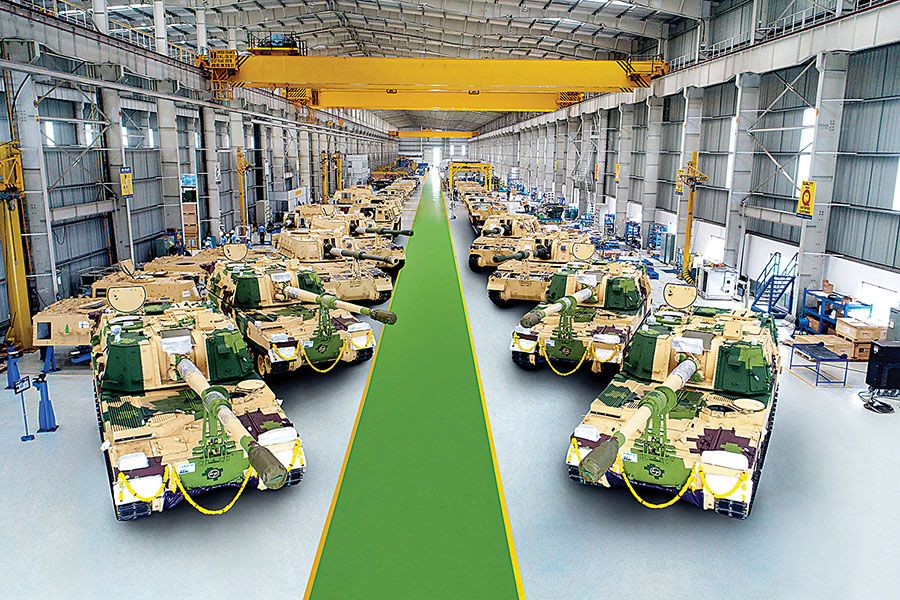
                          The K9 Vajra-T programme was executed at L&T’s Armoured Systems Complex in Hazira, Gujarat
The K9 Vajra-T programme at L&T’s Armoured Systems Complex in Hazira, Gujarat
A couple of years down the line, the investment in technology and move to 3D led to a project for full-fledged submersibles, “very complex jobs, completely undoable without 3D”. While they had been doing weapon systems for the DRDO, in 1995 they also started doing projects for the Navy. “Today there are about one-and-a-half dozen classes of weapon systems that we develop that are used by the Navy,” says Patil.

~~~~~~~

Build up of new defence R&D and manufacturing facilities

Though participation of the private sector in defence was still a few years away—the government cleared the decks in 2001—the company continued to invest in technology and build facilities. The defence business, initiated in Powai [old R&D, Mumbai], had units at Hazira in Gujarat and in Baroda  [old units], and subsequently another four full-fledged defence units were created. In 2006-07, they commissioned a factory in Talegaon near Pune for weapon and engineering  systems and equipment [new, 1] for the armed forces, while in 2010, they designed and built a shipyard in-house at Kattupalli near Chennai  [new, 2]. “We built another ultra-high precision manufacturing unit in Coimbatore  [new, 3], which then became the manufacturing unit for missile sections and systems,” says Patil. The team at Coimbatore also manages realisation of rocket motors and solid and booster stages of PSLV rockets. Another R&D centre, a satellite of the one in Mumbai, was also created in Bengaluru  [new, R&D].

The latest addition to the AM Naik Heavy Engineering Complex in Hazira is the Armoured Systems Complex (ASC)  [new, 4], a 50-acre facility created to manufacture, integrate and test advanced military armoured platforms such as self-propelled howitzers, infantry combat vehicles, future-ready combat vehicles and battle tanks. It is here that the K9 Vajra-T programme was executed, 100 K9s delivered, as per a ₹4,500 crore defence contract, to the Army ahead of schedule.

“In fact, for K9, we took Industry 4.0 and automation to a level where the first hull we produced typically took 100 hours of resources in terms of time or manpower hours. By the time we reached about the 20th, time had come down to close to 1/3rd,” says Patil. By the time they had crossed about 40 hulls, it had come down to 20 percent, and the tank programme was finished and delivered ahead of schedule.

These processes require a lot of research, development, time and effort at the design stage but they pay off amply on the shop floor. It is, says Patil, like the well-known story of the tree-cutter. “You sharpen your axe so much that you spend half the time and effort in sharpening the axe, but you cut the tree faster.”  

~~~~~~~

L&T’s defence business

L&T’s defence arm forms a small portion of the group in terms of revenue and order book. But the percentage is possibly set to grow, with its Industry 4.0, investments into technology, and government policy changes boosting Make in India. 
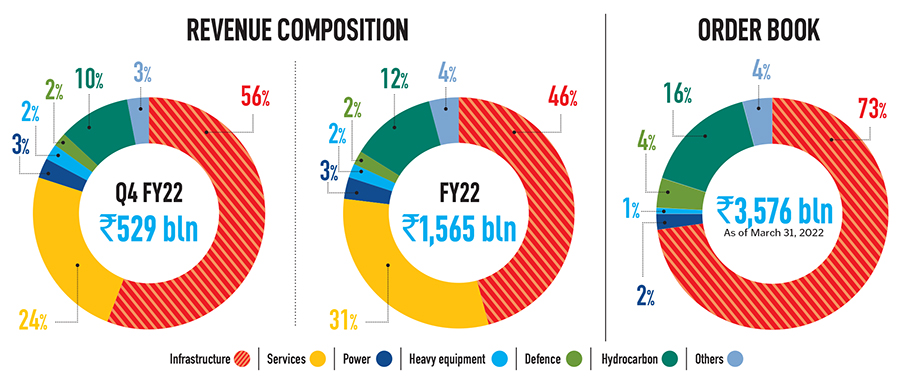
L&T Defence's digitisation is finally paying off
The government, in the Budget this year, earmarked 68 percent of capital procurement allocation for the domestic industry. “If we look at L&T defence revenues, we used to be a few thousand crores over the last four-five years. Some of this came from the government, the rest from PSUs and DRDO,” he recalls. Today, this is changing to direct revenues from Ministry of Defence contracts. “The PSU portion was large, DRDO was another large segment, and what was the smallest [government contracts] will now be the largest.

Currently, in addition to howitzers, at the Armoured Systems Complex, L&T is also indigenously developing 1500hp transmission for main battle tanks, manufacturing and delivering Sarvatra bridging systems, Akash Air Force Missile Launchers and Pinaka launchers for the defence forces. They are also one of the key suppliers of rocket motors, and solid and booster stages of PSLV rockets. According to analysts, the current aim of the Indian Space Research Organisation to produce and launch as many as three to four rockets per year will be a key factor for L&T in the next five years."

When it comes to armoured vehicles, companies like Tata and Mahindra are more dominant, but L&T’s capabilities and future procurement plans for the Navy puts it in a good position to land major supply, design and building contracts for ships and submarines in partnership with other firms, both domestic and international.

L&T and Mazagon Dock Limited have been selected as strategic partners for the Navy for the realisation of the Project-75 India programme. “L&T’s experience in ship and submarine building will be the leading factor for the company’s growth as India plans to procure numerous modern ships and submarines for the Navy, with tenders for the same expected to launch between 2022 and 2024,” points out Mordor Intelligence.

Considering the growth potential, are there any plans for expansion of manufacturing facilities and capabilities on the horizon? Patil shakes his head and laughs. “We have already invested close to ₹8,000 crore in our defence business.”
Friday, July 1, 2022

Gati Shakti initiatives 

— "Ministries are using Gati Skati national masterplan to develop project alignments. Gati Skati brings to the table, the power of technology and government working together."   link

— "In Railways, last mile connectivity is a major cause of high freight costs, and in telecoms, work is held up by messy Rights of Way conflicts with States. Now States are fully engaged and we are plugging connectivity gaps in a comprehensive way."  link

"As against our plan to meet once a month, Network Planning group has held 29 meetings in July 2022! Earlier only heads of planning depts of 7 ministries were involved, now we have 30 ministries constantly in touch with each other."

~ ~ ~ ~ ~

• GS helps identify opportunities for multimodal connectivity, and gaps in connectivity [eg. 4-lane connectivity to all districts] or infrastructure [eg. emergency helipads, suitable hospitals]. It helps avoid built-up areas (or, land acquisition problems) and minimises hazards like wide river crossings, forests, wildlife sanctuary, etc. GS identifies many other ways to optimise [eg. lay utilities/ pipelines under roads, solar panels over canals/ dams, and use of existing RoW (right of way) permits], and these can be taken up expeditiously by respective departments. 

One way to optimise is to plan for expected future growth, eg. with higher initial land acquistion, wider base construction [eg. wider bridges, wider road foundations], multi-level flyovers in cities [6-lane elevated road and overhead metro], space for HSR near/ over new expressways, and higher capacities of pipelines, transmission lines and telecom OFC. 

For example, NHAI officials held a conference to digitally draft alignments of 5 expressways at the pre-feasibility stage. They chose the Gati Skati masterplan tool: Gati Shakti helps draw an alignment in a matter of days rather than 3-4 months, and inter-departmental clearances (eg. forest) can be obtained online.

For example, Power ministry set out to develop transmission corridors for 6 statesRaj, Guj, MP, Maha, Kar, and TN— with the highest potential for renewable energy. 9 major transmission projects were identified with Gati Skati tool & mapped on the National Master Plan (NMP) portal. Most existing and under-construction transmission projects were integrated and others were finalised after route surveys by respective developers.

For example, Railways is tasked to increase freight capacity to 3 billion tonnes (2021 freight carried was just 1.23bt), as well as eliminate bottlenecks [eg. at highly congested or overused routes] and increase cost-efficiencyIt must also create sufficient rail capacity to ensure quick transport of agri products (eg foodgrains) to the hinterlandGati Shakti tool has already identified 3 routes and work has started on 1 doubling project (Rs 1120cr). 

For example, Gati Shakti is being introduced at division levels of Railway zones to further fast-track railway projects and improve local services. 4 divisions of SWR were brought under the PM’s GS initiative and work was started [remodelling yards and augmenting of terminal facilities], which is expected to enhance Bangaluru suburban services from March 2023.

• Since April 2022, finance ministry mandates all public projects over Rs 500 crore to set out details of logistics and infrastructure connectivity. So, all public-funded projects will be examined by an inter-ministerial body under the PM GatiShakti [Network Planning Group].

~ ~ ~ ~ ~
Earlier version of Gati Shakti used in Gujarat   link  Innovative solution to Gujarat's water crisis

From the article:
"The planning of complex infrastructure projects follows satellite mapping. The delays .. from forest approvals, protected coastal zones, wildlife zones, approvals from different departments like railways, etc. are all sorted at the conception stage itself ... Route planning was done to avoid approvals where possible and appovals were fast-tracked and made online, since all domain ministries and departments are present on the same portal."

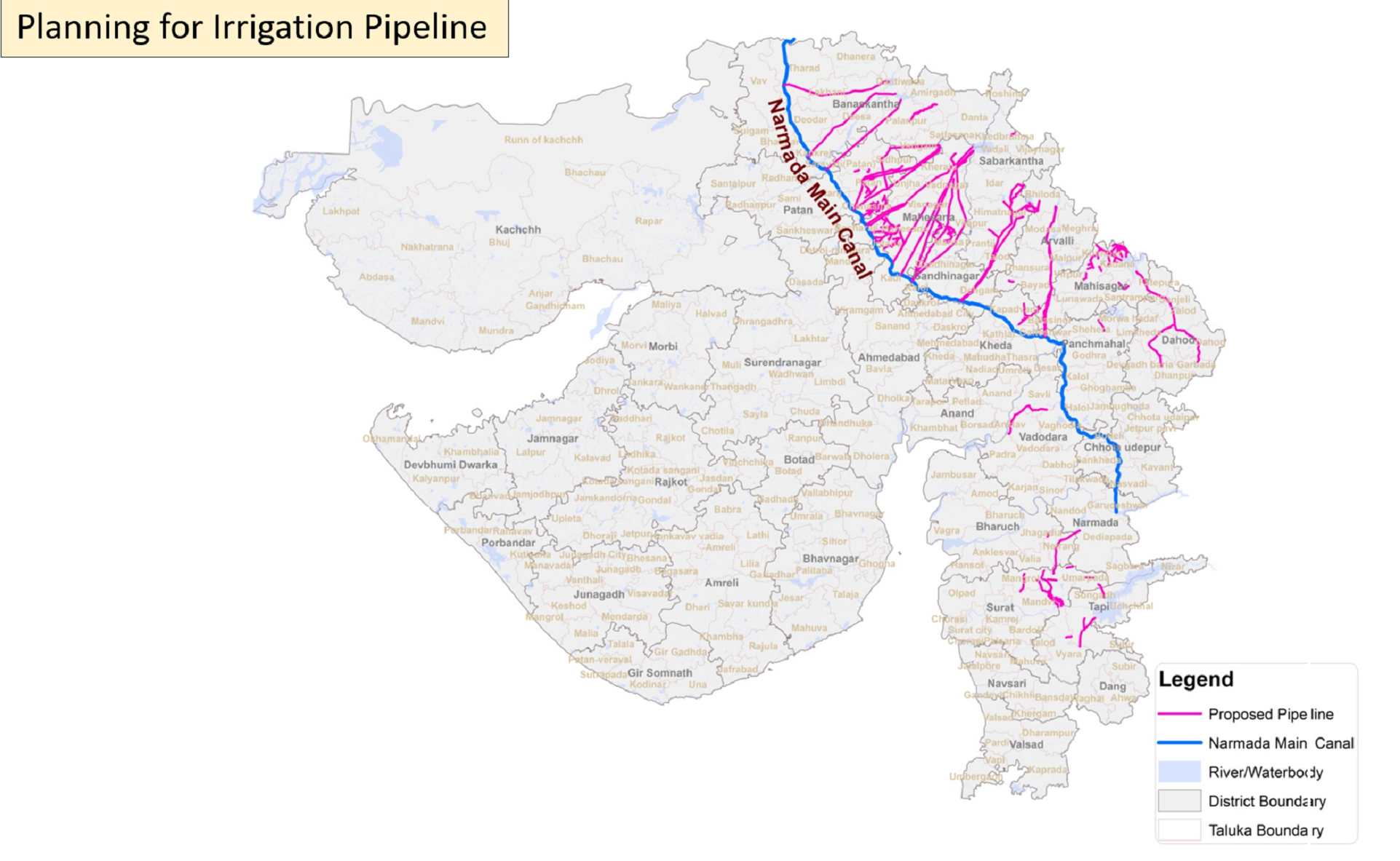
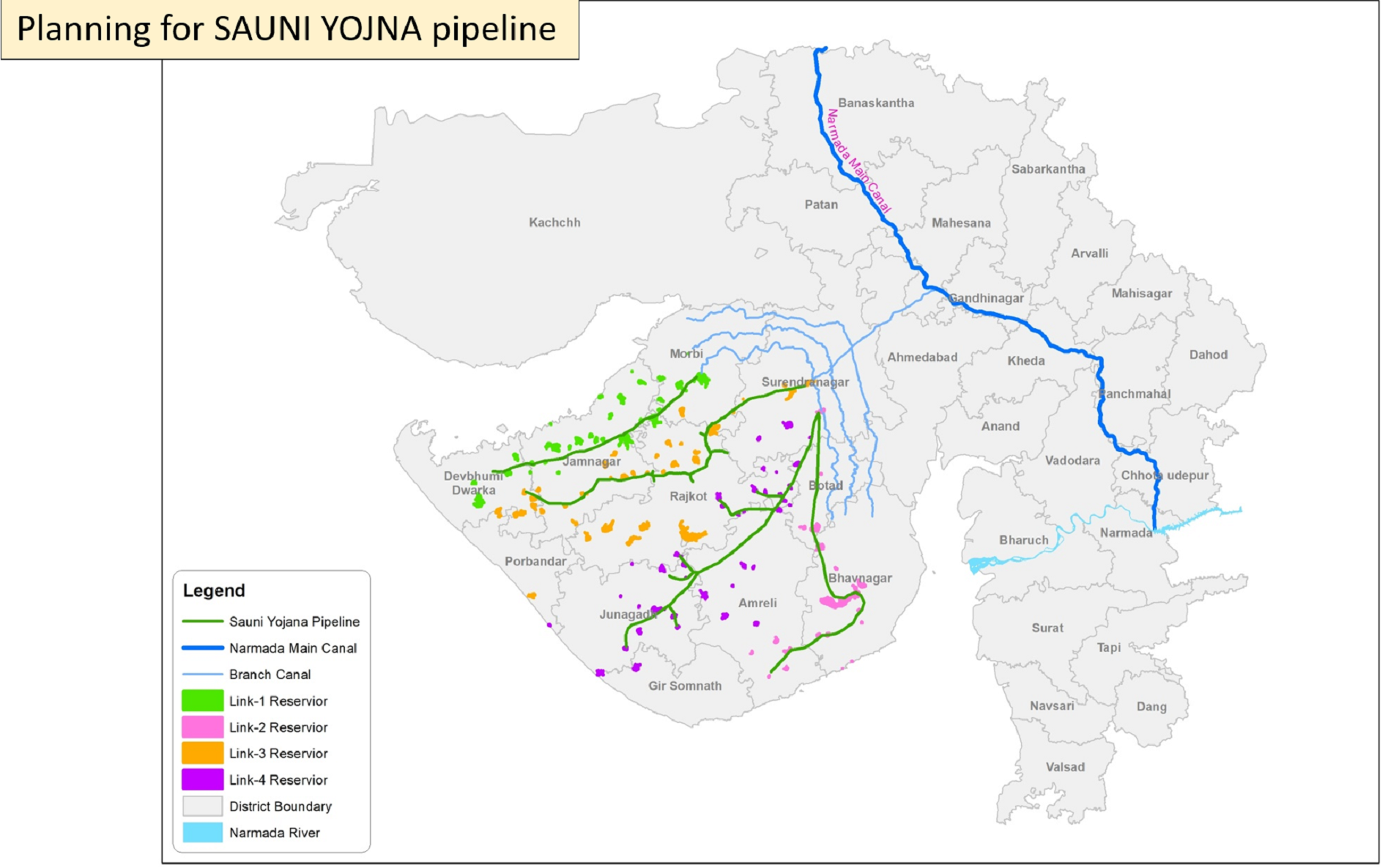
Gati Shakti will serve as a national templete for realising infrastructure build-up of $1.3 trillion in the next few years. The very same principles of GS were used much earlier, btw 2001 to 2014, by PM Modi when as the chief minister of Gujarat, he set out to develop the highly complex, state-wide irrigation system (see: Narmada Main Canal, Sujalam Sufalam Yojana & SAUNI Yojana). Each system of canals and pipelines serves one of 3 arid regions of Gujarat (out of 5 regions).

Gujarat was hit by 12 major droughts in 21 years to 2001 (before Modi became CM of Gujarat). Other years had water scarcity. Groundwater levels of all districts of Gujarat and Kutch had dropped from 30m to over 150m from 1975 to 2001. Most of Gujarat would have become a desert in the next decades, with implications for mass migration and security at the international border.

Scientific approach was adopted by CM Modi whereby he used satellite technology to form a holistic map of the landmass, with details such as road and rail network, administrative boundaries, slope, type of soil, land-use, geology, landform, forest details, sanctuary and national park, etc. Every square centimeter of land (particularly water bodies), private and public infrastructure was mapped.


The project was started as a mass public movement, where tens of thousands of check dams were built for trapping water from rainflows. The check dams would help to raise ground water levels. Over 160,000 check dams were built till 2016, and 0.8 billion cubic meters of water each year was stored in this way. 

Also, 3 major canal projects (see article & inserts) were planned and implemented with a precise and scientific methodology, using satellite mapping and GS-like tool. Canals were built to fill large water-bodies (eg existing, non-perennial lakes) in far away places, and extra effort was made to fully utilise Narmada flood waters.
 
Besides the build-up of canal infrastructure, height of water at the head dam (Sardar Sarovar Dam) was progessively raised after lengthy, well-publised legal battles against the might of foreign-backed NGOs and an equally hostile Central UPA goverment.The official closure to the legal battles, came in 2019, when Centre (with Modi as PM) approved the closure of 30 17m-high gates, which was pending for years. I wrote link

"Water storage capacity will increase from 1.27 MAF to 4.73 MAF, enabling irrigation of 1.8m ha and benefiting 40m people in 9,000 villages. Gujarat has overcome many hurdles to reach this stage. After 7 years of inaction under UPA, permission to install the gates was finally given by PM Modi on taking office in 2014. At the podium to mark this feat, Chief Minister Vijay Rupani termed it a “golden moment in the history of Gujarat.” NB. also 40% increase in hydropower to over 1 billion units!