Featured Post

Visit arvindagarwal2.blogspot.com for posts from 2017 to 2019

Friday, January 31, 2020

High-resolution Maps of India   Link
═════════════════════ 

Governments have begun the mammoth exercise of making high-resolution maps for the entire country. The Survey of India (SOI), the national mapping agency, has been tasked with preparing digital maps that will offer very high accuracy. The mapping process was attempted in 2008 at a cost of Rs 5,400cr but states, which were tasked under the programme, couldn’t make much headway in terms of accuracy standards. Then in 2017-18, SOI pitched in. The process has started in Haryana, Maharashtra, and Karnataka says the Surveyor General of India. "We are flying drones that have two GPS devices, one above and one below, and getting positional accuracy of just 5 cms. The resolution of the map will be 5 cms or better". 


Villagers don't have any record of ownership. They only have loosely recorded notes or 'parchi', and other states have no records at all,” Kumar said. SOI has carried out a mapping exercise in Maharashtra, and on this basis ownership certificates have been registered and handed over to the villagers. This helped them take loans for renovation of their houses, for example, because banks do not consider 'parchi' records as valid. SOI is carrying out a similar activity in Haryana. 


Land records have never been updated because it is a laborious and time-consuming physical process involving a patwari for measuring a piece of land. "But patwaris were not given adequate resources. So, they maintain a log or 'lattha' which is updated manually. We are giving every patwari a map of his area along with a rover. This will lead to a real-time and precise change in property records”. The patwari just has to hold the rover ( equipment designed to receive and transmit signals) and walk around the dimension of the property and return to the starting point. The system will automatically update the records. The entire process takes around 10-20 minutes. The system is based on continuous operating reference stations or CORS. 


The new high-resolution maps will also make road navigation better. “The new 1:500 scale maps will tell us what is the actual width of the road, whether it is motorable, whether cars can go inside or only scooters can go. People will not know this using the existing maps and sometimes get stuck. High-accuracy resolution network will be made available on the new online maps and whatever information the common man needs will be put in them.” Kumar said SOI is going to buy not less than 500 drones for the project. It is training existing staff for the purpose and letting go of cadres that work on old techniques. SOI is also hiring fresh people with a higher-education background and from day one they are exposed to modern technology. "We have changed the mindset of people but it took us some time. But now people are geared up and the entire staff is working well". 


Funding is an issue here as with all government projects. Fortunately, states have pitched in and agreed to take the project forward. “In the case of Haryana, Maharashtra, and Karnataka we are getting funding. The MoU for Rajasthan, Gujarat, Madhya Pradesh, and Andaman is ready. So we can combine funding from different sources”. Kumar is optimistic that by 2024, high-resolution maps will be available for the entire country.


Digitalising land records   Link
═════════════════

Drones are flying at regular intervals to quietly capture images of the land below. From buildings to farmland, roads, and lakes – the drones are mapping the area as part of a joint initiative by the Karnataka government and the Centre to digitally map the country. The project is an ambitious initiative to create high-resolution digital maps of the country. Karnataka’s revenue department, in turn, is using the images to create digital maps and link ownership records of every piece of property.

With the advent of technology Survey of India, along with state and city government agencies, have started using satellite images to map properties and create very accurate images. The evolution of drone technology has opened up new possibilities in land surveying. Taking a cue from the three states which approached it for the survey, the agency sees an opportunity to create a repository of drone images across India, similar to the repository of satellite images by the Indian Space Research Organisation. 

Union secretary to MoST says a complete digital map of India will be very useful for the Centre as it can incorporate all types of records including land details, socio-economic data, road network, etc. "While the accuracy of satellite images is 30-40 cm, drone images are as low as 5 cm. This is precision that we want for the digital maps,” says Surveyor General of India, Girish Kumar. 

The magnitude of the project that SOI has taken up with the three states is huge. It has procured 
30 drones so far and plans to increase the fleet to 300 soon. Haryana has achieved much progress in the survey work, while Maharashtra has limited the survey to only villages in the first phase. The work in Karnataka is more complex as both urban and rural areas including Bengaluru will be surveyed in the first phase itself. The exercise involves capturing images, corroborating it with the ground survey data and then developing it into a high-resolution 3-D map. It is more than mere mapping, as Karnataka is working on developing geo-referenced land records based on drone images. 

In the pilot which was carried out in Karnataka, officials said that they have compared the dimensions of drone sketches with the actual dimensions in the field and have found the images to be satisfactory. Five districts in Karnataka have been chosen for drone mapping and to develop geo-referenced land documents in the first phase, and the work is expected to be completed by the end of 2020. 

In a country where courts are clogged with land disputes, the best use of the drone survey could be to resolve land-related litigations. According to an estimate, about 2.5 million hectares of land in India are under dispute and 25% of the cases decided by the Supreme Court are of land conflicts. 

“Today, land records are beyond comprehension for people. But, using the drone survey data, we want to develop a digitised map - similar to Google Maps - for every piece of land. A person can actually visualise the property and the boundary,” said Munish Moudgil, Survey, Settlement, and Land Records commissioner, Karnataka. The new system allows the surveyor -- carrying a connected device continuously operating reference stations -- to walk precisely on the property boundary, which until now was challenging, especially on agricultural land. “Any changes made to the property thereon will be continuously updated,” Moudgil said. 

Since land ownership records in India are private documents and are presumptive in nature, the generation of digitised property ownership cards based on the drone survey could see a shift in the nature of land ownership from presumptive to conclusive titles. “A project like this can dramatically alter the landscape of computerisation of land records. A land information system can be created in a short span of time and in a cost-effective manner, eventually serving the public at large,” said ESRI India president Agendra Kumar. ESRI is the country’s leading Geographic Information System (GIS) software and solutions provider. 

Other states are experimenting with survey and digitisation of land records based on satellite images of ISRO. Rajasthan is re-surveying 12 districts through satellite imagery. “We have already procured satellite images. The next step is to auto-rectify these, images and process and superimpose them on already digitised old Cadastral maps,” said Mahendra Kumar Parakh, additional commissioner, Settlement. Cadastral maps show the extent, value and ownership of land.

Since the satellite-based survey in Rajasthan has so far been limited to villages, agricultural landowners are quite comfortable with the accuracy of the satellite image. Others think differently. “Accuracy level of the drone survey and the creation of digitised land records will be a boon to resolve land disputes. Since courts have considered satellite images as valid proof in many litigations in the past, the drone survey images could now as well replace satellite images,” said M Jayachandran, project director, Karnataka State Remote Sensing Applications Centre.

Besides generating geo-referenced land ownership documents and resolving land conflict, the drone data is expected to be useful at various levels. “The data created through this project will be usable for many other applications, like land-use planning, water resources etc. Additionally, this project can offer significant economic and governance benefits to states as there will be much higher transparency in land records,” Kumar of ESRI said.

Yet, a survey of this magnitude is not devoid of challenges. Weather is one such. Survey of India officials say that they did not fly drones for months in Karnataka due to extremely unpredictable weather. “We could not fly drones during rains. At one point, a crash happened,” an official said. Despite limitations, subject experts hope that drones could be the next big thing for surveying properties.

“Every technology, be it satellite images, aerial survey, or drone survey, comes with merits and limitations. The advantage of satellite imagery is that it can cover a larger distance in a short period of time and weather is not a factor, unlike drones. But, accuracy and cost-effectiveness are the advantages of drones,” Jayachandran said.

Another challenge is capacity building for processing and managing of data. “These drones will generate terabytes of data. Investment is needed on setting up a system, be it data processing, software, hardware to process data,” Jayachandran said. Kumar agrees, "It is essential to meet the processing requirements to complement the data collection activity. Also, the requirement of trained manpower will be an important factor for the execution of such projects.”

Thursday, January 30, 2020

MUMBAI's INFRA FREN-nnZY
======================
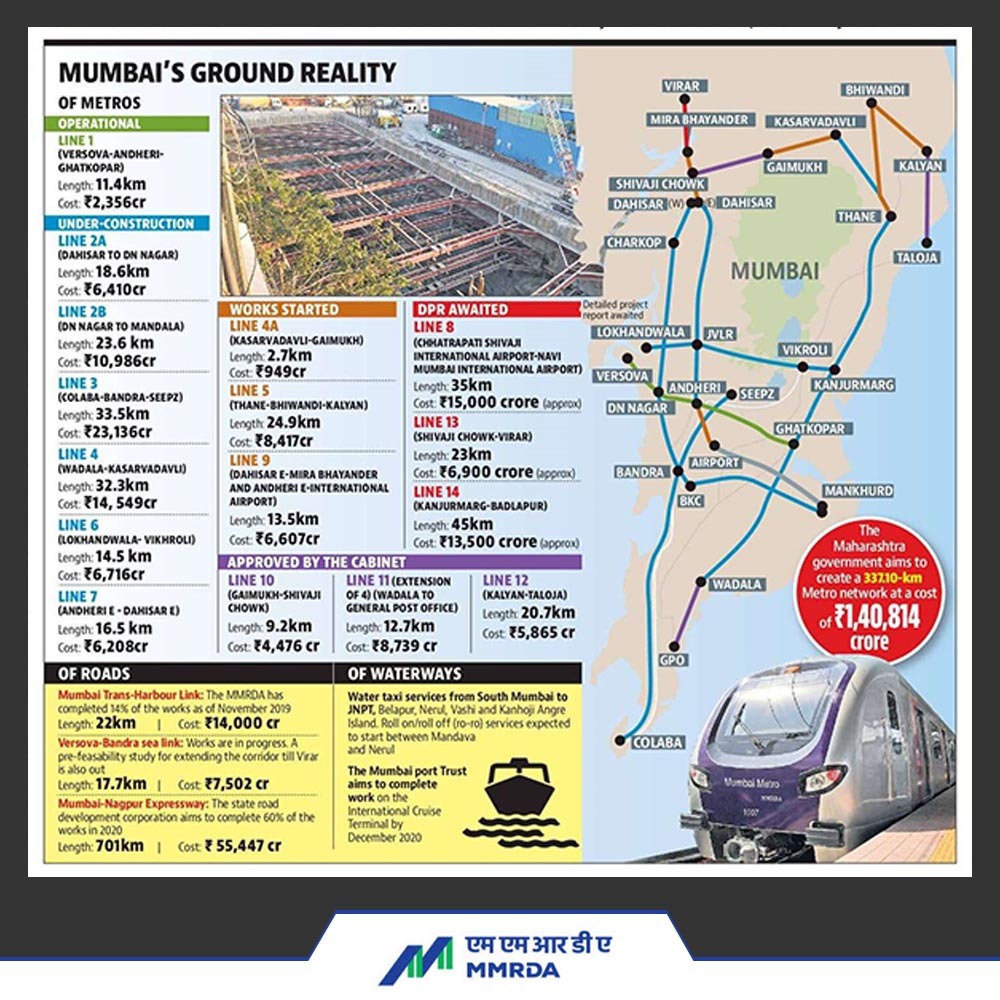
Metro-rail:   started on 180km for Rs84,000cr at 466cr/km.         
                   proposed on 136km for Rs50,000cr at 366cr/km.
Mumbai Metro Network when completed in 2026: 337km, 225 stations, 13m daily ridership!! Link
"The carrying capacity of the completed Mumbai Metro network will be more than the combined existing loads of Mumbai suburban trains, buses and taxis".

Mumbai-Ahmedabad High-Speed Rail508km for Rs110,000cr at 216cr/km.
Construction in over-drive as land acquisition is mostly done. Maha govt is reviewing its earlier go-ahead but is unlike to stop it.

Mumbai-Nagpur e-way701km for Rs55,400cr at 79cr/km.

Mumbai Trans-habour bridge22km for Rs14,000cr at 636cr/km.
Metropolitan region of Mumbai

Coastal Roads:
  started on 10km for Rs12,000cr at 1,200cr/km.       
  proposed on 19km Nth section is not costed.
8-lane road extensions to Bandra-Worli Sea Link (Sth to Priyadarshini Park and tunnel to the Marine Drive; and Nth to Kandivali and beyond). Work between Worli-Marine Drive was stopped after HC cancelled green clearances, but SC stayed this and allowed land reclamation. Work has already recommenced.

Alibaug-Virar multi-modal corridor126km for Rs13,000 at 103cr/km.
An 8-lane road encloses Greater Mumbai & Navi Mumbai suburbs and transverses N-S in the Metropolitan region of Mumbai. The first phase to start in Q1 2020, connects Virar to Balavali (79km, Rs 9,326cr), followed by Balavali to Alibaug (47kms).
Propel livestock production to increase India's GDP Link

According to Niti Aayog, animal husbandry and dairying can reap 10 times more profit compared to crop production. It follows that for raising rural living standards, there must be an increase in livestock production in terms of quality, productivity and quantity.

Despite being the world's largest milk producer, India could not break into the top 15 milk and dairy exporting countries, and buffalo meat exports are struggling to lionise key markets like China. Higher sanitation norms and health parameters in major markets restrict or preclude imports of milk, dairy products and other livestock products. Vaccination for Foot & Mouth Disease is part of a volunteer-run programme to inject about 1 billion doses of vaccine per year and free bovines from FMD, resulting in wide acceptance of Indian milk, dairy products and buffalo meat across the world.

"Government has launched the "National Animal Disease Control Programme (NADCP) for control of Foot & Mouth Disease (FMD) and Brucellosis" with a financial outlay of 13,343 Crore for five years from 2019. This scheme envisages complete control of FMD by 2025 with vaccination and its eventual eradication by 2030. This will result in increased domestic production and increased exports of milk and livestock products" - Economic Survey 2019-20

Milk productivity in India is a fraction of what is achieved elsewhere. For example, an Indian cow's average yearly milk production is around 2,000 kg while in the US, the figure crosses the 10,000 kg mark. Better breeding of cattle has the potential to catapult profits by 6 to 8 times. Advanced artificial insemination technology from two American companies will help select only females calves to be born, and cow inseminated using semen of genetically superior bulls can ensure healthier herds, increased milk production and better fertility.

Details of livestock schemes from NDA
Government has launched three "potentially game-changing" or mega-schemes to fuel the growth of millions of livestock farmers in India. It estimates that in the next 5 years, livestock farmers will save losses worth Rs 2.50 lakh crore, increase incomes four times and contribute a major share in India's GDP. Govt wants to double the growth of the livestock sector from 6% to 12-15% per year. 

National Livestock Mission (NLM), commenced in 2014-15, aims is to improve livestock production systems and capacity building of all stakeholders. It covers matters of productivity, improving availability and quality of feed and fodder, sustainable development, pig farming in NE India, skill development, technology transfer and extension services. Link

Livestock health (and infection control programmes for FMD & Brucellosis), aims to control or vanquish diseases of economic importance as they cause huge economic losses nationally. Vaccinations are given for FMD, Peste des Petits Ruminants (PPR), Brucellosis, Classical swine fever, etc. Monies will go to set up National Institute of Animal health (standards setting), National Animal Disease Reporting System (NADRS), new & improved Veterinary Hospitals and Dispensaries, new central & regional diagnostic labs, Animal Quarantine and Certification Service (valid for exports), strengthening of State animal disease control agencies and training of veterinary personnel, etc. Link

Cattle and Dairy development includes a programme to conserve and improve the genetic stock of indigenous cattle and buffalo breeds, eg. enhance the average productivity of milk of Gir from 4.85 kg per day to 6.77 kg per day. Govt will fund strengthening infrastructure for the production of quality milk; procurement, processing and marketing of milk and milk products through following Dairy Development Schemes : - National Programme for Dairy Development(NPDD) - National Dairy Plan (Phase-I) - Dairy Entrepreneurship Development Scheme(DEDS) - Support to Dairy Cooperatives - Dairy Processing and Infrastructure Development Fund (DIDF) Link

Monday, January 27, 2020

Demand for Indian Seafood sees a 17% yearly growth in Exports  Link

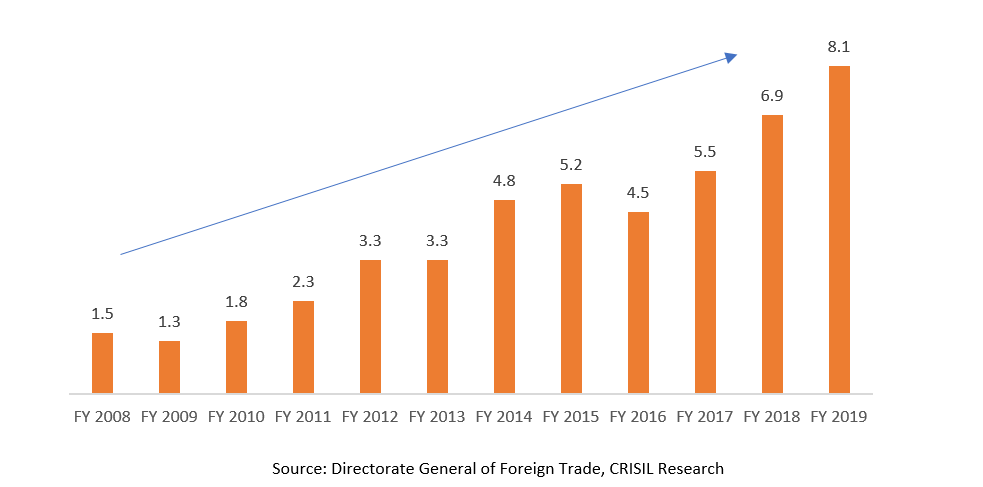
Indian shrimp exports registered a 17% growth in 5 years to December 2017. It was expected to moderate to 7-10% as demand in Europe and Japan would be weak. Since then, US demand has slackened due to high inventory and stringent SIMP controls (started in Jan 2019). Chinese demand has more than made up, for the time being, as imports from India have grown by more than 40% in 2019.
Seafood exports, incl shrimps set to cross $8 billion in fiscal 2019
"The strong uptick in demand for Indian shrimps in the recent past was attributed to weak production in other major Asian shrimp producing nations such as Thailand and Vietnam. Going forward, Indian exporters face stiff competition from Ecuador, Indonesia, and Vietnam”. Ecuador's various investments (eg. automation of feeding) have realized a phenomenal jump in shrimp production. It has become a major player and rival to the Asian nations.  Link

Prices have been volatile due to mismatches in demand and production in top shrimp trading nations. But, the Indian domestic market has absorbed more farmed shrimp in 2018, as and when international sales have slowed down. Link
Farmed Shrimps in Dec 2019
India's farmed shrimp production, which was expected to fall, showed a 7% growth in the first 8 months of 2019. "India's production is closing in on 1 mt, even as issues such as chronic disease are adversely impacting shrimp farming communities. I don't see any surprises coming up here for the next 2-3 years".  Link

Most of India's production is exported. Around 40% of Indian shrimp goes to the US market and around 28 percent as headless and easy-peel shrimps. From looking at month-by-month US imports, India continues to dominate in the US market. China has grown to be the second biggest market for India. Japan is the major market for Black Tiger shrimp with a share of 49.4% in revenues.

Prospective shrimps and fisheries exports
The chairman of MPEDA said India's goal is to now grow annual aquacultural exports to $15billion in 5 years from an already impressive $7billion in 2019 and to take India's share of world seafood exports from 4.1% to 6.7% by 2030. India will aim to raise productivity from 5 to10mt/ha, expand areas, diversify species and look at infra, value addition, brand promotions, and trade promotions. Link

He said the aquacultural area has grown 800% over the last decade, but total area utilized is just 15 percent. India will diversify shrimp production beyond Pacific whites or Litopenaeus vannamei, and start exporting black tiger prawns in large quantities in the next 2 to 3 years. Further investments in advanced farms, hatcheries, and cold storage and more third-party certification for producers will increase exportable surpluses. There is huge scope to grow value-added products in the next few years, up from 5% currently. And looking beyond shrimps, "there is enormous scope for new finfish species, including tilapia in freshwater and cobia and sea bass in seas along the country’s vast coastline".

Black Tiger shrimps, MAC & microbiology labs  Link  Link 
MPEDA is wanting to keep up the pace of shrimp production and yet avoid over-exploitation & over-dependence on L. vannamei, as this species has wreaked havoc through disease in rest of Asia. Also, rising prices and strong international demand for black tiger shrimps have lead to clamour to restart its farming. In the interim, MPEDA was able to research and develop the new "high-health" black tiger shrimp seeds at Rajiv G. Centre and has started distributing them since 2018. They are produced at MPEDA's new hatchery called MAC (or "multi-species aquaculture complex"), a 9-acres facility opened 2018 and based in Valladam, Kerala. MCA caters mainly for black tiger shrimp seeds but also has 6 nurseries for raising fingerlings such as GIFT tilapia, Asian seabass, cobia, pompano and mud crab. New microbiology labs, such as at Kochi inaugurated in Feb 2020, will help exporters to match up on quality demands.


Global shrimps overview, Indian industry, and Outlooks  Link

Asian dominance in global shrimp production
Aquaculture has grown at 6% in 15 years between 2001-16. As a result of the fast growth, its share of total fisheries has jumped from 25% to 45%. Captive fisheries, on the other hand, is debilitated by over-fishing. Shrimp production (derived from aquaculture) now forms a sizeable 7% of production volumes of the global fisheries and is classified as a high-value species with large trading volumes.

The global shrimp production has increased at a CAGR of 3.2% during the period 2011-2017. The top 5 producers are from Asia namely, China, India, Indonesia, Vietnam, and Thailand, accounting for more than 80% of the total global shrimp production. These regions gained from access to large coastal belts, ambient climate, and suitable temperatures to cultivate shrimp. The domestic demand has taken away most of the surpluses in China and SE Asian countries like Indonesia. But, the low consumption of shrimps in India has meant that 80% or more of its production is exported to large markets around the world.

Due to this, India has established a massive prominence within the sector. India is now the largest exporter of shrimp with a 23% share of the total global export volumes. Global demand comes from major developed countries. USA, Europe, and Japan together account for 63% of total global shrimp imports as they have a large and growing demand base and insufficient production sources domestically. Thus, more than 70% of Indian exports are sent to the US (1st), Europe (2nd), and Japan (4th).

The rise of Indian Aquaculture Link Link
Whilst Rest of Asia was suffering from a massive plunge in shrimp production, as seen in China (60% fall in 2016), Thailand (65% below peak) & Vietnam (40% below peak), India was left unscathed.  Asia was battling structural deficiencies like disease, labour issues, environmental norms, inadequate freshwater resources, and illegal fishing whereas Indian aquaculture prospered, mainly due to the low-density fishing approach and high quality throughout the value chain. For example, Indian farmers used resilient specific pathogen-free (SPF) brood-stock, that was imported from the US.

Not only had Indian firms doubled shrimp production (in 5 years to March 2017) and grabbed the leading global export share, but they had also strengthened their balance sheets. In 2017, CISIL predicted shrimp exports from India would double to nearly $7 billion by 2022. It said India had the ability to overcome the Asian comeback and its own rising domestic consumption, mainly due to the buoyant international demand, attention to quality and product development, and an increase of area under aquaculture (in AP, WB, Odisha, Gujarat - Gujarat is marred by higher salinity).

India has a natural advantage in the aquaculture sector. Freshwater resources comprising ponds and tanks amount to 2.43 m ha. The other resources readily available for the seafood industry players are natural lakes, reservoirs, irrigation canals and paddy fields and it boasts of 1.19 mn hectare area under brackish water.

India is the second-largest fish producing country in the world with an annual production of about 12.6 mt (2018), and it is aimed to increase it to 15.00 mt by 2020. In 2017, India was the largest exporter of the shrimp followed by Ecuador and South America.

Indian Industry Dynamics and increased Productivity
Indian shrimp's share in global exports has risen from 6% in 2009 to 23% in 2018. The production has been growing at 27% per annum, starting from just 97,000 tonnes and reaching 690,000 tonnes. The total industry value in 2018 is estimated at $4.3 billion. Positively, the total area under cultivation has increased by a small fraction, from 102,000 ha to 152,000 ha, indicating there was a strong leap in productivity in this period from 1 tonne/ ha to 4.5 tonnes/ ha.

These productivity improvements have helped the country to establish itself as the second-largest aquaculture producer in the world:

1. Modern aquaculture farms – Massive capacity building of modern facilities by large organized sector along the coastline, particularly in Andhra Pradesh which has large access to brackish water, has significantly improved productivity. It has improved disease control protocols compared to traditional aquaculture farms.

2. Growth in production of L. Vannamei species – L. Vannamei shrimp is not only popular but it is significantly easier to breed than other breeds like Tiger Shrimp, as they can be reared in higher densities and have a higher level of tolerance to different levels of water salinity. Production share of L. Vannamei shrimp in India, which was less than 5% of total shrimp production in 2010, has jumped to around 90% in 2018.

3. Use of High-Quality Feeds – High-quality shrimp feeds, made by large domestic organized players, have helped the shrimp industry maintain high-quality and improving productivity.

4. Government Support – The Marine Products Export Development Authority (MPEDA) has been providing the industry with a supportive policy framework, initiatives, and environment to help improve the industry’s productivity and quality. Going forward, the body has set a target to grow the value of the industry to USD 10 billion.

Indian Industry Outlook
The rise of the Indian shrimp industry has propelled it to take a central role in the global industry supply. However, the fast-growing exports from India have resulted in a decline in price realization of shrimp in global markets by ~10-15% depending on the grade and size. Another major cause of the declining price is the slump in demand growth in major developed markets as a result of lower consumer offtake in these countries during the last few years.
The large organized players in India are expected to further expand capacity going forward in line with the target set by the MPEDA to grow the industry to USD 10 Billion. This can play a party pooper and has the potential to spoil the balance in the global market, leading to price declines in the global market.

However, we expect demand to turn around in the medium term, in light of the growing trend of health consciousness. Shrimp demand is expected to see an uptick in developed markets due to its high appeal in the seafood basket and nutritional value. Furthermore, amongst the large exporters, an increase in domestic demand in China is expected to shrink the surplus production available for export and the major South-East Asian exporters are expected to grow exports, only marginally, in line with the overall industry growth. The slowing of exports from other major supplying markets should arrest the current downward trajectory in prices and can stabilize the same.

In light of the same, we believe that Indian exporters will be able to fill a larger share of the expected demand growth in the medium term. The large Indian shrimp manufacturers are also complying with stringent quality standards globally which can help them export a greater volume of exports to other developed and emerging regions globally. This indicates that the future can bear a major role in the fast-growing Indian aquaculture industry in fulfilling global shrimp supplies.

Global outlook for aquaculture Link
Key highlights were that global shrimp production will be 11% higher in 2021 compared to 2018, slowing from growth of 4.5% pa. Diseases, trade wars and unclear production data from China make future market conditions difficult to predict. Ecuador had achieved a 38% production increase in 2019, which is "unbelievable that the second-biggest supplier can do it in a low-price market.” A commentator noted that the sector was very competitive, where "supply and demand – supplies and suppliers  can switch quickly". 
India is a relatively low user of antibiotics and will remain that way in 2030

Saturday, January 25, 2020

GST:  why E-invoicing benefits Govt revenues & Businesses


E-invoicing is emerging technology across the globe. It is estimated to save the US treasury $450 billion every year. In India, the introduction of electronic invoicing for B2B businesses is expected to curb tax evasion and promote a highly efficient, digital method of doing business. E-invoicing has become mandatory for medium and large firms for their business to business transactions.

With e-invoicing, the moment an invoice is made, it will be uploaded to GSTN portal where pre-validation will be done and a unique number called IRN (Invoice Reference Number) will be issuedThe transactions are sent as real-time, online information to the government and serve as proof of exchange. 

Under this system, invoices must be submitted to the GSTN portal. The data will then be authenticated for further use in the GSTN. For example, once a unique IRN is issued, it becomes a tax invoice & can be shared with the recipient, and it can be collated for filing returns. E-invoicing allays concerns of tax authorities and benefits business in many ways.

Manual bill books and accounting software will be dispensed with or radically altered. Medium-sized businesses may prefer to buy tried and tested software rather than undergo additional staff training or hire a professional advisor (which are in short supply!). Organizations that have automated e-way billing will now have to interface with the IRP portal rather than the E-way bill portal so that an IRN is issued. An upgrade to the software will be needed to capture the IRN number in the databases.

Introduction Link
  • E-invoicing requires the submission of business invoices to the GST portal. Likewise, E-way bills need to be input on the E-way portal before goods are transported. Businesses would prefer to automate the process for transferring the invoices from their invoice generating software.
  • Invoice Registration Portal assigns an ID to each invoice, which facilitates data transfer on to the GST and E-way portals. A single point data entry into the electronic software will allow data to flow across different portals with the help of an IRP.
  • All accounting software must follow the PEPPOL standard, the most common global standard for invoice generation.
  • Businesses do not need to manually fill out GST returns. In the new system, GST ANX-1 will take the place of the GSTR-1 return.
  • The electronic invoicing will be mandatorily implemented from 1 April 2020, for taxpayers with turnover over Rs 100 Crore. The aggregate turnover will include the turnover of all GSTINs under a single PAN, across India.
How will Electronic invoicing benefit businesses?
  • E-invoice resolves and plugs a major gap in data reconciliation under GST to reduce mismatch errors.
  • E-invoices created on one software can be read by another, allowing interoperability and help reduce data entry errors.
  • Real-time tracking of invoices prepared by the supplier is enabled by e-invoice.
  • Backward integration and automation of the tax return filing process – the relevant details of the invoices would be auto-populated in the various returns, especially for generating the part-A of e-way bills.
  • Faster availability of genuine input tax credit.
  • Lesser possibility of audits/surveys by the tax authorities since the information they require is available at a transaction level.
How will E-invoicing curb tax evasion?
  • Tax authorities will have access to transactions as they take place in real-time since the e-invoice will have to be compulsorily generated through the GST portal.
  • There will be less scope for the manipulation of invoices since the invoice gets generated prior to carrying out a transaction.
  • It will reduce the chances of fake GST invoices and the only genuine input tax credit can be claimed as all invoices need to be generated through the GST portal. Since the input credit can be matched with output tax details, it becomes easier for GSTN to track fake tax credit claims.
  • Curbing tax evasion and increasing tax collections for the government may ensure that the government will not increase GST rates any further.

Friday, January 17, 2020

Make-over of Discoms


Data from UDAY website

1. Operational performance: 100% scores were achieved in 5/ 9 criteria, namely feeder metering (urban & rural), rural feeder audit, household connections and LED bulbs. Others:
           Feeder segregation      84%
           DT metering (urban)     88%
           DT metering (rural)       62%
           Smart metering              5%  (non-starter for most states)

2. Stats for key performances (   Billing      &        Finance )
      Overall         AT&C losses     21.35%    &    ACS - ARR gap   Rs 0.38/unit  loss
Maharashtra
18.1% -0.12
          Good shape
Karnataka 14.8% -0.12
          Good shape
Himachal 7.4% -0.07
          Good shape
Gujarat 10.2% -0.04
          Good shape
Uttarakhand 31.7% 0.01
          Good shape
Goa 11.9% 0.05            Good shape

Can make profits if AT&C losses are tackled with 100% smart metering, etc  (good to poor)
Chhattisgarh43.8%0.21
     High Potential
Jharkhand37.1%0.22
     High Potential
Uttar Pradesh33.1%0.13
     Good Potential
Tripura23.5%0.16
      Aver Potential
Meghalaya32.6%0.46
     Good Potential
Bihar 35.9% 0.61        Good Potential
Madhya Pradesh30.1%0.47
       Good Potential                   

Need for discom efficiencies, lower supply costs and/or higher prices (worst to bad)
Jammu & Kashmir 48.4% 2.23
      V High loss/ High potential
Tamil Nadu13.6%1.13
      V High loss/ Low potential
Andhra Pradesh 10.3% 0.75
      V High loss/ Low potential
Manipur 20.5% 1.08
    V High loss / Aver potential
Telangana 10.2% 0.32
    Moderate loss/ Low potential
Kerala 10.2% 0.28
    Moderate loss/ Low potential
Rajasthan 25.8% 0.64
     High loss/ Average potential
Punjab 28.5% 0.66
     High loss/ Average potential
Assam 22.1% 0.48
     High loss/ Average potential
Haryana 20.9% 0.34
   Moderate loss/ Aver potential
Analysis
Multiple polynomial regression (2nd-degree) tool shows a 73.5% correlation between AT&C losses (& 70.8% for unit losses) and 4 variables ie {smart metering (70.0% weighted to >500units), feeder segregation, DTmetering rural & urban}. This rises steeply if the following states are removed: Andhra Pradesh, Kerala, Jharkhand, Bihar, Uttarakhand, Meghalaya... to 99.8% (AT&C losses, wt 45-50%) and 99.96% (unit losses, wt 40-45%). In this case, the smart meter weighting can vary btw 40-50%. Online tool

Linear correlations

vs AT&C losses Smart Metering >500 Smart Metering 200-500 Feeder Segregation DT metering urban DT metering rural

Full state list -24.15% -11.49% 9.01% -24.79% -39.52%

Restricted state list -24.32% -9.49% 2.17% -47.56% -46.57%


vs ACS - ARR


Full state list -5.69% -15.60% -13.77% -19.25% -33.59%

Restricted state list -8.21% -18.28% -25.60% -19.90% -39.38%

Five parameters increase in step from 0% (none completed) to 100% (all completed). AT&C is first imputed by MLR, then added to Unit cost MLR analysis. "Yellow Star" marks the current situation (53% completed) - fully in sync.
Post-script
States can achieve govt's stated targets (ie nil unit losses & 12% or less AT&C losses) by completing 90% of the work. But there is much more to be done.

MLR analysis shows that AT&C losses affect unit losses independently of the 5 parameters. These additional factors are likely to be billing efficiency (ie. ability to collect 100% of electricity dues) & technical line losses. In other words, AT&C loss reduction is not only about accurately recording electricity usage, reducing the scope to cheat and early disconnections of defaulters.

Reasons for unit losses are many and more varied (eg level of subsidy not refunded, tariff revisions, cost of supply, apportionment of investment & levels of investment, financial efficiency of discoms). Whilst underpricing of electricity for political gain is also there, discoms can manage to eliminate unit losses if the fundamentals of operational & billing efficiency are tackled.

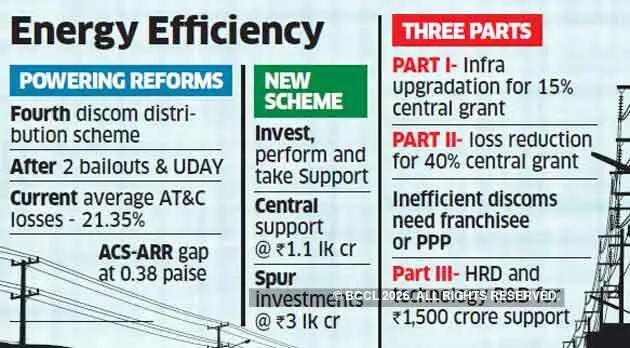
Government proposes a grant of Rs 1.1 lakh crore for state discoms
Discoms are facing heavy losses and are unable to invest in infrastructure upgrades. Earlier discom restructuring schemes have failed to control losses. The centre is proposing a new scheme that is expected to bring Rs 3 lakh crore into the sector.

It wants state discoms to start with a massive Rs 230,000cr investment in smart meters. Centre is contributing 15% or up to Rs34,500cr and state govts will add Rs 25,000cr.

Discoms must also take decisive action on billing and operational inefficiencies. Discoms with large losses first have to make institutional changes in the way they are run. The target for discoms is to not make overall losses and peg AT&C losses to 12% or less.

After billing efficiency, financial measures and smart meters have sufficiently stabilised the operating cashflows, Govt proposes a 60% grant or Rs 85,000cr for loss reduction measures like feeder segregation & aerial bunch cabling. Grant can be used to pay overdue bills, but discoms will want to keep investing as there is an incentive for over-achieving the targets for loss reduction.

On the other hand, discoms that fail to meet targets will face a consequence. In effect, states will lose absolute control over discoms. They have to go for a new arrangement, which is either a PPP model or private franchise model.

Lastly, Centre wants discoms to have a long-term vision of new technology infusion and human resource development. Rs 1,500cr is set aside for this. 


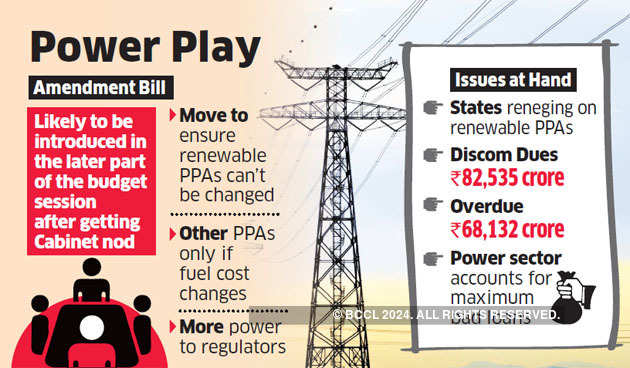
Reasons to amend existing Electricity Act or bring in new legislation

1. Change in Electricity Act to prevent states from reneging on power contracts
Renewable energy contracts are only entered into once a tender is called and bids are accepted by states. A unilateral violation of the contract, that robs investors of their hard-earned returns, is not acceptable. It is a case of abuse of power -- and the state govt knows it. Unfortunately, it also leads to "bad apples destroying the party for the rest".

2. An Act of parliament to tackle gross non-payment by state discoms
No industry can countenance unpaid dues of Rs 82,000cr which is what state discoms have notched up against power generating companies. The culprits (ie. state govts) are behaving like nutcases that have lost commonsense, or like little children that need a parent to discipline them. "The accumulated dues have to be settled to ensure the viability of power producers and the sector” -- very true, and which makes states' actions very short-sighted.

3. Discoms need more regulation for bad behaviour and help with unforeseen problems
The outcome of not being able to control oneself, or wilfully behaving badly, is more regulation. And a right for the aggrieved party to appeal regulatory decisions to the Appellate Tribunal. A separate resolution court may be set up to resolve unforeseen issues between discoms and power generating companies in a time-bound manner.


Smart Metering >500U Smart Metering 200-500U Feeder Segregation
DT
metering urban
DT metering rural
AT&C loss
ACS-ARR loss Rs/unit

Karnataka 0% 1% 100% 100% 80% 14.85% -0.12
Maharashtra 0% 0% 100% 31% 19% 18.09% -0.12
Himachal P. 81% 100% 0% 100% 72% 7.40% -0.07
Gujarat 0% 3% 100% 100% 100% 10.25% -0.04
Uttarakhand 0% 0% 37% 100% 0% 31.71% 0.01
Goa 0% 0% 0% 94% 94% 11.87% 0.05
Uttar Pradesh 0% 91% 80% 100% 8% 33.14% 0.13
Tripura 42% 46% 0% 65% 46% 23.52% 0.16
Chhattisgarh 0% 0% 38% 71% 50% 43.77% 0.21
Jharkhand 0% 0% 43% 100% 100% 37.14% 0.22
Kerala 0% 0% 0% 76% 80% 10.22% 0.28
Telangana 15% 1% 9% 100% 100% 10.20% 0.32
Haryana 15% 0% 100% 66% 7% 20.87% 0.34
Meghalaya 2% 3% 100% 100% 41% 32.59% 0.46
Madhya P. 23% 12% 100% 43% 100% 30.13% 0.47
Assam 38% 10% 22% 100% 38% 22.07% 0.48
Bihar 0% 0% 100% 100% 34% 35.90% 0.61
Rajasthan 58% 0% 32% 25% 0% 25.84% 0.64
Punjab 0% 0% 99% 63% 1% 28.52% 0.66
Andhra P. 0% 0% 100% 94% 53% 10.29% 0.75
Manipur 38% 57% 100% 96% 92% 20.53% 1.08
Tamil Nadu 0% 0% 0% 100% 3% 13.64% 1.13
Jammu &K. 0% 0% 0% 52% 0% 48.38% 2.23